

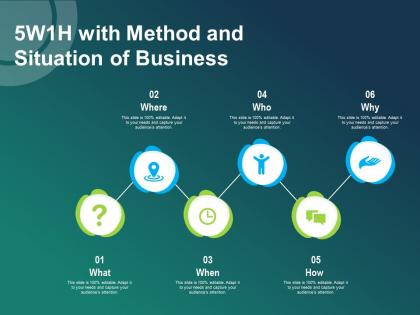
5w1h with method and situation of business




Try Before you Buy Download Free Sample Product
 Impress Your
 Audience
 100%
100% Editable
 Save Hours
 of Time


Our 5w1h With Method And Situation Of Business are explicit and effective. They combine clarity and concise expression.
People who downloaded this PowerPoint presentation also viewed the following :
5w1h with method and situation of business with all 2 slides:
Give your audience a fulfilling experience. They will find our 5w1h With Method And Situation Of Business elevating.
FAQs for 5w1h with method and
The key components of 5W1H methodology in business analysis include Who (stakeholders and team members), What (specific processes and deliverables), When (timelines and milestones), Where (locations and systems), Why (objectives and business rationale), and How (methods and implementation strategies). This systematic framework streamlines requirement gathering, enhances project clarity, and minimizes miscommunication, with many organizations finding that structured questioning ultimately delivers more accurate specifications and improved stakeholder alignment.
The 5W1H framework improves project management outcomes by ensuring comprehensive planning, clear stakeholder communication, and systematic risk identification from project initiation. This structured questioning approach enables project managers to define precise objectives, allocate resources effectively, and establish realistic timelines, while preventing costly oversights and scope creep that commonly derail project success.
Asking "Who?" in business analysis helps identify stakeholders by systematically mapping decision-makers, end-users, process owners, regulatory bodies, and impacted departments across the organization. This comprehensive stakeholder identification enables analysts to gather complete requirements, manage expectations effectively, and ensure project success, with many financial services and healthcare organizations finding that thorough stakeholder mapping significantly reduces project risks and enhances solution adoption.
The "What?" question clarifies project scope by defining specific deliverables, functionalities, features, success metrics, and stakeholder requirements that need to be addressed. By systematically identifying what needs to be built, modified, or achieved, business analysts create clear boundaries and measurable objectives, while eliminating ambiguity that often leads to scope creep, ultimately ensuring project teams maintain focus and deliver targeted business value.
Effective "Where?" strategies in market analysis include geographic segmentation, location-based customer profiling, competitive territory mapping, supply chain optimization analysis, and regional market penetration assessment. These approaches enable businesses to identify underserved markets, optimize resource allocation, and tailor strategies by location, with many retail and financial services organizations finding that geographic insights significantly enhance market positioning and operational efficiency.
The "When?" component establishes critical timing parameters by identifying project phases, milestone dependencies, resource availability windows, and external deadline constraints that directly shape realistic timeline development. Through systematic timing analysis, business analysts can sequence deliverables effectively, anticipate bottlenecks, and align stakeholder expectations, while ensuring adequate buffer periods, ultimately enabling more accurate project scheduling and reducing deadline-related risks across complex initiatives.
Including "Why?" in requirements gathering ensures business analysts understand the underlying business purpose, strategic objectives, and value drivers behind each requirement, rather than simply documenting what stakeholders request. This approach enables analysts to identify root causes, validate actual needs versus perceived wants, and propose alternative solutions that better align with organizational goals, ultimately delivering more effective outcomes and preventing costly misaligned implementations.
"How?" guides analysts in identifying specific methods, processes, and implementation pathways that transform insights into executable strategies, ensuring solutions are practical rather than theoretical. Through systematic process mapping, workflow analysis, and resource planning, organizations can bridge the gap between identifying problems and delivering measurable outcomes, ultimately enabling scalable improvements that drive competitive advantage.
**INPUT**: Can you provide examples of scenarios where 5W1H has led to successful business decisions? **OUTPUT**: Successful 5W1H applications include retail companies identifying customer drop-off points, manufacturing firms streamlining production bottlenecks, and financial institutions reducing loan processing times. These structured inquiries enable organizations to uncover root causes, optimize resource allocation, and enhance operational efficiency, with many businesses finding that systematic questioning ultimately delivers faster decision-making and measurable competitive advantages. **Word count: 57 words**
Tools enhancing 5W1H application include process mapping software, stakeholder analysis matrices, root cause analysis frameworks, data visualization platforms, and collaborative workshop techniques. These methodologies streamline business analysis by facilitating systematic questioning, improving stakeholder engagement, and enabling comprehensive problem documentation, with many organizations finding that structured 5W1H approaches ultimately deliver faster decision-making and clearer strategic outcomes.
The 5W1H framework adapts to agile environments by incorporating iterative questioning cycles, sprint-based analysis, and continuous stakeholder feedback loops throughout development phases. Agile teams leverage these questions during daily standups, sprint planning, and retrospectives to maintain project clarity, streamline decision-making processes, and enhance team collaboration, ultimately delivering faster iterations and improved product outcomes.
Analysts may encounter challenges including incomplete stakeholder information, time constraints limiting thorough questioning, resistance from team members uncomfortable with detailed scrutiny, and difficulty prioritizing which questions to pursue first. However, these obstacles often reveal critical knowledge gaps that strengthen analysis quality, with many organizations finding that systematic 5W1H implementation ultimately streamlines decision-making processes and enhances strategic outcomes.
5W1H offers simplicity and comprehensive coverage compared to more complex frameworks like SWOT or Porter's Five Forces, making it accessible for rapid problem analysis and stakeholder communication. While specialized tools like fishbone diagrams excel in root cause analysis, 5W1H provides broader versatility across planning, troubleshooting, and strategic initiatives, with many organizations finding it particularly effective for cross-functional collaboration and initial problem scoping.
5W1H facilitates better communication by establishing shared understanding through structured questioning, eliminating ambiguities in project requirements, and ensuring all stakeholders align on objectives, timelines, and responsibilities. This systematic approach streamlines discussions in cross-functional teams, with many organizations finding that consistent 5W1H application reduces miscommunication, accelerates decision-making, and ultimately enhances project outcomes across departments.
Best practices for integrating 5W1H include establishing it as a standard questioning framework, training analysts on systematic application, embedding it into documentation templates, using it during stakeholder interviews, and applying it consistently across project phases. These practices enhance analytical rigor by ensuring comprehensive problem exploration, reducing assumptions, and improving solution accuracy, with many organizations finding that structured 5W1H integration ultimately delivers more thorough requirements gathering and strategic clarity.
No Reviews