


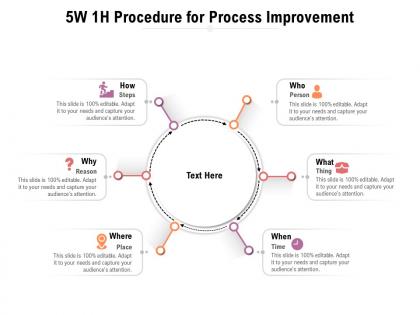
5w 1h procedure for process improvement




Try Before you Buy Download Free Sample Product
 Impress Your
 Audience
 100%
100% Editable
 Save Hours
 of Time


Our 5W 1H Procedure For Process Improvement are topically designed to provide an attractive backdrop to any subject. Use them to look like a presentation pro.
People who downloaded this PowerPoint presentation also viewed the following :
5w 1h procedure for process improvement with all 2 slides:
Use our 5W 1H Procedure For Process Improvement to effectively help you save your valuable time. They are readymade to fit into any presentation structure.
FAQs for 5w 1h procedure
Key principles of process improvement include customer focus, data-driven decision making, continuous monitoring, employee involvement, and systematic problem identification. These principles enable organizations to streamline operations, reduce waste, and enhance quality by fostering collaboration, measuring performance metrics, and implementing sustainable changes, with many companies finding that adherence ultimately delivers improved efficiency and competitive advantage.
Organizations effectively identify improvement opportunities through process mapping, performance metrics analysis, stakeholder feedback collection, bottleneck identification, and cost-benefit assessments. These methodologies enable teams to systematically evaluate workflows, prioritize high-impact areas like customer service delays or inventory management inefficiencies, and ultimately deliver enhanced operational efficiency and competitive advantage across departments.
Data analysis plays a crucial role in process improvement by identifying bottlenecks, measuring performance metrics, predicting outcomes, and validating improvement strategies. Through advanced analytics and real-time monitoring, organizations streamline operations, reduce costs, and enhance efficiency, with many manufacturing and financial services companies finding that data-driven insights deliver measurable competitive advantages.
Involving employees in process improvement enhances buy-in by leveraging their frontline expertise, creating ownership through participation, and reducing resistance to change through collaborative decision-making. Organizations across manufacturing, healthcare, and retail find that employee-driven improvements deliver faster implementation, higher adoption rates, and sustained operational efficiency, with many discovering previously overlooked optimization opportunities.
Common process improvement tools include Lean manufacturing, Six Sigma, Kaizen, Value Stream Mapping, and DMAIC methodology. These approaches streamline operations by eliminating waste, reducing defects, and optimizing workflows, with many organizations finding that strategic combination of these methodologies delivers measurable cost reductions and enhanced operational efficiency.
Technology facilitates process improvement by automating repetitive tasks, providing real-time analytics, and enabling seamless workflow integration across departments. Tools like robotic process automation, business intelligence dashboards, and cloud-based collaboration platforms streamline operations in manufacturing, healthcare, and financial services, ultimately delivering enhanced efficiency, reduced operational costs, and improved customer experiences.
Organizations should track cycle time, cost per transaction, error rates, customer satisfaction scores, employee productivity metrics, and compliance adherence rates. These measurements enable businesses to quantify operational efficiency gains, identify bottlenecks requiring attention, and demonstrate ROI to stakeholders, with many companies finding that consistent metric tracking accelerates continuous improvement and delivers sustained competitive advantage.
Cultural factors significantly impact process improvement effectiveness by influencing employee engagement, resistance to change, communication patterns, and leadership support throughout implementation phases. Organizations with collaborative cultures, transparent communication, and change-embracing mindsets typically see faster adoption and better results, while hierarchical or risk-averse cultures may experience slower progress, ultimately requiring tailored change management strategies for successful transformation.
Organizations typically face resistance to change, insufficient resources, lack of leadership support, poor communication, and inadequate employee training when implementing process improvement strategies. These challenges often stem from organizational culture barriers and competing priorities, with many companies finding that successful implementation requires dedicated change management, clear metrics for measuring progress, and sustained commitment from all levels to ultimately deliver operational efficiency and competitive advantage.
Continuous feedback loops are established through regular performance monitoring, stakeholder surveys, data analytics, automated reporting systems, and scheduled review meetings. These mechanisms enable organizations to identify bottlenecks, measure efficiency gains, and implement iterative improvements across departments, with many companies finding that systematic feedback collection ultimately delivers faster response times, reduced operational costs, and enhanced customer satisfaction.
Process improvement directly enhances customer satisfaction by streamlining operations, reducing wait times, minimizing errors, and delivering more consistent service quality. Through optimized workflows and enhanced efficiency, organizations across retail, healthcare, and financial services achieve faster response times, improved product quality, and seamless customer experiences, ultimately building stronger loyalty and competitive advantage.
Process improvement aligns with strategic goals through systematic evaluation of current workflows, identification of bottlenecks that hinder organizational objectives, and implementation of targeted solutions that directly support corporate vision. By mapping improvement initiatives to key performance indicators, companies in manufacturing, healthcare, and financial services streamline operations while enhancing customer satisfaction, ultimately delivering measurable competitive advantage and sustainable growth.
Successful process improvement examples include Toyota's lean manufacturing reducing waste by 30%, Amazon's warehouse automation accelerating fulfillment, and McDonald's standardized operations ensuring consistency across locations. These strategic implementations demonstrate how systematic optimization streamlines workflows, minimizes inefficiencies, and enhances customer experiences, with organizations across manufacturing, retail, and service industries finding significant cost reductions and competitive advantages.
Regulatory and compliance considerations significantly shape process improvement initiatives by requiring adherence to industry standards, documentation protocols, and audit trails throughout implementation. While these requirements can slow initial deployment, they ultimately enhance organizational credibility and risk management, with sectors like healthcare and financial services finding that compliant improvements deliver sustainable operational advantages.
Training resources for process improvement include Lean Six Sigma certifications, online platforms like Coursera and LinkedIn Learning, internal workshops, cross-functional project assignments, and mentorship programs. Many organizations combine formal methodologies with hands-on experience through improvement initiatives, kaizen events, and process mapping exercises, ultimately building internal capabilities while delivering measurable operational efficiency and competitive advantage.
-
Awesomely designed templates, Easy to understand.
-
Great product with highly impressive and engaging designs.