


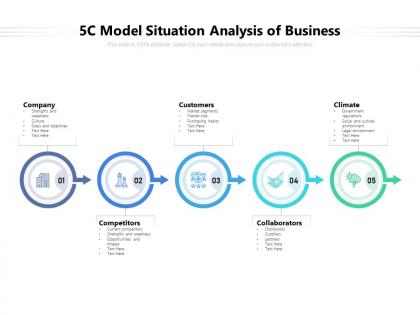
5c model situation analysis of business




Try Before you Buy Download Free Sample Product
 Impress Your
 Audience
 100%
100% Editable
 Save Hours
 of Time


Avoid any fabrication with our 5C Model Situation Analysis Of Business. Blindly depend on the facts depicted.
People who downloaded this PowerPoint presentation also viewed the following :
5c model situation analysis of business with all 2 slides:
Our 5C Model Situation Analysis Of Business discourage fabrication. They adhere to established and actual facts.
FAQs for 5c model situation
So the 5C Model is basically Company, Customers, Competitors, Collaborators, and Context. Start with your company's strengths, then figure out what customers genuinely want - not what you assume they want, which honestly trips up so many businesses. Check out your competition next. Don't forget collaborators and partners who can help you out. Context covers all the external stuff like market trends and regulations. Here's the thing though - they're all connected. If market context shifts, it'll change what customers need, which changes how you compete. You've gotta look at all five together or you'll miss obvious opportunities.
Just go through each C one by one - Company first (your strengths and weak spots), then Customers (who they are, what they actually want). After that, hit Competitors to see what they're nailing or screwing up. Don't forget Collaborators though - I swear everyone skips this part but your partners can totally tank your plans if you ignore them. Context comes last - all the market stuff, regulations, economic weirdness. Honestly, it's like having a checklist so you don't miss obvious things. Works way better than just winging it and realizing later you forgot something huge.
The 5C Model works really well for segmentation because it makes you examine segments from different angles before diving in. Look at your Company's capacity to serve each group, plus the actual Customers and what they want. Check out Competitors who are already going after those same people. Context stuff like regulations or economic trends matters too - honestly, this part gets overlooked way too much. Don't forget Collaborators either - your partners need to actually reach these segments effectively. Way better than just using basic demographics. I'd start by taking your existing segments and running them through all five C's to see what you're missing.
So the 5C Model is basically Company, Customers, Competitors, Collaborators, and Climate (the external stuff). Way more organized than just stalking your competitors on LinkedIn all day - which honestly we've all done. You go through each C systematically to get the full picture. Map out your internal strengths first, then figure out what customers actually want. Don't forget indirect competitors too, they'll sneak up on you. Check your partnerships and market conditions. I swear this beats random competitive research every time. Just start with where you are now for each C.
Customer analysis is where you start with the 5C framework - it's literally the backbone of everything else. Dig into who you're serving: their behaviors, needs, what pisses them off, how they actually buy stuff. Get this wrong and you're screwed because it affects how you compete, what skills your company needs, all of it. Don't just stare at spreadsheets though. Talk to real customers - like, actually pick up the phone or grab coffee with them. I know it sounds obvious but most people skip this part. The insights you get will shape your entire strategy way better than any dashboard ever could.
Start with your 5Cs - it's like doing homework before the real work. Then plug those insights into SWOT (competitor stuff becomes your threats/opportunities), Porter's Five Forces, whatever. Works great with customer journey mapping too if you dig deeper into that Customer piece. Honestly, I think it's most useful as step one rather than a standalone thing. Your Company and Competitor analysis pairs well with positioning frameworks. Oh, and don't sleep on using it with the marketing mix - makes everything way more informed since you've actually done the research first.
The 5C Model is clutch for checking if your product actually fits the market - Company, Customers, Competitors, Collaborators, and Context. Honestly, it's saved me from so many stupid decisions. Like when I thought users would love this feature and they absolutely hated it. Context is probably the most underrated part since regulatory stuff or economic changes can totally sink your launch. You'll catch blind spots early instead of finding out the hard way later. Oh and the Collaborators piece? Often overlooked but super important for partnerships. Try it during your next planning session - way better than just guessing what'll work.
Yeah, the 5C Model works pretty well for crisis stuff. Basically you look at your Company's strengths, which Customers are getting hit, Competitors (who are probably loving this drama), your Collaborators, and the whole Context around everything. It's like a mental checklist so you don't miss obvious things when you're panicking. Honestly, I've seen people tunnel vision on the main problem and totally ignore that their competitors are swooping in. The framework keeps you thinking about everyone involved. Just go through each C and figure out how it applies to whatever mess you're dealing with.
Yeah, culture totally changes how you use the 5C model everywhere. Japanese customers care about completely different things than Brazilian ones - values and buying habits are worlds apart. Competition works differently too. Some markets are all about relationships, others just want the cheapest price. Your company messaging? Might need a total makeover for each region. Context gets messy fast with different regulations and social norms everywhere. Even partnerships work differently - what collaborators expect varies wildly. Honestly, trying to use the same 5C analysis globally is just asking for trouble. You've gotta customize it for each market.
Honestly? Most people try doing all 5Cs at once and just burn themselves out. Pick the one that's actually causing you problems right now and focus there first. Also - and this drives me crazy - teams treat it like some one-time project instead of checking in regularly. Your competitors aren't sitting still, you know? Markets change every few months. Don't get stuck researching forever either. I've watched people spend ages perfecting their competitor analysis while real opportunities slipped by. Get some quick wins with your biggest pain point, then move on to the next C.
Honestly, I'd say quarterly is a good starting point, but it really depends on your industry. Tech moves crazy fast - you might need to check monthly. More stable stuff like manufacturing? Maybe twice a year is fine. Watch for big competitor moves or when your customers start acting weird - those are your red flags. I always do quick monthly peeks at the customer and competitor sections since those change the most. Oh, and set a calendar reminder right now or you'll totally forget about it. Trust me on that one.
Honestly, the 5C Model is a game-changer for getting everyone on the same page. You map out Company, Customers, Competitors, Collaborators, and Context - basically all the people who can make or break your campaign. Each group needs totally different messaging, right? Can't talk to customers the same way you'd talk to partners. Once people see where they fit in the bigger picture, they're way more likely to actually help instead of just nodding along. I've started using the 5Cs as my meeting agenda and it's been surprisingly effective - keeps things focused but covers everything.
Look, data analytics turns your 5C analysis from guesswork into something solid. Instead of wondering what customers want, you'll see their actual buying patterns. Competitive intelligence tools show you exactly what rivals are charging and how much market share they're grabbing. Market research helps spot trends before they blow up - though honestly, some trends are just noise. Demographics, economic data, and industry forecasts make context way less fuzzy. You can even measure how your internal teams are actually performing instead of just hoping they're doing well. Pick maybe 2-3 good data sources per category. More than that and you'll drown.
The 5C Model kills it in retail, healthcare, tech, and finance - basically anywhere customer relationships make or break your business. Competitive markets especially benefit since mapping out customers, competitors, and your own strengths actually sets you apart. B2B companies see huge wins too, which makes sense when you think about it. What I love is how it pulls together all those insights that are usually scattered across different team members' brains. My advice? Don't try tackling all five at once. Pick whichever C feels most broken in your business right now and start there.
Honestly, tech changes everything about the 5C analysis. You'll get insane amounts of customer data now - purchase history, social media reactions, instant feedback. Sometimes it's almost too much to handle! Segmenting customers becomes way more precise though. Competitors are trickier - yeah, you can track them easier with monitoring tools, but they can also change direction super fast. New startups pop up overnight and mess with your whole market. I'd definitely start using analytics tools to watch both customer behavior and what your competition's doing. Set up some alerts so you don't miss anything important.
No Reviews