

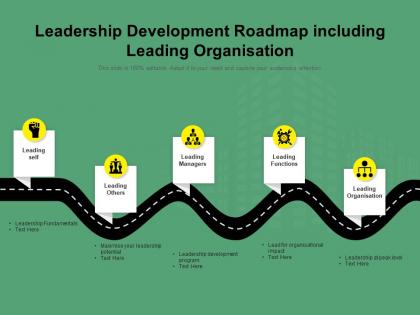
Leadership development roadmap including leading organisation




Try Before you Buy Download Free Sample Product
 Impress Your
 Audience
 100%
100% Editable
 Save Hours
 of Time


Encourage inventive attitudes with our Leadership Development Roadmap Including Leading Organisation. Appreciate intent to improve conditions.
People who downloaded this PowerPoint presentation also viewed the following :
Leadership development roadmap including leading organisation with all 2 slides:
Appreciate intent to improve conditions with our Leadership Development Roadmap Including Leading Organisation. Encourage inventive attitudes.
FAQs for Leadership development roadmap
Effective leaders in today's organizational landscape demonstrate emotional intelligence, adaptability, strategic vision, authentic communication, and collaborative decision-making. These characteristics enable leaders to navigate complex challenges, inspire diverse teams, and drive organizational transformation, with many companies finding that leaders who combine empathy with strategic thinking ultimately deliver stronger employee engagement and sustainable business growth.
Leadership development programs can be tailored by customizing content, delivery methods, and focus areas for each management level, from frontline supervisors to C-suite executives. Entry-level managers benefit from foundational skills training, while senior leaders require strategic thinking workshops and executive coaching, with many organizations finding that level-specific programs deliver faster promotion readiness and enhanced decision-making capabilities.
Emotional intelligence enables effective leadership by enhancing self-awareness, empathy, social skills, and decision-making under pressure. Leaders with strong emotional intelligence create more cohesive teams, navigate organizational change more successfully, and build stronger stakeholder relationships, with many executives finding that these capabilities ultimately drive higher employee engagement and superior business performance.
Feedback mechanisms enhance leadership development by providing real-time insights into performance gaps, strengthening self-awareness, and accelerating skill acquisition through targeted coaching interventions. Through 360-degree assessments and peer evaluations, organizations streamline leadership growth, improve decision-making capabilities, and foster accountability, with many companies finding that structured feedback ultimately delivers stronger succession planning and competitive advantage.
Mentoring accelerates leadership growth by providing personalized guidance, real-world insights, skill development opportunities, and strategic perspective from experienced leaders. Through structured mentorship programs, organizations see emerging leaders develop stronger decision-making capabilities, enhanced emotional intelligence, and improved team management skills, ultimately creating a robust leadership pipeline that drives sustained business performance.
Organizations face challenges including inconsistent program alignment with business goals, limited executive buy-in, inadequate measurement systems, resistance to change, and insufficient follow-up support. These obstacles often result from poor strategic planning, competing priorities, and lack of integration with existing workflows, with many companies finding that successful programs require sustained commitment, clear metrics, and cultural reinforcement to deliver meaningful leadership transformation and competitive advantage.
Technology facilitates remote leadership training through virtual reality simulations, AI-powered coaching platforms, interactive video conferencing tools, gamified learning modules, and real-time feedback systems. These digital solutions enable organizations to deliver personalized leadership development at scale, with many companies finding that remote training reduces costs while increasing accessibility and engagement across global teams.
Diverse leadership teams significantly enhance organizational performance by bringing varied perspectives, improved decision-making capabilities, and stronger innovation outcomes to strategic planning. Companies with diverse leadership consistently demonstrate better financial results, enhanced employee engagement, and superior market adaptability, with many organizations finding that diverse teams identify opportunities and mitigate risks more effectively than homogeneous groups.
Leaders cultivate continuous learning cultures by encouraging experimentation, providing regular feedback, investing in training programs, and modeling learning behaviors themselves. Through mentorship initiatives, cross-functional projects, and knowledge-sharing sessions, organizations in sectors like technology and healthcare enhance team adaptability, innovation capacity, and employee engagement, ultimately delivering competitive advantage in increasingly dynamic business environments.
Best practices for measuring leadership development success include 360-degree feedback assessments, performance metrics tracking, employee engagement surveys, retention rates analysis, and business outcome correlations. These measurement approaches streamline evaluation by capturing behavioral changes, team performance improvements, and organizational impact, with many companies finding that combining quantitative metrics with qualitative feedback ultimately delivers comprehensive insights into program effectiveness and ROI.
Storytelling enhances leadership training by making complex concepts relatable, improving emotional intelligence, and helping leaders communicate vision effectively through narrative techniques. Through case studies and real scenarios, executives develop better decision-making skills, inspire team engagement, and build authentic connections, with many organizations finding that story-driven approaches significantly improve leadership retention and impact.
Leaders can manage remote teams effectively through regular one-on-one check-ins, clear communication protocols, goal-setting frameworks, virtual team-building activities, and flexible scheduling approaches. These strategies enhance team cohesion by fostering trust, maintaining accountability, and creating inclusive digital environments, with many organizations finding that structured remote leadership ultimately delivers higher employee engagement and improved productivity across distributed teams.
Cross-cultural understanding enhances global leadership by improving communication across diverse teams, building trust with international stakeholders, and enabling culturally sensitive decision-making that resonates across markets. Leaders with cultural intelligence navigate complex global environments more effectively, ultimately delivering stronger international partnerships, expanded market reach, and enhanced organizational performance in increasingly interconnected business landscapes.
Ethical considerations in leadership development include ensuring equitable access to opportunities, maintaining transparency in selection processes, respecting cultural diversity, protecting confidential information, and avoiding favoritism or bias. These practices enhance organizational trust, improve employee engagement, and create sustainable leadership pipelines, with many companies finding that ethical development programs ultimately deliver stronger retention rates and competitive advantage.
Organizations promote inclusive leadership through comprehensive training programs, diverse mentoring initiatives, bias-awareness workshops, cross-cultural collaboration projects, and psychological safety frameworks. These approaches enhance decision-making by incorporating varied perspectives, experiences, and problem-solving methods, with many companies finding that inclusive environments accelerate creative solutions, improve employee engagement, and ultimately deliver stronger market performance and competitive advantage.
No Reviews