

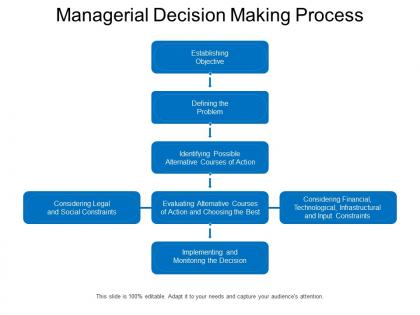
Managerial decision making process




Try Before you Buy Download Free Sample Product
 Impress Your
 Audience
 100%
100% Editable
 Save Hours
 of Time


Our Managerial Decision Making Process always include every aspect. Ensure all important factors are covered.
People who downloaded this PowerPoint presentation also viewed the following :
Managerial decision making process with all 5 slides:
Generate concern for the downtrodden with our Managerial Decision Making Process. Help alleviate the difficulties they face.

FAQs for Managerial
So basically you wanna identify what's actually wrong first, then dig into the details - and I mean really dig, don't just skim the surface like most people do. Come up with a few different ways to handle it. Then weigh each option against the others - what could go wrong, what might work, all that stuff. Pick one and go for it. Oh, and this part trips people up constantly - you gotta check back later to see if your solution actually fixed anything. Otherwise you're just shooting in the dark and hoping for the best.
Ugh, cognitive biases are the worst for managers - they're basically your brain taking shortcuts that backfire. Like confirmation bias makes you cherry-pick info that backs up what you already believe. Then there's anchoring bias where you get weirdly fixated on the first number someone throws out in meetings. Overconfidence is probably the sneakiest one though - suddenly you think your hunches are gospel. Honestly, just knowing these traps exist helps a ton. I always try to get pushback from my team before major calls. Also sleeping on big decisions actually works, even if it sounds cheesy.
Look, data analytics basically stops you from making decisions based on hunches. You get real patterns from your actual numbers instead of just winging it. So much better than guessing what customers want, right? It's like finally seeing what's really going on behind the scenes. You'll catch opportunities that would've flown right past you otherwise. Plus you can actually tell if your strategies worked or totally flopped. My advice? Start small though - just pick one thing you decide on regularly and figure out what data could help. No need to go crazy with it at first.
Honestly, start with the data but don't ignore your instincts. Get the facts first - that's your foundation. But here's the thing: your gut feelings matter too, especially with people stuff or when you've dealt with similar situations before. Your brain's basically been collecting data for years through experience. When both align? Perfect. When they don't? That's when you need to dig deeper and figure out what you're missing. Oh, and sleep on the big decisions if you can - I swear your brain works through things overnight that you totally miss during the day.
Ugh, honestly the worst part is when everyone just nods along to avoid drama - classic groupthink. Then you've got people who barely contribute while others carry the whole team. Loud personalities will totally bulldoze quiet teammates too. Sometimes groups get so stuck debating options they never actually decide anything. People also love hoarding information that could've saved everyone time if they'd just shared it earlier (why do they do this?). And don't even get me started on trying to coordinate schedules. Set clear roles from the start. Use some kind of decision framework so you're not just winging it. Actually ask for opposing views.
Honestly, your company's culture totally dictates how decisions happen. Top-down places? Everything needs approval from like three managers above you. More collaborative spots want everyone's input, which can be painfully slow but people actually follow through better. Some cultures are super cautious - you'll be pulling reports for weeks before anyone moves. Others let you just try stuff and fail fast. I learned this the hard way at my last job. The trick is figuring out what type yours is so you can play the game instead of constantly hitting walls.
Honestly, scenario planning is a game-changer for big decisions. Instead of crossing your fingers and hoping for the best, you map out 3-4 different ways things could actually go down. Each scenario forces you to question your assumptions - like what if that competitor enters the market, or funding gets tight? It's not about predicting the future (impossible anyway), but about stress-testing your strategy. Your team starts catching blind spots you'd normally miss. I always feel way more confident in decisions after running them through different scenarios first. Give it a shot next time you're facing something major.
Honestly, I'd start with scenario planning - like what's the best case, worst case, and realistic outcome for each option? Get other people's opinions too since they'll catch stuff you totally missed. Pilot programs are clutch if you can swing it - basically test things small before committing big. Oh, and set up checkpoints where you can pivot if needed. The thing that's helped me most though? Write down what you're assuming going in. Sounds boring but you'll be surprised how many assumptions turn out wrong, and then you can actually fix course instead of just wondering what happened.
So basically you map out everyone who'd be affected by your decision before you make it. List employees, customers, investors - whoever. Then figure out how much power they have and what they actually want. Honestly, it's kind of a pain at first but saves you from those "oh shit" moments later when someone important gets pissed. You can spot potential problems early and maybe get key people on your side. Sometimes you'll realize certain groups could completely wreck your plans, which is... good to know beforehand I guess? Start by rating everyone's influence level - that foundation makes everything else way easier.
Honestly, ethics will totally change how you make decisions. You can't just think about money anymore - now you're considering who gets screwed over and what your reputation looks like down the road. Super annoying sometimes because doing the right thing often costs more upfront. But trust me, people notice when you're ethical. Employees stick around longer, customers actually like you, partners want to work with you again. I always ask myself two things: "who does this hurt?" and "would I be embarrassed if this ended up in the news?" Works pretty well as a gut check.
Look, good communication stops you from making decisions blindfolded. Your team brings different viewpoints that'll catch risks you totally missed. People actually follow through when they've had a say in shaping the decision - honestly, it's night and day compared to just being told what to do. The trick is making everyone comfortable enough to disagree with you or share crappy news. Try asking open questions in your next meeting. Don't get defensive when someone pushes back on your idea. You'll be surprised how much better your decisions get.
Honestly, SWOT analysis is pretty clutch for mapping out strengths, weaknesses, opportunities and threats before major decisions. Decision trees help you visualize different paths too - I actually use those way more than I expected. Oh, and try the 10-10-10 rule: how will you feel about this choice in 10 minutes, 10 months, and 10 years? Cost-benefit analysis works great for data-heavy stuff. The Pareto principle is solid for focusing on what actually matters most. Just pick whatever framework fits your situation best and don't overthink it.
Ugh yeah, time pressure totally screws with your decision-making. Your brain just grabs the first option that seems decent instead of actually thinking it through - kind of like when you're starving and order the first thing on the menu. You end up skipping the analysis part and not considering other possibilities. Plus you rely way more on gut feelings, which honestly can be pretty biased. I've learned this the hard way lol. Try to build in buffer time when you can. If you're really stuck though, at least stop for a sec and ask "what am I missing here?"
Honestly, post-decision reviews are a game changer. Instead of just rushing to the next crisis, you actually stop and look at what went down. Were your assumptions on point? What did you completely miss? I used to skip this stuff because who has time, right? But it's seriously the fastest way to get better at making tough calls. The trick is being real about what went wrong without spiraling into self-hate mode. Set a calendar reminder for like 30-60 days after major decisions. Quick review, learn something, move on.
So here's the thing - when you've got people from different backgrounds on your team, they'll catch stuff you'd totally miss. Like, someone who grew up somewhere else or worked in a different industry will ask questions that never occurred to you. It prevents that whole echo chamber situation where everyone just nods along. The tricky part though? You actually have to make people feel safe to disagree with you, otherwise what's the point of having all those different perspectives if nobody uses them. But yeah, it's honestly one of the best ways to avoid those "how did we not see this coming" moments.
No Reviews