

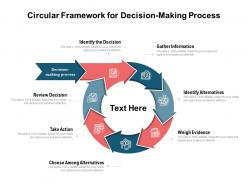
Circular framework for decision making process





Try Before you Buy Download Free Sample Product
 Impress Your
 Audience
 100%
100% Editable
 Save Hours
 of Time


Create awareness about the judgement with our Circular Framework For Decision Making Process. Broadcast information about critical clauses.
People who downloaded this PowerPoint presentation also viewed the following :
Circular framework for decision making process with all 2 slides:
Broadcast information about critical clauses with our Circular Framework For Decision Making Process. Create awareness about the judgement.
FAQs for Circular framework for
So instead of making a decision and calling it done, circular decision-making is more like... you keep coming back to reassess stuff. You analyze, decide, implement - but then you actually circle back when things change or you get new info. Traditional approaches act like you can figure everything out upfront and make the "perfect" choice. Honestly, that's just not realistic most of the time. With circular thinking, you're constantly adjusting based on feedback, which sounds exhausting but it's actually less stressful once you realize tweaking decisions is totally normal. Next time you've got a big choice coming up, try building in some check-in points to see how this works for you.
First thing - figure out where you're currently bleeding resources or missing obvious connections. The whole linear "make-use-toss" approach is honestly pretty wasteful. Try building feedback loops instead, so one team's output actually feeds into another's decisions. Like when marketing wraps a campaign, get those insights straight to product dev instead of buried in some report nobody reads. Cross-functional teams help too - have them regularly check how big decisions ripple across departments. Oh, and always think both short-term needs plus long-term cycling. Start with one department first though. See what clicks before going company-wide.
Look, you can't make good decisions without getting everyone's input first. Different people spot problems you'll totally miss - finance catches budget issues, ops knows what's actually doable, customers tell you if it sucks to use. The circular thing just means you keep going back to them as stuff changes, not just asking once at the beginning (which honestly most people do and then wonder why things fall apart). Map out who actually matters for your decision, then set up regular check-ins instead of those awful one-time meetings where everyone pretends to care.
Track your decision speed and how happy stakeholders are - those tell you if the process works. Also watch how often you have to revisit decisions, which honestly caught me off guard as a useful metric when I started doing this. Survey people about feeling heard and whether blind spots get uncovered. That stuff matters more than you'd think. Compare your results to how linear decision-making went before. Just throw together a basic dashboard and check it monthly. Don't overthink it - the revisit rate alone will probably surprise you with what it reveals about your process.
So there's actually a bunch of different approaches you can try. Design thinking workshops are honestly where I'd start - they're way more useful than people think. LCA software maps out environmental impacts pretty well, and Material Flow Analysis tracks how resources move through your system. Manufacturing folks love Cradle to Cradle or the Ellen MacArthur Foundation's ReSOLVE model (weird name but it works). Supply chain mapping and stakeholder analysis work for most industries too. Pick whatever matches your project scope first and don't try to do everything at once.
So basically you keep looping back on decisions instead of just deciding once and calling it done. You test stuff, get feedback, then adjust - way less pressure than trying to nail everything perfectly from the start. Your competitors? They're probably still stuck in those rigid step-by-step processes while you're already pivoting based on what actually works. The whole thing makes you way more adaptable to market shifts and customer feedback. Plus you learn faster since you're constantly refining. I'd say start with just one decision and build in some regular check-ins to see how it's going.
Honestly? Getting everyone to slow down is the hardest part - people think involving more voices will drag everything out forever. Managers who are used to just telling people what to do get weird about it too, like they're gonna lose all their power or something. Your teams will need to learn how to actually facilitate these discussions without letting them turn into those awful meetings that go nowhere. I'd say start with small stuff first - decisions that don't really matter if you mess up. Once people see it works, then you can try the bigger strategic things.
Honestly, tech just puts your feedback on cruise control. You've got real-time dashboards and AI constantly watching how your decisions play out, then feeding that info right back to you. Netflix does this perfectly - watch one true crime doc and suddenly your whole feed shifts. Same idea for business calls. IoT sensors and predictive stuff catch problems before you even know they exist. The trick is setting up smart alerts so you're not buried in random data points (been there, it sucks). You want actual insights that keep your decision loop running smooth.
Toyota's got those worker improvement circles down to a science - frontline employees spot issues, pitch fixes, then everyone refines ideas together before rolling anything out. Interface (the carpet people) went carbon negative using similar loops, constantly cycling through impact data and tweaking based on what they find. Pretty wild for manufacturing, honestly. Buffer does this cool thing with salary transparency where employee feedback circles revisit their pay formulas regularly. What's interesting is none of these are set-it-and-forget-it decisions. They're more like living systems that just keep getting better through constant iteration and real input from people actually doing the work.
Build your ethics right into every step, don't just slap them on afterward. Figure out your main values first, then create questions you'll ask each time through - like "does this still match what we believe?" or "who are we potentially screwing over here?" The whole circular thing is actually pretty genius because you're constantly double-checking instead of making one huge call and crossing your fingers. Oh, and get different people involved in those check-ins too. You'll miss stuff that seems obvious to someone else.
Honestly, skip the boring classroom stuff and go straight for hands-on workshops. Systems thinking exercises are huge - get people actually mapping out stakeholders and practicing real scenarios. I'd throw in conflict resolution training too, plus sessions on running meetings where quieter people actually speak up. Cross-functional projects work amazingly well since people suddenly realize other departments aren't the enemy. Oh, and definitely start with leadership first - if your executives aren't bought in, you're basically wasting everyone's time. The simulation-style training where teams juggle different perspectives? That's what actually sticks with people long-term.
Honestly, your company culture makes or breaks this whole thing. Hierarchical places hate giving up that top-down control - they'll fight you on collaborative approaches. Trust is massive too. When people don't trust each other, nobody wants to share half-baked ideas or admit they screwed up and need a do-over. Makes sense, right? But if your culture already celebrates failing fast and people actually talk openly? Way easier sell. I'd start with teams who already experiment a lot - maybe that one group that's always trying weird stuff. Let them nail it first, then watch other teams get jealous and want in.
Ugh, circular decision-making is the worst for supply chains. Everyone keeps bouncing choices around instead of just picking someone to decide. Your vendors end up confused and waiting around forever while internal teams play hot potato with decisions. Lead times get totally screwed because nobody knows what's happening. Inventory planning becomes a nightmare too - honestly, I've seen companies order way too much just because they can't get straight answers. The costs add up fast when everyone's hedging their bets. Just assign one person per function to make the call and set actual deadlines. Better to make a decent decision quickly than a perfect one never.
Think about where your product goes after someone's done with it - that's the whole game. Pick materials that can actually be recycled or will break down naturally. Make stuff modular so people can swap out broken parts instead of buying new (Framework laptops are genius for this). Maybe even keep ownership yourself and lease the product - then it's your problem to figure out the lifecycle, which honestly makes you design better. I always ask "okay but what happens in 5 years?" with every choice. Most companies just stop thinking after the sale, which is kinda crazy.
Ugh, circular decision-making is a compliance nightmare. Auditors show up and you literally can't tell them who decided what - it's just this messy loop where everyone's kinda responsible but nobody really owns anything. Regulators hate that stuff. They want clean lines of accountability, not some collaborative free-for-all. SOX compliance gets tricky, risk frameworks fall apart, and good luck explaining it to your board. Honestly feels like describing a group chat to your parents sometimes. You gotta map out who actually makes the calls, even if it kills the collaborative vibe a bit.
No Reviews