


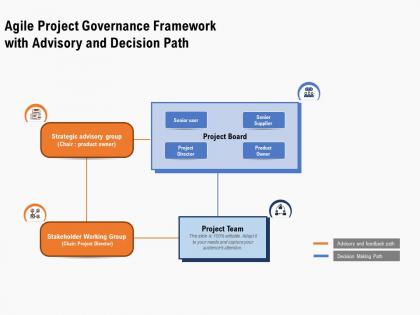
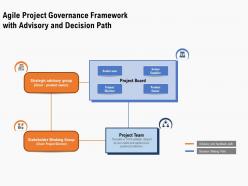
Agile project governance framework with advisory and decision path




Try Before you Buy Download Free Sample Product
 Impress Your
 Audience
 100%
100% Editable
 Save Hours
 of Time


Introducing Agile Project Governance Framework With Advisory And Decision Path template. Showcase the structured approach by which organizations conduct their business as well as project activities with the help of this PowerPoint visual. Give an overview of three main agile frameworks with the help of this PowerPoint theme. Take the assistance of the agile project management PPT template to discuss the important elements of the governance framework. Utilize this scrum framework PPT visual and present core principles of agile methodology. Highlight the important elements of a good governance framework. Depict the purpose of governance on a lean-agile governance program using this agile project management PPT theme. This slideshow is fully adaptable to your need, so you can replace the content with your own. Explain the characteristics of good and bad governance with the help of attention-grabbing agile framework PPT template. Therefore, download and incorporate this agile governance model PPT slide design now.
People who downloaded this PowerPoint presentation also viewed the following :
Agile project governance framework with advisory and decision path with all 2 slides:
Give your audience a fulfilling experience. They will find our Agile Project Governance Framework With Advisory And Decision Path elevating.
FAQs for Agile project governance framework with advisory
So agile governance is basically the opposite of those endless approval chains that make you want to scream. Instead of rigid hierarchies, you're pushing decisions down to the people actually doing the work. It's all about adapting fast and learning as you go - way better than planning everything to death upfront. Teams get regular feedback loops and can pivot when stuff changes. The whole point is speed over perfect documentation (which nobody reads anyway, let's be honest). Traditional governance feels like molasses sometimes. Start by figuring out where your biggest bottlenecks are and see if those decisions can happen closer to the action.
Honestly, agile governance is a game-changer because it pushes decisions down to the people actually doing the work. No more waiting weeks for approvals from like five different managers. Teams know exactly who owns what, which cuts through so much confusion. You get these regular check-ins that catch problems early - way better than finding out months later something's broken. When teams can pivot without going through bureaucratic hell, they actually respond to changes quickly. Oh, and the whole "fail fast" thing? It's not just buzzword nonsense here. Pick one decision that's currently stuck in approval limbo and try letting the team handle it directly.
So basically, agile governance is all about staying flexible instead of getting stuck in endless approval cycles. Your teams need clear boundaries but shouldn't have to wait around for committee decisions on every little thing - that just kills all momentum. Weekly check-ins work way better than quarterly meetings that drag on forever. Focus on tracking actual outcomes, not just busy work metrics. The trick is figuring out which decisions actually need oversight versus what your people can handle on their own. Oh, and make sure your governance folks can actually pivot when new info comes up. Otherwise you're just calling it "agile" for no reason.
Think of stakeholders as your reality check in Agile - they're constantly feeding you insights and helping figure out what actually matters. Get them in sprint reviews and steering meetings, not just sending them boring status emails. The tricky part? Keeping them involved without letting them hover over every little decision (honestly, some stakeholders love to do this). Set clear expectations upfront about time commitment and give them real decision-making power. Create regular touchpoints that actually work. Oh, and start with your most important stakeholders first - don't try to manage everyone at once.
Track your cycle times and delivery frequency first - those numbers don't lie about whether governance is actually working. Defect rates matter too, obviously. But here's the thing: if your team starts hating their jobs, you've probably overcomplicated things. I'd also watch for blocked work items and how often stuff gets escalated - way better early warning signs than waiting for quarterly reviews. Team satisfaction surveys are clutch here. Honestly, stakeholder feedback can be all over the place, but it's still worth collecting. Start simple with maybe 3-4 metrics and adjust as you go.
Honestly, the resistance is the worst part - compliance folks especially freak out when you mess with their rigid processes. Finding that sweet spot between quick reviews and proper oversight is tricky too. And don't even get me started on stakeholders who keep demanding those massive documents nobody actually reads anymore lol. Speed versus control becomes this constant tug-of-war. My advice? Start with a small pilot project first. Show some quick wins to get people on board instead of overhauling everything at once. Once they see it actually works, the trust builds itself.
So with Agile, you're basically doing risk management on the fly instead of those massive upfront assessments that nobody reads anyway. Daily standups and sprint reviews become your risk radar - you catch stuff early and can actually do something about it. Way better than waiting three months to realize you're screwed, honestly. Each iteration teaches you something new, so you're constantly shifting priorities based on real data. The trick is just weaving risk talks into meetings you're already having. Don't create some separate process - people will just ignore it. Quick pivots when problems pop up? That's the whole point.
Look, SAFe is your heavy-hitter here - covers everything from teams up to portfolio level, though it can feel like overkill sometimes. If you're already doing Scrum, just try Scrum of Scrums first. Way easier transition. LeSS is cleaner but kinda rigid about doing things their way. For tools, Jira Align works great, or Azure DevOps if that's what you've got. Even Confluence can track your governance stuff decently. Here's the thing though - doesn't really matter which framework you pick if people won't stick with it. I'd honestly just go with whatever feels closest to what you're doing now and build from there.
Tech companies love agile governance - so do banks and healthcare orgs. Makes sense since they're all dealing with constant changes but can't ditch compliance. Startups use it when they're scaling fast, hospitals for patient data stuff. Even government agencies are trying it out (shocking, I know). The old bureaucratic approval thing just doesn't work anymore when everything moves this quick. My advice? If you're in a regulated industry, try small pilot programs first. Show people it actually helps compliance instead of breaking it. That's usually the biggest fear anyway.
Don't wait until the end to think about compliance - that's a nightmare I've seen too many teams go through. Get your compliance people involved right from sprint one. Build those regulatory requirements straight into your definition of done. Yeah, it feels like extra work upfront, but retrofitting compliance later? Way more painful. Demo your compliance stuff alongside features at sprint reviews. Document everything as you build it - use automated tools when you can because manual documentation sucks. Make it visible throughout the process instead of some scary gate at the end. Oh, and those compliance stakeholders I mentioned? Actually put them on your cross-functional team, don't just invite them to meetings.
Honestly, leadership has to walk the walk first - can't preach agile while micromanaging everything. Make your decisions visible to everyone and let teams experiment, even if some stuff fails. Retrospectives are clutch here because they prove you actually care about getting better. Try cross-functional sessions or casual lunch-and-learns where people share what they're testing out. The whole thing falls apart if people don't feel safe speaking up or pushing back when something isn't working. Oh, and celebrate the learning from failures, not just the wins.
So Agile Governance basically gets departments to stop hoarding info and actually work together. You create mixed teams with people from different areas, and decisions happen way faster since you're not waiting for approvals to crawl through the bureaucracy. Honestly, the transparency part is huge - everyone knows what's going on instead of guessing. Teams meet regularly and solve problems together rather than throwing issues over the fence to each other. Pick one process that currently bounces around between departments and rebuild it with reps from each team involved from the start.
Skip the boring PowerPoint sessions - nobody retains that stuff anyway. Get your teams into hands-on workshops where they're actually working through real scenarios from your projects. Role-playing exercises work great for practicing decisions within those governance boundaries. Here's the thing though - train cross-functional groups together since governance is basically just different departments learning to play nice. I mean, you could do separate training, but you'd miss the whole collaboration piece. Make it interactive and tied to what they do daily. Otherwise they'll forget everything by Friday.
Honestly, remote Agile is way harder than people think - you lose all that natural back-and-forth. Start by moving your ceremonies online but make them work across time zones. Set up virtual governance with clear decision rules, and get everyone looking at the same dashboards for transparency. The async communication thing is crucial though. Use Confluence or Miro so everyone can see what's happening in real-time. Regular pulse checks help too. I'd map out what you're doing now and figure out async versions that actually work for your team's schedule. Takes more effort but totally doable once you find your rhythm.
Look at ING Bank - they ditched their whole hierarchy for autonomous squads and tribes, which cut their decision-making time like crazy. Spotify's model is famous too (though they've moved past the original framework). Then there's Haier, this Chinese appliance company that broke itself into 4,000 tiny micro-enterprises. Honestly, it sounds wild but it works. The common thread? You've got to trust your teams way more than feels comfortable and let them make decisions without running everything up the chain. Don't go all-in right away though - test it with one team first.
No Reviews