


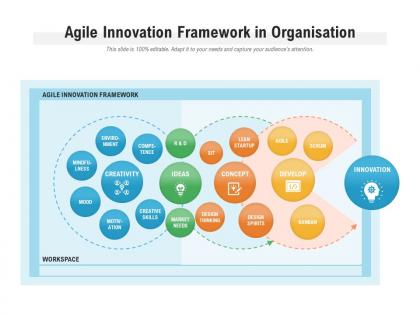
Agile innovation framework in organisation





Try Before you Buy Download Free Sample Product
 Impress Your
 Audience
 100%
100% Editable
 Save Hours
 of Time


Express your joy with our Agile Innovation Framework In Organisation. Clearly convey your cause for elation.
People who downloaded this PowerPoint presentation also viewed the following :
Agile innovation framework in organisation with all 2 slides:
Clearly convey your cause for elation with our Agile Innovation Framework In Organisation. Be able to express your joy.

FAQs for Agile innovation
Agile Innovation principles include iterative development, customer collaboration, rapid prototyping, cross-functional teams, and continuous feedback loops, distinguishing it from traditional linear approaches. These methodologies streamline product development by embracing change, reducing time-to-market, and minimizing risk through early testing, with many organizations finding that agile frameworks deliver faster innovation cycles and more market-responsive solutions.
Teams foster experimentation culture through safe-to-fail environments, regular retrospectives, dedicated innovation time, cross-functional collaboration, and leadership support for calculated risks. Through rapid prototyping and iterative testing, organizations like tech startups and financial services firms accelerate product development, reduce time-to-market, and enhance customer experiences, ultimately delivering competitive advantage in increasingly dynamic markets.
Customer feedback serves as the foundational driving force in Agile Innovation, enabling continuous product refinement, rapid iteration cycles, market validation, and user-centered design decisions. Through regular feedback loops, organizations can pivot strategies quickly, minimize development risks, and enhance product-market fit, with many tech companies and startups finding that early customer insights ultimately deliver competitive advantages and accelerated time-to-market success.
Organizations measure Agile Innovation success through key performance indicators like time-to-market reduction, customer satisfaction scores, innovation pipeline velocity, and revenue from new products or services. These metrics enable companies to track iterative improvements, employee engagement levels, and market responsiveness, with many finding that combining quantitative data with qualitative feedback ultimately delivers comprehensive insights into innovation effectiveness.
Common challenges teams face when implementing Agile Innovation include resistance to change, lack of cross-functional collaboration, insufficient leadership support, rigid organizational structures, and inadequate feedback mechanisms. These obstacles can be overcome by fostering a culture of experimentation, establishing clear communication channels, providing comprehensive training, and implementing iterative processes that encourage rapid prototyping, with many organizations finding that structured change management and dedicated innovation time ultimately deliver enhanced adaptability and competitive advantage.
Agile methodologies integrate with design thinking through iterative prototyping, continuous user feedback loops, cross-functional collaboration, and rapid testing cycles that validate assumptions early. This strategic combination enables organizations to streamline innovation processes, reduce development risks, and accelerate time-to-market, with many companies finding that merging these approaches delivers more user-centered solutions and sustainable competitive advantage.
Tools enhancing Agile Innovation collaboration include cloud-based project management platforms, real-time communication software, digital whiteboarding solutions, version control systems, and integrated development environments. These technologies streamline team coordination by enabling instant feedback loops, transparent progress tracking, and seamless resource sharing, with many organizations finding that strategic tool integration accelerates innovation cycles while reducing development costs.
Cross-functional teams accelerate Agile Innovation by combining diverse expertise, eliminating handoffs, and enabling rapid decision-making throughout development cycles. These collaborative structures streamline problem-solving, reduce time-to-market, and enhance product quality, with many organizations finding that integrated teams deliver 40% faster innovation cycles while maintaining higher customer satisfaction and competitive advantage.
Iterative development enables organizations to test, refine, and enhance products through repeated cycles, reducing risk while accelerating time-to-market and improving quality outcomes. This approach allows teams to incorporate customer feedback continuously, adapt to changing requirements, and deliver value incrementally, with many companies finding that iterative processes significantly enhance innovation speed and competitive advantage.
Agile Innovation enables organizations to respond rapidly to market changes by fostering iterative development cycles, cross-functional collaboration, and continuous customer feedback integration. Through flexible methodologies and rapid prototyping, companies can pivot strategies quickly, test market assumptions efficiently, and deliver adaptive solutions, with many financial services and retail organizations finding that this approach significantly reduces time-to-market while enhancing competitive positioning.
Best practices for prioritizing ideas in an Agile Innovation pipeline include value-based scoring frameworks, customer impact assessment, resource requirement analysis, strategic alignment evaluation, and market timing considerations. These approaches enable organizations to streamline decision-making by balancing potential ROI, implementation feasibility, and competitive advantage, with many companies finding that systematic prioritization accelerates time-to-market while minimizing resource waste.
Leadership can drive Agile Innovation by fostering psychological safety, removing bureaucratic barriers, and empowering cross-functional collaboration. Through regular sprint reviews, resource allocation flexibility, and celebrating iterative failures as learning opportunities, leaders enable teams to experiment rapidly, adapt to market changes, and deliver customer-centric solutions, ultimately creating a competitive advantage in increasingly dynamic business environments.
Key metrics include cycle time, customer satisfaction scores, innovation pipeline velocity, time-to-market for new features, and team productivity measures like story points completed. These indicators enable organizations to streamline development processes, enhance product quality, and accelerate delivery timelines, with many technology companies finding that tracking these metrics ultimately delivers competitive advantage and improved customer experiences.
Agile Innovation significantly accelerates time-to-market by enabling iterative development, rapid prototyping, continuous customer feedback integration, and cross-functional team collaboration. Through shorter development cycles and early market testing, companies like tech startups and pharmaceutical firms reduce launch timelines by 30-50%, while minimizing risks and enhancing product-market fit, ultimately delivering competitive advantage.
Essential skills for Agile Innovation teams include design thinking, rapid prototyping, data analysis, collaborative problem-solving, and adaptability to changing requirements. These capabilities enable teams to iterate quickly, validate ideas through customer feedback, and pivot strategies effectively, with many organizations finding that cross-functional training in both technical and creative methodologies delivers faster innovation cycles and more market-responsive solutions.
No Reviews