


3c Business Strategy Model Analysis Framework




Try Before you Buy Download Free Sample Product
 Impress Your
 Audience
 100%
100% Editable
 Save Hours
 of Time


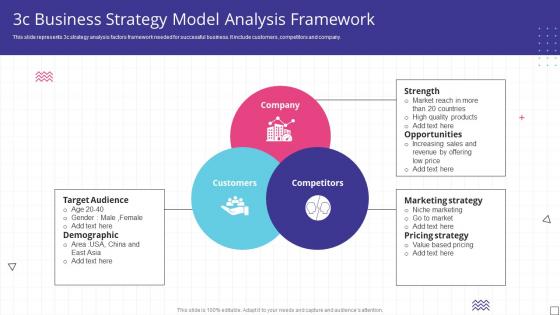
This slide represents 3c strategy analysis factors framework needed for successful business. It include customers ,competitors and company.
People who downloaded this PowerPoint presentation also viewed the following :
3c Business Strategy Model Analysis Framework with all 6 slides:
Use our 3c Business Strategy Model Analysis Framework to effectively help you save your valuable time. They are readymade to fit into any presentation structure.





FAQs for 3c Business Strategy
The 3C Model's core components are Company (internal capabilities and resources), Customers (market needs and segments), and Competitors (rival strategies and positioning), which interact through continuous analysis and strategic alignment. These components work synergistically by enabling organizations to leverage internal strengths against competitor weaknesses while meeting customer demands, ultimately delivering sustainable competitive advantage and market differentiation.
The 3C Model proves most effective in competitive market analysis, strategic planning initiatives, product launch evaluations, and market entry decisions. Companies entering new markets, launching products, or facing competitive threats find this framework particularly valuable, as it systematically examines customer needs, competitor positioning, and internal capabilities, ultimately delivering strategic clarity and informed decision-making for sustainable competitive advantage.
The 3C Model assists startups by enabling rapid market validation, competitive positioning assessment, and core capability identification to secure initial market foothold and funding opportunities. For established companies, it facilitates strategic pivots, market expansion analysis, and competitive advantage reinforcement, with many organizations finding that this framework streamlines resource allocation decisions and enhances long-term strategic planning across diverse business units.
Common pitfalls include inadequate competitor research, misunderstanding customer needs, overestimating company capabilities, failing to integrate all three elements, and static analysis without regular updates. These challenges often occur when organizations rush implementation or work in silos, with many marketing teams finding that successful 3C Model application requires continuous monitoring, cross-functional collaboration, and adaptive strategies that evolve with market dynamics.
The 3C Model focuses specifically on customers, competitors, and company capabilities for strategic positioning, while SWOT examines internal strengths/weaknesses and external opportunities/threats, and PEST analyzes broader political, economic, social, and technological factors. This targeted approach enables organizations to streamline competitive analysis and market positioning decisions, with many consulting firms and retail companies finding that the 3C framework delivers faster strategic insights and clearer competitive advantage identification than broader analytical models.
Toyota successfully implemented the 3C Model by analyzing customer demand for fuel efficiency, competitor weaknesses in hybrid technology, and their manufacturing capabilities, leading to the revolutionary Prius launch. Similarly, Amazon leveraged customer convenience needs, competitor limitations in logistics, and their technological competencies to dominate e-commerce, ultimately delivering sustained competitive advantage through strategic market positioning.
Consumer behavior significantly influences each 3C component by shaping company strategies, competitive positioning, and customer expectations. Through purchasing patterns, preference shifts, and feedback mechanisms, consumers drive companies to adapt their value propositions, force competitors to differentiate their offerings, and continuously evolve their own demands, ultimately creating dynamic market conditions that require strategic agility and customer-centric approaches.
Competition analysis in the 3C Model evaluates rival strategies, market positioning, strengths, weaknesses, and competitive dynamics to identify market opportunities and threats. This assessment enables companies to differentiate their offerings, anticipate competitor moves, and develop strategic advantages, with many organizations finding that thorough competitive intelligence ultimately delivers better market positioning and sustainable competitive differentiation.
Businesses can utilize the 3C Model by analyzing Customer needs and preferences, evaluating Company capabilities and resources, and studying Competitor strategies and market positioning. This strategic framework enables organizations to identify service gaps, optimize product offerings, and differentiate their value propositions, with many retailers and financial services finding that this comprehensive approach ultimately delivers enhanced customer satisfaction and competitive advantage.
**INPUT**: What are the best practices for conducting an analysis using the 3C Model? **OUTPUT**: Best practices for 3C Model analysis include comprehensive market research, competitive benchmarking, internal capability audits, stakeholder interviews, and data-driven insights collection. These approaches enhance strategic planning by identifying market opportunities, assessing competitive positioning, and evaluating internal strengths, with many organizations finding that systematic 3C analysis ultimately delivers clearer strategic direction and sustainable competitive advantage. **Word count: 56 words**
The 3C Model accommodates market changes by providing a dynamic framework that continuously monitors customers, competitors, and company capabilities as market conditions evolve. Through regular reassessment of these three elements, organizations can quickly identify shifting consumer preferences, competitive threats, and internal capacity gaps, enabling strategic pivots that maintain competitive advantage in increasingly volatile business environments.
Technology integration enhances the 3C Model by providing real-time competitive intelligence, advanced customer analytics, and comprehensive company performance dashboards. Through AI-powered market research tools and data visualization platforms, organizations can continuously monitor competitor strategies, analyze customer behavior patterns, and assess internal capabilities, ultimately delivering faster strategic insights and more agile decision-making in competitive markets.
The 3C Model adapts across industries by customizing competitor analysis, customer insights, and company capabilities to sector-specific dynamics and competitive landscapes. In tech, companies focus on innovation cycles and platform ecosystems, while retail emphasizes supply chain efficiency, customer experience touchpoints, and omnichannel strategies, ultimately delivering tailored competitive advantages.
Businesses can measure 3C Model strategy outcomes through customer satisfaction scores, market share growth, competitive positioning analysis, brand awareness metrics, and operational efficiency indicators. These measurements enable organizations to track how well their strategies align customer needs with company capabilities while maintaining competitive advantage, with many companies finding that regular assessment of these interconnected metrics delivers sustained strategic success.
Teams ensure alignment using the 3C Model by establishing regular communication checkpoints, creating shared documentation for customer insights, and conducting collaborative review sessions throughout project phases. Through structured coordination meetings, teams can validate customer requirements, assess competitive positioning, and evaluate company capabilities together, ultimately delivering consistent project outcomes while maintaining strategic focus across all stakeholders and departments.
-
Definitely recommend SlideTeam to all who need help with PowerPoint presentations. Their design team can create anything you need.
-
Perfect template with attractive color combination.