


International Business Strategy Development Framework




Try Before you Buy Download Free Sample Product
 Impress Your
 Audience
 100%
100% Editable
 Save Hours
 of Time


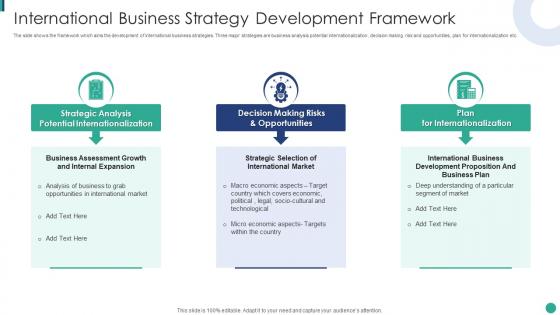
The slide shows the framework which aims the development of international business strategies. Three major strategies are business analysis potential internationalization, decision making risk and opportunities, plan for internationalization etc.
People who downloaded this PowerPoint presentation also viewed the following :
International Business Strategy Development Framework with all 6 slides:
Use our International Business Strategy Development Framework to effectively help you save your valuable time. They are readymade to fit into any presentation structure.





FAQs for International Business
Key components of an effective international business strategy include market analysis, entry mode selection, competitive positioning, cultural adaptation, and risk management frameworks. These elements work together by identifying viable opportunities, determining optimal market penetration methods, and establishing localized operations, with many multinational corporations finding that strategic integration of these components delivers sustainable competitive advantage and accelerated global growth.
Cultural differences significantly shape international market entry strategies by influencing consumer behavior, communication preferences, business practices, and regulatory expectations across different markets. Companies must adapt their products, marketing approaches, and operational methods accordingly, with successful organizations like McDonald's and Starbucks tailoring offerings to local tastes and customs, ultimately delivering enhanced market acceptance and sustainable competitive advantage.
Economic factors serve as fundamental drivers in global business strategy, influencing market entry decisions, resource allocation, pricing strategies, operational locations, and competitive positioning across international markets. These variables enable companies to identify growth opportunities, assess market viability, and optimize supply chains, with many multinational corporations finding that economic analysis ultimately delivers competitive advantage and sustainable expansion in increasingly dynamic global environments.
Companies assess international market risks through comprehensive political, economic, cultural, legal, and operational analysis, including currency fluctuation studies, regulatory compliance reviews, and competitive landscape evaluations. Through systematic due diligence and local partnerships, organizations can identify potential challenges in sectors like manufacturing or financial services, ultimately enabling informed market entry decisions and strategic risk mitigation approaches.
Organizations can enhance cross-border collaboration through digital communication platforms, standardized project management systems, cultural competency training, flexible scheduling accommodations, and clear governance frameworks. These strategies streamline international workflows by reducing communication barriers, aligning operational processes, and fostering cultural understanding, with many multinational companies finding that structured collaboration protocols ultimately deliver faster project delivery and stronger global partnerships.
Multinational corporations adapt marketing strategies through localization of messaging, cultural customization of products, region-specific pricing models, and targeted distribution channels. Companies like McDonald's modify menus for local tastes, while banks adjust services for regulatory environments, ultimately delivering culturally resonant experiences that enhance market penetration and competitive advantage.
Global supply chain management delivers cost reduction through economies of scale, access to diverse suppliers, enhanced flexibility, and improved risk distribution across multiple markets. While organizations benefit from lower production costs and expanded market reach, they also face challenges including increased complexity, currency fluctuations, and geopolitical risks, with many finding that strategic diversification ultimately provides competitive advantage.
Technology revolutionizes international business strategy development by enabling real-time global market analysis, facilitating cross-border communication, and streamlining supply chain management across multiple countries. Through digital platforms and data analytics, companies can assess international opportunities more accurately, coordinate global operations seamlessly, and adapt strategies quickly to local markets, ultimately delivering competitive advantage in an increasingly interconnected business landscape.
Firms must navigate trade regulations, tax compliance, employment laws, intellectual property protection, data privacy requirements, and industry-specific licensing across different jurisdictions. These legal frameworks vary significantly between markets, with companies in sectors like pharmaceuticals, financial services, and technology finding that proactive regulatory strategy and local legal partnerships ultimately streamline market entry and minimize compliance risks.
Political environments significantly influence international business strategies through regulatory frameworks, trade policies, taxation structures, and diplomatic relationships between nations. Companies operating globally must navigate varying political climates, with many multinational corporations finding that stable democracies often provide predictable business conditions while emerging markets may offer growth opportunities alongside political volatility, ultimately requiring adaptive strategies that balance risk management with competitive positioning.
Key metrics for evaluating international business performance include revenue growth by region, market share penetration, local customer acquisition costs, currency-adjusted profit margins, and cross-border operational efficiency ratios. These indicators enable organizations to assess market-specific success while identifying optimization opportunities, with many multinational companies finding that combining financial metrics with cultural adaptation measures delivers comprehensive performance insights and sustainable competitive advantage.
Companies leverage competitive advantages globally by identifying unique strengths like technology, brand reputation, operational efficiency, or cost structures, then strategically adapting these assets across international markets. Through localized marketing, strategic partnerships, and scalable business models, organizations in sectors like technology and manufacturing deliver enhanced customer experiences, capture market share, and ultimately establish sustainable competitive positioning worldwide.
Successful international M&A strategies include comprehensive due diligence, cultural integration planning, regulatory compliance assessment, local partnership development, and phased integration approaches. These methodologies streamline cross-border transactions by minimizing cultural conflicts, ensuring legal adherence, and leveraging local expertise, with many multinational corporations finding that strategic cultural alignment ultimately delivers enhanced market penetration and operational synergies.
Businesses can utilize local partnerships to strengthen their international presence by leveraging regional expertise, established distribution networks, cultural insights, and regulatory knowledge. Through strategic alliances with local firms, companies streamline market entry, enhance customer relationships, and navigate complex compliance requirements, with many organizations finding that these partnerships significantly reduce operational risks while accelerating growth in new markets.
Sustainable practices enable international businesses to meet regulatory requirements, reduce operational costs, and enhance brand reputation across diverse markets. These strategies help companies navigate increasingly stringent environmental regulations, attract conscious consumers, and secure long-term partnerships, with many multinational corporations finding that sustainability delivers competitive advantage and operational resilience globally.
-
“Immediate response, professional support, and effective solutions that were customized and immediately provided. Well done- Thank you!”
-
Innovative and attractive designs.