


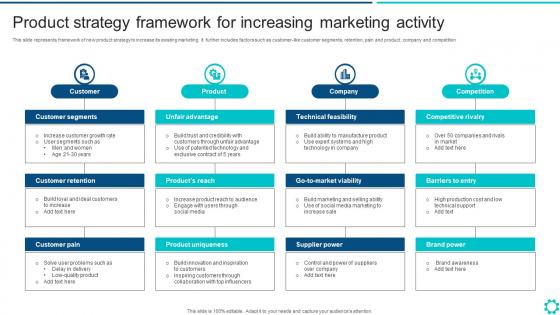
Product Strategy Framework For Increasing Marketing Activity




Try Before you Buy Download Free Sample Product
 Impress Your
 Audience
 100%
100% Editable
 Save Hours
 of Time


This slide represents framework of new product strategy to increase its existing marketing. It further includes factors such as customer like customer segments, retention, pain and product, company and competition.
People who downloaded this PowerPoint presentation also viewed the following :
Product Strategy Framework For Increasing Marketing Activity with all 6 slides:
Use our Product Strategy Framework For Increasing Marketing Activity to effectively help you save your valuable time. They are readymade to fit into any presentation structure.





FAQs for Product Strategy Framework For
You need five main things to nail this. Vision gives you direction - like your North Star. Figure out your target market so you know exactly who you're building for. Then craft a value prop that explains why people should pick you over everyone else. Success metrics are huge too (seriously, don't skip this part like half the teams I know). Oh and positioning against competitors matters way more than people think. Connect everything with a roadmap that ties features back to actual business results. Start there and you'll be in good shape.
Dude, market research is like your safety net - it shows you what customers actually need instead of what you're guessing they need. I've watched so many teams (including mine once, embarrassingly) skip this and build stuff that just sits there unused. You'll want both the survey data and actual conversations with people. This feeds directly into which features matter most, how you position things, and your whole launch strategy. Honestly? The competitive intel you get is pretty valuable too. Start collecting feedback early and don't stop - it'll save you from those "why did we build this" moments later.
User feedback is your reality check - tells you if your strategy actually works or just looks pretty on paper. I've watched so many teams build stuff in a vacuum then act shocked when nobody uses it. You need consistent feedback loops going - surveys, interviews, digging through support tickets, whatever clicks with your users. But here's the thing: don't just hoard all that data. Actually use those insights when you're making roadmap calls and pivoting your strategy. It validates assumptions and helps you catch those annoying gaps between what you think people want versus reality.
Think of it this way - you're claiming your own little corner of people's brains before someone else does. When customers have a problem, you want them thinking of YOUR product first. The trick is finding something competitors can't easily copy, like better tech or maybe you're the only one actually serving some overlooked group. Be super specific about what makes you different. Honestly, vague positioning is basically useless - people need to instantly get why they'd pick you over the other guys. It's about creating those mental shortcuts so buyers don't have to think too hard.
Honestly, start with the basics - who are these people demographically and what do they actually care about? Their pain points matter way more than you think. How do they make buying decisions? Some people will research a $20 purchase for weeks (drives me crazy lol), others just buy instantly. Market size is huge too - doesn't matter how perfect your segment is if you can't reach them without burning through cash. I'd create maybe 2-3 detailed customer personas, then actually talk to real people before you get too attached to your assumptions. That's saved me from some pretty embarrassing mistakes.
So your product roadmap is basically how you execute your bigger strategy. Strategy covers the "why" and "what" – your vision, goals, who you're targeting. The roadmap handles "when" and "how" you'll actually build stuff. I always think of strategy like your destination, and the roadmap as your GPS directions to get there. It turns those big strategic ideas into actual features and timelines your team can work with. Oh, and definitely keep checking that your roadmap still matches your strategy as things change – strategies evolve way more than people expect.
Honestly, most PMs I know totally skip the obvious first step - actually figuring out what the business wants to accomplish. So start there. Then directly connect your product stuff to real metrics like revenue or customer retention. Regular leadership check-ins are clutch since priorities change constantly (learned this the hard way). Oh, and make a simple one-pager showing how each feature ties to business goals. Sounds basic but it's such a good reality check. Share it with your team too - everyone should know why we're building what we're building.
Honestly, you've gotta track both quick wins and your bigger picture stuff at the same time. I'd set up quarterly goals that mix revenue-driving features with the foundational work - sounds boring but it matters. Most teams totally blow this part because they can't explain to stakeholders WHY they're doing both tracks. Short wins are great, but make sure they're actually testing your longer-term strategy assumptions. Even when everyone's screaming for quick results, try to keep like 30% of your roadmap focused on bigger bets. The metrics will save you here - show how everything connects back to where you're headed.
Honestly, focus on three buckets: money stuff, how users actually behave, and whether your product is falling apart. Revenue growth, customer acquisition cost, lifetime value - that's your "are we making money" check. Then track active users, retention, feature adoption. The technical metrics are super boring but you need them - bug rates, how fast your team ships stuff. I made the mistake of tracking like 15 different things when I started. Total nightmare. Pick maybe 5-7 that actually matter for your goals. Throw them in a simple dashboard, check weekly. That way you can course-correct fast instead of realizing three months later that everything's broken.
Honestly, ditch the whole "set strategy once a year" thing - it's dead. Talk to customers constantly and scan what competitors are doing every quarter, not annually. Your roadmap needs to bend when stuff changes, which it will. I learned this the hard way watching teams stick to plans that made zero sense anymore. Quick story - set up alerts for market shifts and make your team comfortable flagging problems early. Don't wait for some formal review meeting that's months away. Short feedback loops save you from building stuff nobody wants.
RICE is probably your best bet - it scores features on Reach, Impact, Confidence, and Effort so you get actual numbers instead of just arguing about gut feelings. MoSCoW works too if you want something simpler (Must have, Should have, etc.). The Kano model's good but honestly feels kind of overthought for most teams. Oh, and those value vs effort grids? Super quick for sprint planning. Pick whatever doesn't make your team's eyes glaze over and just stick with it consistently.
Cross-functional collab is huge - like, make-or-break for your strategy. Engineering knows what's actually possible, design gets the user experience right, marketing handles positioning. Sales has all the customer dirt, ops keeps things running smooth. Each team sees blind spots you'll miss on your own. Without them bought in early? You're looking at misaligned priorities and features nobody wants. I've seen so many strategies just collect dust because people tried to go solo. Get everyone in those strategy sessions from the start - saves you tons of headaches later.
So Jobs-to-be-Done is great for figuring out what customers actually want. ICE model helps you prioritize features - Impact, Confidence, Ease. Pretty straightforward. OKRs keep your goals measurable while cohort analysis shows how users behave over time. Most teams totally underuse A/B testing, which is honestly crazy since it's so valuable. North Star Framework keeps everyone focused on the one metric that really drives your product forward. Oh, and don't try implementing everything simultaneously - that's a recipe for chaos. Pick 2-3 methods that match where your team's at right now.
So here's what I'd do - map your product gaps against what's actually becoming available now. AI for personalization, IoT for real-time stuff, blockchain if you've got trust problems. But honestly? I've watched too many teams fall in love with shiny tech and completely lose sight of the actual customer problem. Always ask "what job could this help us do better?" instead of "how do we shoehorn this cool thing in?" Start small with experiments. Don't blow your whole budget on something that sounds amazing in theory but tanks when real people try to use it. The tech's just a tool - the customer need comes first.
Honestly, competitor analysis is like your sanity check for product decisions. It shows you what's actually working vs. what you *think* should work. You'll find weak spots where they're failing (jackpot for you), catch trends early, and avoid launching "groundbreaking" features that have been around forever. Don't just copy though - that's boring and obvious. Use their strategies to figure out your own angle and positioning. I do quick competitive checks monthly, then go deeper every quarter. Keeps me from making dumb moves, you know?
-
The design is clean-cut, modern, and sleek, keeping the users' needs in mind. The multiple uses make this product worth every penny!
-
The customer care of SlideTeam is very responsive. I was having a payment issue and they fixed it for me in no time.