


Banking products and services digital ppt powerpoint presentation professional





Try Before you Buy Download Free Sample Product
 Impress Your
 Audience
 100%
100% Editable
 Save Hours
 of Time


Our Banking Products And Services Digital Ppt Powerpoint Presentation Professional are explicit and effective. They combine clarity and concise expression.
People who downloaded this PowerPoint presentation also viewed the following :
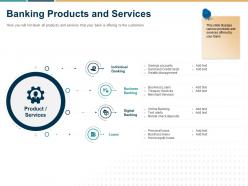
Banking products and services digital ppt powerpoint presentation professional with all 2 slides:
Give your audience a fulfilling experience. They will find our Banking Products And Services Digital Ppt Powerpoint Presentation Professional elevating.

FAQs for Banking products and services digital ppt
So AI personalization is massive right now - banks are basically reading your mind before you know what you need. Embedded finance is everywhere too, like getting loans through your shopping apps instead of calling your bank. Open banking lets third parties peek at your data (if you're cool with it) to build better tools. Real-time payments are finally catching up to where they should've been years ago. Voice banking's picking up steam, though I'm still weird about talking to my phone for money stuff. Everything's blending together - can't tell if you're dealing with a bank, tech company, or retailer anymore. Focus on making things stupid simple and think beyond traditional banking if you're building anything new.
Dude, good UX literally makes or breaks digital banking apps. I've seen people delete apps mid-signup because they couldn't figure out basic stuff. Your customers want banking that feels as smooth as Instagram or whatever - clean design, fast loading, easy navigation. The successful banks? They're treating design like their secret weapon instead of some checkbox to tick off. Quick loading times aren't optional anymore either. Honestly, just watch people try to use your current app and you'll spot the problems real quick. Those pain points are probably costing you customers right now.
So basically AI runs most of the banking stuff you use every day. Your fraud alerts? That's AI watching your spending patterns. Those chatbots are hit or miss but they're getting way better. It also handles loan approvals automatically and gives you those personalized suggestions in your app. Honestly, the fraud detection alone has saved me from sketchy charges multiple times. Investment portfolios get optimized by it too. Banking feels way more intuitive now compared to like five years ago. Next time you're in your app, try asking the assistant something - it'll probably surprise you how smart it's gotten.
Dude, you've gotta layer your security like crazy. End-to-end encryption is non-negotiable, plus get multi-factor auth set up ASAP. Real-time fraud detection will catch the sneaky stuff, and honestly? Train your employees because they're usually the weak link. Biometrics work great for customer authentication - way better than just passwords. You'll want 24/7 monitoring too, which sounds expensive but beats dealing with a breach. Oh, and pen testing regularly because hackers get creative fast. Having a solid incident response plan ready saves your butt when things go sideways.
Honestly, the biggest thing is making sure your digital stuff and branches actually talk to each other. Nothing pisses customers off more than having to repeat their whole story when they switch from the app to calling in. Your team needs access to the same info - like if someone started something online, branch staff should see that right away. Banks that keep these separate are just making life harder for everyone (including themselves). Map out how customers actually move between channels - those transition points are where things usually break down. Oh, and obviously keep your branding consistent across everything. Sounds basic but you'd be surprised how many miss this.
Dude, regulatory stuff is like the rulebook for what you can actually build. Data protection, anti-money laundering, consumer protection - all that has to be baked in from the start. Honestly, it's a total maze at first. But here's the thing: it actually shapes your entire app, from features down to how users sign up and verify their identity. The weird part? Having clear rules can make innovation faster because you're not guessing what's allowed. Oh, and get your compliance people in those early product meetings - trust me, way better than rebuilding everything later.
Look at user adoption first - are people actually using your stuff daily/monthly? Feature usage tells you what's working. Revenue from digital channels matters obviously, plus cost per transaction compared to your old-school methods. Customer satisfaction is probably the most underrated metric honestly. Banks obsess over the numbers but ignore if customers are happy. Retention rates show the real story too. Don't go crazy measuring everything though - pick maybe 3-5 metrics that match what you're trying to accomplish. Cross-selling through digital is worth tracking if that's your thing.
Honestly, personalized banking just works better because people feel seen instead of being another account number. Your app remembers what they like, suggests stuff that actually makes sense for them, sends helpful money tips based on how they spend - and suddenly they're thinking "okay these guys actually get it." Way stickier than the boring cookie-cutter stuff everyone else does. Smart data use is everything though. Show budgeting help when someone's overspending, push savings options when they're stockpiling cash. I'd start simple - custom dashboards, smart notifications - then go from there.
Ugh, digital transformation for banks is such a mess. Their tech systems are ancient - we're talking decades old stuff that's held together with duct tape basically. Regulatory compliance is insane too, plus cybersecurity threats that honestly would give me nightmares if I worked there. Staff need retraining, older customers hate change, and the costs? Brutal. You're rebuilding everything while keeping the old junk running simultaneously - it's like renovating your house while living in it. I'd say start with small pilots first. Get your security bulletproof before scaling though, that part's non-negotiable.
Honestly, payment apps are way more convenient for daily stuff - instant transfers, splitting dinner bills, no fumbling around for cards. But there's a catch. Your money usually isn't FDIC-insured like with regular banks, plus they have lower spending limits and weaker fraud protection. I learned that the hard way when my friend got scammed on Venmo last year. Best move? Keep your main savings in a traditional bank account but load some cash onto payment apps for everyday purchases and quick friend transfers. Gets you the convenience without the major risk.
So basically, fintech companies are forcing banks to actually get their act together with technology. Banks used to take forever to update anything - like, literally years for simple features. But now they're scrambling because customers started jumping ship to these slick fintech apps with instant transfers and budgeting tools. Most big banks finally caught up and offer decent mobile experiences, though some are still pretty clunky if we're being honest. Here's the thing though - whatever cool feature you see from a fintech startup will probably show up in your regular bank's app within a year or two.
Big data can totally transform how you handle customers - predicting what they'll buy next, catching fraud as it happens, personalizing everything. Transaction patterns alone reveal crazy insights about user behavior. Like, you'll see exactly where people bail on loan applications or which app features nobody touches. Pricing optimization becomes way easier too. Plus you can predict system loads to cut costs and improve credit decisions with non-traditional data sources. Honestly, the possibilities are kind of overwhelming at first. My advice? Start with something specific like fixing your mobile app's user flow, then expand from there once you get the hang of it.
Digital banking basically removes all the usual roadblocks - no more hunting for bank branches or meeting crazy minimum balance requirements. Your phone becomes your bank, which is huge for people stuck in remote areas who couldn't access this stuff before. Small businesses can finally take digital payments without dropping cash on expensive card readers. Plus AI lending looks at things like your utility bills instead of just traditional credit scores, which honestly makes way more sense. The trick is building apps that actually work on older phones with sketchy internet - that's where you'll see the real impact happen.
So first thing - survey your customers to figure out what's actually stopping them from going digital. Then hit them with education from all angles. In-app tutorials are clutch, plus email tips and those branch demos for people who still need hand-holding. Video content absolutely crushes it because nobody wants to read boring instructions, right? Webinars and social posts help you reach different age groups too. The trick is being genuinely helpful instead of annoying - like that friend who actually explains tech stuff without making you feel dumb. Focus on solving their real problems and they'll come around.
Dude, mobile optimization can literally make or break your bank right now. People do like 80% of their banking on phones these days - I actually just checked my account while writing this lol. If your app is slow or confusing, customers will bounce to another bank without thinking twice. Fast load times are huge. Touch-friendly navigation matters way more than you'd think. And honestly? Security has to be perfect since everyone's handling money stuff on public wifi now. Banks that still design for desktop first are getting destroyed by the competition. Your mobile experience IS your bank experience at this point.
No Reviews