


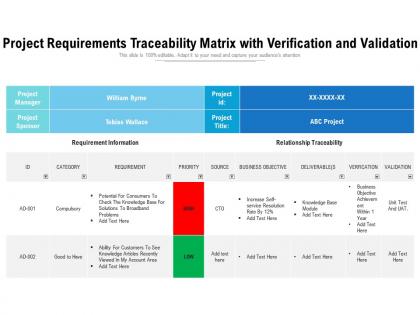
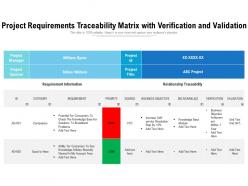
Project requirements traceability matrix with verification and validation




Try Before you Buy Download Free Sample Product
 Impress Your
 Audience
 100%
100% Editable
 Save Hours
 of Time


Accelerate the flow with or Project Requirements Traceability Matrix With Verification And Validation. Endorsements come in by the dozens.
People who downloaded this PowerPoint presentation also viewed the following :
Project requirements traceability matrix with verification and validation with all 2 slides:
Exude dynamism with our Project Requirements Traceability Matrix With Verification And Validation. The air will be brimming with enthusiasm.
FAQs for Project requirements traceability matrix with
So basically you're tracking how your requirements connect to everything else - design, code, tests, the whole shebang. Trace forward to see what a requirement affects, or backward to find which requirement justifies some piece of work. Yeah, it's pretty tedious to keep up with, but trust me it's worth it. Requirements always change (Murphy's Law or whatever), and traceability helps you spot what else needs fixing fast. Also super helpful during testing to make sure you actually built what they wanted. Start early though - trying to piece together those connections later is a nightmare.
Think of traceability as your project lifeline - it links requirements to design, code, and testing so you don't miss anything important. When requirements inevitably change, you'll know exactly what downstream stuff needs updates. No more playing detective! Testing becomes way easier too since you can verify everything actually works. Honestly, the traceability matrix seems like extra work upfront but it's a total lifesaver. You catch problems early when fixes are cheap instead of scrambling during final testing. Just build it early and actually keep it current - I can't stress that enough.
So you'll need requirement IDs and descriptions obviously, plus links to your source docs. The real meat is in those forward/backward trace connections - they show how requirements connect to design specs, test cases, code modules, all that stuff. Honestly feels like mapping out a huge web sometimes. Add status columns so you can track what's implemented, tested, verified. Priority levels help too if your team's into that. Oh and ownership info - trust me, you don't want mystery requirements floating around with no clear owner. Start basic though, you can always expand later.
Okay so these automated tools basically create this digital thread connecting your requirements to design docs, code, and test cases. When something changes, you can instantly see what's impacted. No more hunting through spreadsheets like a maniac trying to figure out dependencies - honestly that stuff gave me nightmares at my last job. The tools auto-flag broken links and generate traceability matrices. They'll send alerts when requirements get modified too. Jira and Azure DevOps work great, or you could try specialized ones like Polarion. Start simple though - just pick one tool and map your current requirements. Basic linking alone will save you so much headache.
Ugh, the maintenance is brutal - constantly updating links between requirements, code, and tests as stuff changes. Teams always start motivated but dump it when crunch time hits because it feels like extra work. Tool issues don't help either, especially when requirements are in one system and code's somewhere else entirely. Honestly though, frequent requirement changes are what really kill you - those trace links become impossible to keep current. My take? Don't try to trace everything at once. Start with your most critical requirements and build from there. Way more manageable that way.
So basically, traceability lets you show stakeholders exactly how their requests turned into actual features. When someone inevitably asks "where's my thing?" or challenges a design choice, you can trace it right back to what they originally wanted. Think of it like keeping receipts for every decision - honestly saves your butt in those awkward review meetings. You'll be able to walk through how requirements changed, what got bumped up the priority list, and why you made certain trade-offs. The transparency thing really works too. People trust the process more when they see their input didn't just vanish into the development void.
Traceability is your backup when regulators show up asking questions. You can prove every requirement got handled properly - from the original specs through design, coding, and testing. Think of it like keeping receipts, except way more tedious. Without it, you're basically guessing whether you covered everything. Changes get tracked, requirements don't fall through cracks, and you can actually show your system works as intended. Honestly, just build your traceability matrix from day one and update it constantly. Trust me, trying to piece it together during an audit is absolute hell.
So forward traceability is basically following your requirements down through the whole dev process - requirements → design → code → tests. Backward traceability flips it around, letting you trace from tests or code back up to whatever requirements started it all. Think of it like following a recipe vs working backward from a finished dish (kinda weird comparison but whatever). Forward helps you make sure you're actually building what you need to build. The backward stuff though? That's where it gets really useful - when requirements change, you can instantly see what code and tests are gonna break.
Look, start with the stuff that'll actually hurt if it breaks - high value, high risk items. Don't try tracking everything or you'll drown in spreadsheets (learned that one the hard way). Begin with your critical user flows and whatever regulatory stuff you can't mess up. Trace those from business needs down to test cases. Honestly, it's way better to have solid traceability on your top 20% than half-hearted tracking everywhere else. You can always expand later once you've got the important bits locked down tight.
Start linking your requirements to code and tests right away - bidirectional connections are everything. Jira or Azure DevOps work great for this, way better than spreadsheets which turn into a nightmare pretty quickly. Give each requirement a unique ID and connect it to specific commits and test cases. Run traceability audits regularly to spot missing pieces early. Automated tools are clutch for catching orphaned requirements or features that aren't tested. Keep it simple though - if it's too complicated, nobody'll actually use it. I'd say start with your critical features first, then build out from there. Oh and honestly? The tool matters less than just being consistent about it.
Oh man, scope changes are the worst for traceability. Everything breaks - your links from requirements to test cases, business objectives, all of it. I learned this the hard way on my last project. You've got to update your traceability matrix right when changes happen, not later when you're scrambling. Broken links create orphaned items and you'll spend forever trying to figure out what connects to what. Get a tool that automatically flags broken links if you can. Trust me, it's way better than manually hunting down every broken connection when you're already behind schedule.
So basically you want to track a few key things. Coverage percentage is huge - like 90% of your requirements should link to design and tests. Also check how fast you can do impact analysis when stuff changes (trust me, this saves your butt later). I always look for "orphans" first - requirements or tests just floating around with zero connections. Those are red flags. Time how long it takes to trace a defect back to its original requirement too. If your team's spending ages on that, something's broken in your setup. Just start measuring these basics in whatever you're working on now.
So traceability is basically your roadmap for testing - it shows you what to test and why. Map your requirements straight to test cases and you'll spot coverage gaps instantly. Honestly, it's clutch when stakeholders want proof that everything got tested. Requirements always change (ugh), so having that connection helps you figure out which tests need fixes without playing guessing games. I'd start by matching what you have now to existing test cases. You'll probably find some weird gaps you didn't know existed.
Honestly, collaborative traceability is a game changer. Developers catch impossible requirements super early instead of you finding out at the worst possible moment. Testers spot coverage gaps before crunch time hits. Product owners stay on top of whether everything actually makes business sense - which sounds boring but trust me, it matters. The best part? Everyone's working from the same info instead of five different outdated versions floating around. Just make sure people update the matrix as they go. Don't let it become one person's nightmare cleanup job at the end.
Honestly, AI tools are about to make requirements traceability way less painful. You'll get automated linking between user stories, code, and tests - no more manual hunting. Real-time visual mapping is finally getting decent too. Machine learning can even predict which requirements will probably change based on your team's history, which is pretty cool. Since everything's moving toward continuous deployment, your traceability needs to be live now. Don't wait for sprint updates. Start playing with tools that have solid API integrations. Trust me, when the really smart automation drops, you'll want to be ready for it.
No Reviews