


Project requirements traceability matrix strategy pmp documentation requirements it




Try Before you Buy Download Free Sample Product
 Impress Your
 Audience
 100%
100% Editable
 Save Hours
 of Time


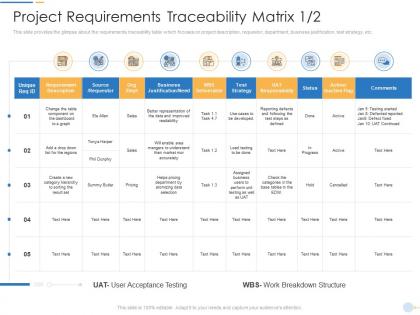
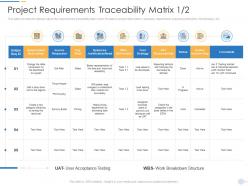
This slide provides the glimpse about the requirements traceability table which focuses on project description, requestor, department, business justification, test strategy, etc.
People who downloaded this PowerPoint presentation also viewed the following :
Project requirements traceability matrix strategy pmp documentation requirements it with all 2 slides:
Use our Project Requirements Traceability Matrix Strategy PMP Documentation Requirements IT to effectively help you save your valuable time. They are readymade to fit into any presentation structure.

FAQs for Project requirements traceability matrix strategy pmp
So a traceability matrix is just a document that connects all your project stuff together - requirements to test cases, deliverables to acceptance criteria, that kind of thing. Think of it as your backup plan. When things get messy (and they will), you can check that every requirement actually got tested and all your deliverables tie back to what you promised. I know it sounds super dry, but trust me - when audit season hits or someone starts asking "why did we build this again?" you'll be so glad you have it. Just keep it simple though, otherwise you won't bother updating it.
Think of a traceability matrix as your project's roadmap - it connects requirements to design, tests, and final deliverables. Super helpful when requirements change (and they always do) or when someone asks "wait, did we actually build that thing?" You can trace forward to see what breaks when something changes, or backward to make sure you're not building random stuff nobody asked for. Honestly, it feels like busywork at first, but it'll save your butt later. Just start simple and keep updating it as you go.
So basically you need requirement IDs and descriptions as your foundation. Map those to test case IDs with descriptions too. Test execution status is huge - passed, failed, or pending. I personally always add requirement priority because when deadlines hit, you'll thank me later. Oh and defect IDs when stuff breaks, plus test types like functional or regression. The whole point is connecting every single requirement to at least one test case. Otherwise things slip through and nobody catches it until it's too late. Honestly the matrix looks overwhelming at first but it saves your butt during crunch time.
Aerospace, automotive, medical devices, pharma - that's where you'll see these matrices everywhere. Basically any industry where screwing up means people die and regulators breathe down your neck. FDA, FAA, ISO standards all demand proof that you tested every single requirement. Software teams use them too, though honestly it's pretty overkill for most apps. When auditors show up or things go sideways, you need rock-solid docs showing your testing didn't miss anything. Oh, and if you're in one of those regulated fields? Start doing this stuff now - trust me, it's a nightmare trying to backfill later.
Honestly, you've gotta make it a habit instead of scrambling last minute when someone asks for it. I learned this the hard way during an audit - total nightmare. Set weekly check-ins to see if requirements changed or new test cases got added. Get your team using something shared like Excel or whatever requirements tool you have so everyone can update it as they go. The trick is building it into your normal workflow, not treating it like extra homework nobody wants to do. Also? Assign someone each sprint to actually validate the thing. Makes a huge difference.
So requirements traceability matrix? That's your full lifecycle tracker - connects business needs to design, code, test cases, the whole thing. Test case traceability matrix just focuses on linking your tests back to requirements. Way more narrow scope. Honestly, I use the test case version way more often since I'm usually knee-deep in testing phases anyway. Requirements RTM is better for the big picture stuff when stakeholders want to see everything's covered. Both stop things from getting missed, which happens more than you'd think. Just pick based on what phase you're in really.
So basically it's like having a roadmap that everyone can actually read. When stakeholders ask "where's my feature?" you just point to the exact row instead of digging through a million emails. Requirements always change (ugh), but at least you can quickly show people what breaks when they want something new. Honestly, it saves so much back-and-forth confusion between devs, testers, and business people. I'd update it weekly and throw it in your meetings - keeps everyone on the same page about what you're actually building. Way better than those conversations where everyone's talking about different things.
Ugh, the worst part is definitely keeping that matrix current. Teams always forget to update it when requirements shift, and suddenly nothing traces back properly. Different tools across departments make it even messier - they never sync well together. Honestly though? Most people just hate the manual linking work. Connecting requirements to test cases feels like busy work, even when it saves your ass later. My advice - automate whatever you can and bake matrix updates into your definition of done. Otherwise it'll always be an afterthought that everyone avoids.
Yeah totally! Just don't go crazy with it like waterfall teams do. Keep it simple and focus on your current sprint - link user stories to acceptance criteria and test cases. Most people use Jira for this stuff since it's already built in. Update it as you go instead of making it this huge thing that everyone dreads touching. Honestly, I've seen teams spend more time on the matrix than actual development, which is ridiculous. Start with just your current sprint's stories and their tests. See how it goes during sprint review - you might actually like having everything connected.
Honestly? Most teams I know just start with Excel or Google Sheets and that works fine for basic stuff. If you need something beefier later, Jama Connect and IBM DOORS are solid picks. Azure DevOps is clutch if you're already using Microsoft everything. Some people swear by Jira with traceability add-ons too. The real trick is getting everyone to actually stick with whatever you choose - I've seen fancy tools gather dust because nobody wanted to learn them. Start with whatever's easiest, then move up if you hit limits.
So basically, a traceability matrix is your lifesaver when auditors show up. It maps all your requirements to test cases and deliverables - super clean documentation that proves you actually tested everything you were supposed to. Healthcare, finance, aerospace... those guys eat this stuff up. You can pull it out and be like "yep, here's proof we covered requirement X with test Y." Way better than digging through random files hoping you didn't miss something. Oh, and start building it early! I learned that the hard way - trying to piece it together afterward is honestly a nightmare you don't want.
Honestly, the key is just keeping it updated constantly - don't let it become one of those documents you create once and never touch again. Map everything both ways so you can trace forward to tests and backward from bugs to requirements. Give each requirement a unique ID (sounds obvious but you'd be surprised). Store it somewhere everyone can actually access - I've worked on teams where only one person could edit the matrix and it was a nightmare. Review it during sprint planning or whatever regular meetings you have. The whole thing's pointless if it doesn't match what you're actually building right now.
Okay so basically a traceability matrix shows you how your requirements connect to deliverables, tests, all that stuff. Super helpful for catching risks early - you'll spot gaps like requirements that don't have tests or deliverables that make no sense for the actual business needs. Honestly it's kind of a pain to keep updated (I always forget until someone asks for it), but it's totally worth doing. You can catch scope creep way faster this way. Plus when requirements change you'll know exactly what gets impacted. Audits become less scary too since you can actually prove compliance.
Don't try mapping every single thing to every other thing - you'll create a nightmare that nobody wants to touch. I learned this the hard way on my last project. Start with basic requirement-to-test connections, then build from there. Actually assign people to own different sections, otherwise it becomes this orphaned document gathering digital dust. Many-to-many relationships sound smart but they're usually just confusing. Keep updating it as you go (yeah, I know, easier said than done). Oh and check that your tool can actually handle the scale you're thinking - some of them choke on big projects.
Honestly, traceability matrices are lifesavers for audits. They map out how your requirements connect to test cases and what actually got delivered. When auditors come knocking, you can just point to the matrix and show them everything's covered - no scrambling around looking for proof. Stakeholders love them too because they can see exactly what was built versus what was originally asked for. We had one project where scope creep was getting crazy, and the matrix helped us catch it early. Keep yours updated as you go though, not just at the end when panic sets in.
-
Perfect template with attractive color combination.
-
Much better than the original! Thanks for the quick turnaround.