


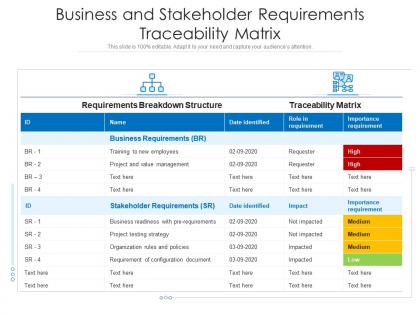
Business and stakeholder requirements traceability matrix




Try Before you Buy Download Free Sample Product
 Impress Your
 Audience
 100%
100% Editable
 Save Hours
 of Time


Our Business And Stakeholder Requirements Traceability Matrix are topically designed to provide an attractive backdrop to any subject. Use them to look like a presentation pro.
People who downloaded this PowerPoint presentation also viewed the following :
Business and stakeholder requirements traceability matrix with all 2 slides:
Use our Business And Stakeholder Requirements Traceability Matrix to effectively help you save your valuable time. They are readymade to fit into any presentation structure.
FAQs for Business and stakeholder
A Traceability Matrix basically maps out how your requirements connect to test cases and deliverables. Think of it as your safety net - shows that every requirement gets tested and every feature actually serves a purpose. Look, maintaining one feels like a pain sometimes, but trust me on this. When audit time comes or your boss suddenly asks "remind me why we're building this?" you'll be so glad you have it. I learned that the hard way on my last project. Just start with a simple spreadsheet linking requirements to tests. Don't overthink it. You can always add more detail later as things get more complex.
So basically a traceability matrix is like your insurance policy for audits. Map every requirement to your test cases and deliverables - auditors love seeing this stuff documented. Think of it as keeping receipts for everything you did. When someone comes asking "did you actually test requirement X?" you can point right to it. The whole point is proving you didn't skip anything important. Oh and definitely keep it updated as you go - I learned that one the hard way when mine got completely out of sync halfway through a project. Makes audit time way less stressful.
Honestly, it's like having a cheat sheet that stops all those annoying "what happened to that feature we talked about?" emails. Clients can actually see how their requests turned into real stuff, which is pretty satisfying for everyone. Developers get why they're building things too - no more random tasks appearing out of nowhere. The visual part makes it obvious when something's missing or changed. Oh, and keep stakeholders in the loop so they can check it themselves instead of bugging you every five minutes. Trust me, it saves so many headaches.
Start with the basics - requirement IDs, test case IDs, and how they map together. Add requirement descriptions and test case names so people actually know what they're looking at. Execution status is clutch for tracking progress. I'd throw in priority levels too, honestly makes a huge difference when you're drowning in work and need to know what matters most. Defect IDs help if bugs come up. Coverage metrics are solid for reporting. Oh, and maybe testing phases depending on your project. Just don't go overboard initially - you can always add more columns later.
Honestly, treat it like a living document that gets updated whenever requirements, design, or test cases change. During the early phases you'll be in there almost daily - sometimes feels like overkill but it saves you later. Testing phase gets crazy with multiple updates per week as bugs pop up and things shift around. The trick is building it into your normal routine instead of letting it pile up. I learned this the hard way after ignoring mine for a month once. Set up some kind of reminder system so you don't forget about it completely.
Ugh, the manual work alone will drive you crazy. Requirements change constantly and you're stuck updating all those links between them and test cases - it's such a mess. Incomplete requirements are the worst because how do you even trace something that's half-baked? Getting your team to actually maintain it consistently? Good luck with that one. Oh, and the volume of connections gets overwhelming fast. Start small though - just tackle critical requirements first. Find a tool that handles some linking automatically, otherwise you'll burn out. Make sure someone actually owns it or it'll just become another dead spreadsheet collecting digital dust.
Yeah, you can definitely do traceability matrices in Agile! Just make them way lighter than the traditional waterfall monsters. Map your user stories to acceptance criteria, then connect those to test cases as you build. Update it each sprint instead of trying to nail everything upfront - that never works anyway. Excel or Jira work fine, nothing fancy needed. Sure, it feels like more paperwork, but trust me, it's a lifesaver when stakeholders start grilling you in sprint reviews about what got missed. Keep it simple and let it grow with your sprints.
So basically, software traceability connects requirements to test cases and code - you're tracking how features move through development. Manufacturing is totally different though. You're tracing actual physical stuff like parts, materials, and where they came from. Software cares about functional relationships, manufacturing cares about compliance and provenance. Both save you from that nightmare scenario where something breaks and nobody knows why (been there!). The key is figuring out what you actually need to track first. Are you following logic flows or physical components? That'll determine your whole approach.
Honestly, Excel's still huge for this stuff since everyone already knows how to use it. But if you're dealing with anything complex, tools like Jira or Azure DevOps will save you so much headache. DOORS is solid too, though kinda pricey. Requirements management tools like Helix RM handle the bidirectional tracing thing really well - that's where you can trace both ways between requirements and tests. Oh, and if you're already doing agile, check what traceability features your current project management tool has first. Here's the thing though: doesn't matter how fancy the tool is if your team won't actually use it consistently.
So basically, a Traceability Matrix is like your insurance policy against testing disasters. It maps requirements to test cases so you can see what's actually being tested and what isn't. Super boring to maintain, but trust me - it'll save your ass when things go sideways. You can spot gaps before they become problems, figure out which tests to run first based on business impact, and when requirements change (they always do), you'll know exactly what needs retesting. Just don't let it get stale or it's useless.
So basically a Traceability Matrix maps your requirements to test cases - think of it like a checklist that shows what you've actually tested. Nothing slips through the cracks this way. When stakeholders start asking "wait, did we test feature X?" you can just point to your matrix instead of panicking. Honestly, it's a lifesaver during audits too. The key thing? Don't wait until the end to build it - I learned that the hard way on my last project. Keep updating it as you go and you'll thank yourself later. Makes the whole testing process way more organized.
So traceability matrices are actually pretty clutch for catching gaps early on. You map each requirement to business goals, stakeholders, and test cases - boom, you instantly see what's missing or doubled up. Think of it as a smart checklist that does the thinking for you. When stakeholders see their needs connected to real outcomes, they give way better feedback during those analysis meetings. Forces you to be systematic instead of just randomly collecting stuff (which honestly happens more than we'd like to admit). Build it during your first stakeholder interviews - trust me, it'll save you so much rework down the road.
Heat maps are your best bet for presentations - way better than boring tables. The color-coding makes gaps super obvious. I usually stick with Excel's conditional formatting since most people have it, but Lucidchart's pretty solid too if you want something fancier. Swimlane diagrams work well when you need to show flow between requirements and test cases. Don't dump everything on them though. Pick the critical stuff - coverage gaps, risky areas, whatever needs fixing. People's eyes glaze over with too much detail. Keep it focused and they'll actually pay attention to what matters.
So traceability matrices are basically your safety net when things go sideways. They map out which test cases and design docs connect to each requirement - super handy when requirements change (which, let's be real, happens constantly). Instead of scrambling around trying to figure out what broke, you can just follow the trail. Think of it like a family tree but for your project stuff. You'll spot version changes fast and update everything that's connected. The trick is keeping it current though - don't just set it up once and forget about it. Start with something basic like requirements-to-tests if you're just getting into this whole thing.
Honestly, get your team into hands-on workshops first - they need to actually build these matrices with real requirements, not just talk about it. Too many people think it's just busywork if they don't understand why traceability matters in the first place. Train them on the stuff they'll actually face: requirement changes, creating test cases, impact analysis. Oh, and give them good templates plus naming conventions so they're not reinventing the wheel every time. Pick a few traceability champions per project who can help others and spot problems before they get messy.
-
Visually stunning presentation, love the content.
-
The Designed Graphic are very professional and classic.
-
Awesome presentation, really professional and easy to edit.