

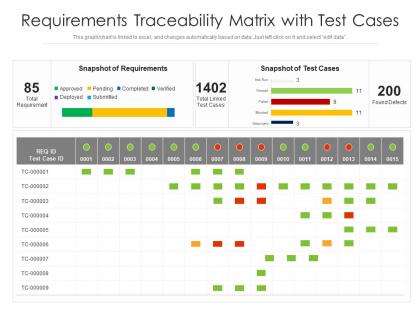
Requirements traceability matrix with test cases




Try Before you Buy Download Free Sample Product
 Impress Your
 Audience
 100%
100% Editable
 Save Hours
 of Time


Our Requirements Traceability Matrix With Test Cases are topically designed to provide an attractive backdrop to any subject. Use them to look like a presentation pro.
People who downloaded this PowerPoint presentation also viewed the following :
Requirements traceability matrix with test cases with all 2 slides:
Use our Requirements Traceability Matrix With Test Cases to effectively help you save your valuable time. They are readymade to fit into any presentation structure.
FAQs for Requirements traceability matrix
So requirements traceability is just following each requirement from when someone first thinks of it all the way through building and testing it. Why bother? Well, you can work backwards from any feature to figure out why it even exists, or go forward from a requirement to see what actually got built. Honestly, it's saved my butt so many times when stakeholders ask "wait, why does this work like that?" months later. Also helps when requirements change - and trust me, they will. I'd start with something dead simple, like a basic spreadsheet linking requirements to your design docs and test cases. Don't overcomplicate it at first.
Oh man, requirements traceability is a lifesaver. You can literally trace each requirement from start to finish - design, code, testing, the whole thing. Catches all those nasty gaps before they bite you in the ass. Like when you're halfway through development and realize nobody actually built that key feature the client wanted? Yeah, this prevents that nightmare. It's basically your early warning system for scope creep and contradictory requirements. I learned this the hard way on a project last year. Bottom line: you'll spot problems early instead of panicking right before launch when it's way too expensive to fix anything.
JIRA's probably your best bet - most people use it and the linking between requirements and test cases works pretty well. Azure DevOps is solid too if you're already doing Microsoft stuff. There's also specialized tools like Polarion or codeBeamer, though DOORS is getting pretty dated at this point. I mean, you could even use a spreadsheet for small projects but that gets messy fast. The key thing is finding something that actually plays nice with whatever dev tools you're using. Oh, and make sure it enforces those links instead of just storing them - trust me on that one.
Think of requirements traceability as your safety net when auditors show up. You can point directly from each requirement to your design choices, tests, and verification work. Trust me, teams without this are basically dead in the water during reviews - I've watched it happen and it's not pretty. Standards like ISO 26262 actually require traceability matrices because they prove you covered everything systematically. My advice? Set these up from day one. Don't wait until crunch time to backfill all that documentation.
Set up your traceability stuff from the very beginning - like, before anyone touches code. Pick a simple numbering system for requirements first. Tools matter but honestly? A decent spreadsheet that everyone actually uses beats some expensive software that sits there collecting dust. Make templates that force people to link back to parent requirements when they're building new stuff. The trick is baking this into your normal process instead of treating it like some annoying extra step. Oh, and set up reports that automatically flag missing connections - trust me, you don't want to be hunting for those links when audit time rolls around.
Honestly, the worst part is dealing with tool chaos - everyone's using different stuff that doesn't sync up. Plus people absolutely hate doing extra documentation (and who can blame them really?). Requirements keep shifting too, so you're constantly updating traces. Start with a small pilot project first. Pick one tool that actually works for everyone instead of trying to force compatibility. I'd make traceability part of your "done" criteria so it's not optional anymore. The key is showing your team how it catches bugs early rather than just creating more work. Oh, and automate those links wherever you can - saves tons of headaches later.
Think of traceability matrices like a really useful spreadsheet that maps your requirements to design stuff, tests, and deliverables. You'll instantly see what's covered and catch gaps early. When requirements change, you know exactly what needs updating downstream - no more "oh shit, forgot the tests" panic moments. Honestly, they're way more helpful than they sound on paper. Start basic with requirement-to-test mapping. Build from there as your project gets messier (and it will). Pretty much saves your butt during audits too.
Ugh, bad traceability will wreck your project. When requirements change (which they ALWAYS do), you can't figure out what else breaks. Testing becomes impossible - how do you even know if you covered everything? Then there's scope creep because nobody knows what's actually needed vs just wanted. Honestly, stakeholders get super annoyed when they can't track progress against what they originally asked for. I know setting up a traceability matrix feels boring at first, but do it early. You'll thank yourself later when things inevitably get messy.
So basically, your CI/CD pipeline becomes this automatic tracker that connects code changes back to specific requirements. Pretty neat, right? When you commit something, the pipeline checks if it actually meets the requirement and doesn't break other stuff. Your builds can tag releases with requirement IDs and run tests tied to user stories. Here's what I'd do - set it up so builds fail when those traceability links are missing. Sounds harsh but it'll force everyone to document better. You get reports showing which requirements made it into each deployment too.
Look, Waterfall wants everything mapped out upfront - your requirements linked to design docs, test cases, the works. Big traceability matrices that show how it all connects. Agile's way more chill about it. You just do user story mapping and link stories to epics in whatever tool you're using. Oh, and acceptance criteria obviously. The main thing is Waterfall traces backwards from what you built, Agile traces forward from what users need. Honestly though? Just pick whatever your team will actually keep up with. Perfect documentation that gets ignored after week one is pretty much pointless.
So basically, traceability is a lifesaver for change management. You can see exactly what gets affected when requirements shift - no more digging through endless docs trying to figure out what breaks. A stakeholder wants changes? Just follow the links to spot which design pieces, tests, and code need tweaking. Super helpful for estimating real costs too before you say yes to anything. Oh and definitely build your matrix early - I learned that one the hard way. Keep updating it or you'll hate yourself later when everything's out of sync.
Dude, AI is seriously a lifesaver for requirements traceability. It'll automatically find connections between your requirements, code, and tests - saves you from manually hunting through endless spreadsheets (ugh). Real-time trace matrices are clutch, plus you get instant impact analysis when stuff changes. The AI can spot requirement conflicts before they bite you and catch coverage gaps too. Only catch is your requirements need to be clean going in. Messy input = messy results, you know? I'd honestly start with whatever plugs into your current ALM setup. Way less headache that way.
So traceability is basically your way of showing stakeholders exactly how their requests turned into actual features. No more vague "we're working on it" updates - you can point to specific stuff and say "this addresses what you asked for." Honestly, it's a lifesaver when people start questioning decisions later. You'll catch when different groups want totally opposite things too, which happens more than you'd think. The trust factor is huge because they see their input actually mattered. My advice? Start small with just the critical requirements. Don't go crazy trying to trace everything right away.
Honestly, you can't do decent testing without traceability - they're totally connected. Map your test cases back to requirements so you can see what's actually covered. You'll probably find some weird gaps where nobody's testing certain stuff. When requirements change (which happens constantly), you know exactly which tests need fixing. I always do this before releases because otherwise you're just guessing if everything got tested. Pro tip: start by going backwards from your current test cases to requirements. It's kind of tedious but you'll catch things you missed. Trust me on this one.
So for measuring traceability, I'd start with coverage - like what percentage of your requirements actually connect to code and tests. Time how long impact analysis takes too, because that's where you really feel the pain. We used to waste so much time on that stuff! Count defects that slip through when traceability sucks. Survey your team about whether the trace links actually help them or just feel like busywork (spoiler: it's often busywork). The gold standard is answering "what breaks if we change this?" in under 5 minutes. Pick 2-3 metrics max though - don't overcomplicate it.
-
It saves your time and decrease your efforts in half.
-
Perfect template with attractive color combination.