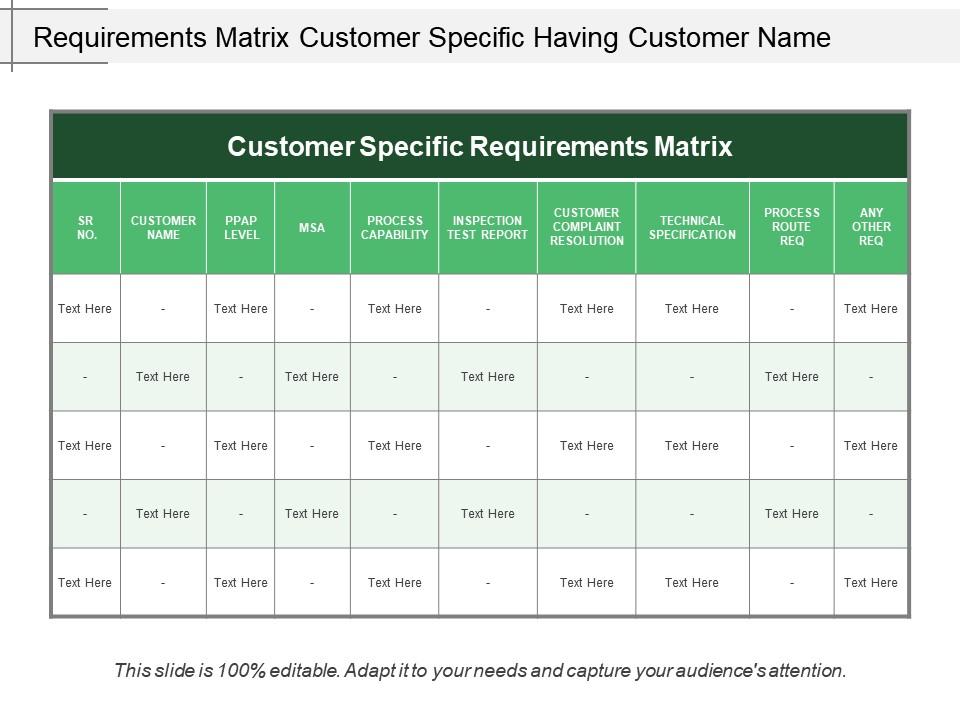
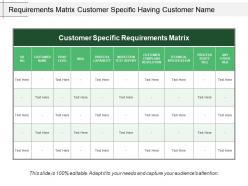
Requirements matrix customer specific having customer name

Rating:
100%
Requirements matrix customer specific having customer name
Slide 1 of 5
Favourites Favourites

Try Before you Buy Download Free Sample Product

Audience Impress Your
Audience
Editable 100%
Editable
Time Save Hours
of Time
The Biggest Sale is ending soon in
0
0
:
0
0
:
0
0
Rating:
100%
Presenting this set of slides with name - Requirements Matrix Customer Specific Having Customer Name. This is a nine stage process. The stages in this process are Requirements Matrix, Needs Matrix, Requirements Table.

People who downloaded this PowerPoint presentation also viewed the following :

FAQs for Requirements matrix customer specific

Think of a Requirements Matrix as your project's master tracker - it's basically a spreadsheet that connects what stakeholders want to what you're actually building. Maps requirements to deliverables, test cases, all that stuff. Honestly, it's a lifesaver when clients start adding random features mid-project. You can point right to the matrix and show what's in scope vs. what isn't. Plus testing becomes way less chaotic since you can trace everything back to the original requirements. My advice? Build it early and don't let it get stale - update that thing regularly or it becomes useless pretty fast.

Honestly, a Requirements Matrix is just a fancy way to keep everyone on the same page. You map out each requirement with who wanted it, how important it is, and what "done" actually looks like. Super helpful when stakeholders start arguing later (and they will). I update mine after big meetings - probably overkill but whatever works, right? The best part? When someone tries to sneak in new features, you can literally point to what was agreed on originally. It also shows you which requirements clash with each other before things get messy.

So you'll need the basics first: unique IDs for each requirement, clear descriptions, and priority levels. Traceability links back to source docs are crucial too. Don't skip the owner/responsible party info and status tracking. Acceptance criteria for each one is huge - saves so many headaches later. I'm obsessed with adding "last updated" fields because stakeholders will definitely bug you about changes. Verification methods and dependencies between requirements matter too, though honestly the dependency mapping can get messy fast. Start with simple columns and build from there as things get more complex.

Honestly, a Requirements Matrix is a game-changer for getting everyone aligned. You know how projects always have those awkward moments where someone goes "wait, that's not what I meant"? This kills that completely. Developers, business people, stakeholders - they can all look at the same visual breakdown and actually understand what's happening. No more digging through random emails or docs scattered everywhere. Everything's mapped out clearly: what needs building, who owns what, how it all fits together. I started using one last quarter and wow, meetings move so much faster now. Pull it up first thing and watch how quickly decisions happen.

Start with clear, testable requirements - give each one a unique ID. Skip the fuzzy stuff like "user-friendly" because honestly, what does that even mean? Your matrix shouldn't be crazy complicated. Stick to the basics: ID, description, priority, source, status. I've watched teams create these monster spreadsheets with a million columns that nobody wants to touch. Get everyone involved upfront to spot what's missing. Keep updating it throughout the project - it's not a set-it-and-forget-it thing. Oh, and use a shared tool instead of hiding it in someone's Excel file.

So basically, a Requirements Matrix is like a master checklist that maps each requirement to deliverables and shows if they're done, in progress, or stuck. Super helpful for seeing the big picture at a glance. You can track dependencies too - which is clutch because then you'll know if one delay is gonna mess up everything else. Honestly, the best part is during those status meetings when people ask "where are we?" Instead of scrambling with vague answers, you just point to real data. Just make sure you set it up early and actually keep it updated (otherwise it's useless).

Honestly? Just start with Excel or Google Sheets - I know it sounds boring but most PMs I work with still live in spreadsheets anyway. They're stupidly flexible for this stuff. If your project gets massive or you're dealing with crazy complex traceability, then look at Jira, Azure DevOps, or IBM DOORS. There are also specialized tools like Modern Requirements that have matrix features built right in. My take is don't overthink it initially. Use whatever your team already knows, then switch later if you're spending half your day wrestling with manual updates and version nightmares.

So basically a requirements matrix is like putting all your stuff in a spreadsheet grid instead of those endless Word docs that become a nightmare to navigate. You can map each requirement against things like priority or test cases - makes spotting dependencies way easier. Traditional docs? Just walls of text that you're constantly searching through. With the matrix you can actually filter and sort things, which honestly saves so much time. I always tell people to start simple though - just throw it in Excel first and see how it feels. Way better than scrolling through pages trying to find that one requirement you wrote three weeks ago.

Think of a Requirements Matrix as your project's early warning system. It shows you which requirements are make-or-break critical and helps spot those sneaky dependencies that'll wreck your timeline if you miss them. When stakeholders start asking for changes (spoiler: they will), you can quickly see what else gets affected. I've found it's super helpful for figuring out where requirements clash or have gaps - then you know where to focus your energy instead of stressing about everything. Just don't let it get stale or it's useless.

Honestly, just bake it into your normal routine instead of treating it like this separate thing you'll "get to later." Get alerts set up for when source systems change. Have someone check the matrix weekly - seriously, this stuff gets buried if nobody owns it. Monthly reviews with stakeholders help too, though those meetings can drag on forever. Link everything to your project milestones so updates happen naturally as you hit deadlines. Oh, and tell people they can flag changes right away rather than waiting for the formal review stuff.

Oh totally! Works great with both actually. Waterfall's pretty straightforward - you build the matrix early and track everything through each phase. Agile gets trickier since requirements are always changing, but that's honestly where you need it most. I've watched so many Agile teams lose track of stuff without one. Requirements just spiral out of control. The trick is keeping it simple and actually updating it regularly - especially when you're dealing with shifting user stories and sprints. Don't overcomplicate it though, or you'll spend more time maintaining the matrix than using it.

Don't get too detailed with your matrix or you'll get lost in the weeds. Focus on the big stuff that actually moves the needle. I've watched people create these insane many-to-many relationships that nobody can figure out later - total nightmare. Keep owners clear for each requirement. Update it when things change (and they will). Honestly? I've seen teams spend more time fiddling with the matrix than doing actual work. Review it in your regular meetings but don't overthink it. Simple beats complex every time.

Think of a Requirements Matrix like a checklist that connects what people want to what you're actually building. It's super helpful for catching scope creep - when someone asks for something new, you can point to the matrix and show how it fits (or doesn't). Your stakeholders have to get specific about their requests too, which honestly saves everyone headaches later. Each requirement gets tied to clear success criteria, so your team knows when they're actually done with something. Just start simple: list your requirements, then add columns for deliverables, who owns what, and how you'll measure success.

Don't just email them a spreadsheet and hope for the best - that's where most people mess up. Get everyone in a room (or Zoom) from the start and actually build the requirements together. Whiteboards work great for this. Do some one-on-one interviews first to understand what's really bugging them, then bring the group together for workshops. I'd assign different people to own specific sections so they actually care about the outcome. Regular check-ins are clutch too. The whole point is making them part of the process instead of just reviewers at the end.

Look, simple projects can totally get away with just requirement ID, description, and status - I actually miss those straightforward days sometimes. But once things get messy? You'll need to add priority levels, dependencies, risk stuff, maybe even links to your design docs. Complex projects are where you start needing cross-references between requirements and impact analysis columns. Honestly, some teams even split into separate matrices for different subsystems or stakeholder groups - which sounds like overkill but it works. My advice: start basic and only add the extra layers when you're drowning without them.

Ratings and Reviews

100% of 100
Write a review
Most Relevant Reviews
  1. 100%

    by Edmund Ortega

    It saves your time and decrease your efforts in half.
  2. 100%

    by Derek Mills

    Very unique, user-friendly presentation interface.

2 Item(s)

per page: