


Seven process of consulting methodology




Try Before you Buy Download Free Sample Product
 Impress Your
 Audience
 100%
100% Editable
 Save Hours
 of Time


Give equal attention to advantages and disadvantages with our Seven Process Of Consulting Methodology. It initiates the debate for change.
People who downloaded this PowerPoint presentation also viewed the following :
Content of this Powerpoint Presentation
Consulting is a glamorous industry. There is a halo around consultants as they are seen turning companies around. Yet, ask any successful consultant the secret to his success, and the answer will be processed and their strict adherence.
For decision-makers, it is wise to download this six-step consulting methodology and approach here for a great experience with the client.
It is like following a good diet and staying healthy; it is boring but very profitable in terms of results. Consultants know this very boring process is the secret to their riches.
Businesses in the consulting domain, however, can sometimes stray from the process. To remind them of it, SlideTeam has curated this seven-step consulting methodology template. The idea is to ensure that this process is clear to all stakeholders through this wonderful PPT Template.
This template showcases your in-depth knowledge of the consulting process and how to communicate it through our clutter-free tool. Even better, each template is 100% editable and customizable, providing you with structure, a starting point, and the capability to tailor the presentation to the audience profile.
Find the best-in-class template on the six steps of consulting methodology here.
Let’s explore these templates now!
Template 1 Seven-step Process of Consulting Methodology PPT Template
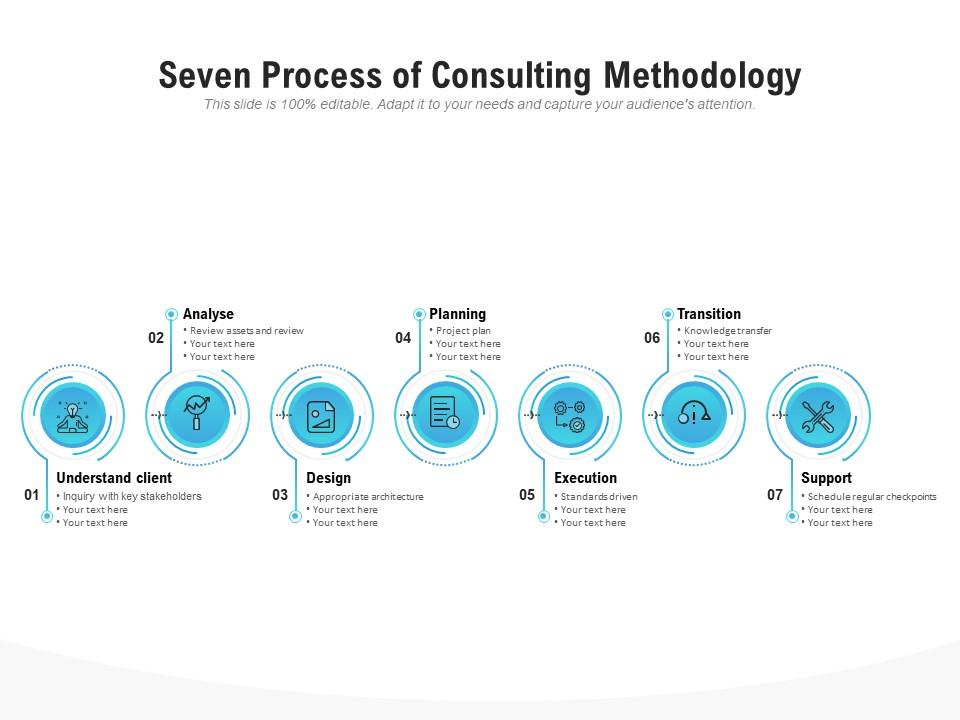
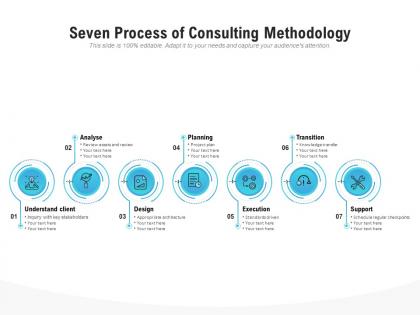
This is a ready-made PowerPoint Template to help you clarify and implement a seven-step process of consulting methodology. Incorporate this professionally done, clutter-free, and appealing PPT Slide to monitor activities involved in consulting. This PPT Diagram showcases key consulting processes, such as understanding the client; this is the first step. Then, businesses in consulting need to perform steps such as analysis, design, planning, execution, and transition. The last and the seventh steps are listed as supporting. This flexible PPT Template also outlines the tactical and practical strategical tasks that need to be undertaken within each of the seven steps. This is a content-ready diagram showcasing seven steps in consulting, along with the associated tasks. For instance, in the 3rd consulting process of design, the slide advises that an appropriate architecture for the consulting solution be devised. Deploy this pre-designed PowerPoint Template to help businesses stay on top of their game. Use this professional and appealing slide to improve the benefits and results that your consulting provides to the business community. Download now!
PROCESS EASES WAY
Usually, businesses fall off the success road because they stray from a process in search of quicker profits. The solution, then, is to follow another process that eases the way. Without processes, companies risk being forever in experimentation mode.
PS The business process of consulting methodology is a great product to add to your consulting presentation library.
Seven process of consulting methodology with all 2 slides:
Initiate the deliberations with our Seven Process Of Consulting Methodology. Give equal consideration to all arguments.
FAQs for Seven process
So basically there are four main steps most consultants use. First, figure out what problem you're actually trying to solve - seriously, don't skip this or you'll hate yourself later. Then gather data through interviews and research. After that, develop your recommendations and test them with people. Finally, map out how to actually implement everything with timelines and metrics. Oh, and you'll probably bounce between these steps as you learn new stuff - it's not really linear. The problem definition part is honestly the most crucial though.
Dude, spend way more time upfront figuring out their industry and what's actually broken. Cookie-cutter stuff is trash - I learned that the hard way. Some clients want you drowning them in spreadsheets and data, others just want to build something fast and see what happens. Big corporations? They need everything mapped out because they move like glaciers. Startups will pivot tomorrow if you tell them to. Oh, and always ask what winning actually looks like for them specifically - sounds obvious but you'd be surprised how many people skip that. Stay flexible with your methods but don't compromise on solving the real problem.
Honestly, data analysis is what separates real consulting from just winging it with fancy PowerPoints. You'll want to use it for diagnosing problems and backing up whatever you recommend - clients get pretty annoyed when they're paying big money for gut feelings. The insights you find should actually shape which frameworks make sense and how you prioritize everything. Plus it helps you avoid that one-size-fits-all trap that makes you look lazy. I always tell people to start with collecting data first, then let what you discover guide your whole approach. Way better than the other way around.
Dude, technology is a game-changer for consulting. AI tools can spot patterns in huge datasets in hours instead of weeks - honestly saves your sanity. Real-time collaboration platforms kill those nightmare email threads with clients. I've seen people use automated surveys and predictive analytics to deliver way better insights faster. Project management tools keep the chaos organized too. Oh, and visualization software makes your findings actually look professional instead of like a college PowerPoint. Just don't go crazy adopting every shiny new tool - pick what actually fixes your biggest headaches.
Honestly, the worst thing you can do is over-engineer everything when a simple fix would work fine. Consultants get obsessed with their pretty frameworks - guilty as charged lol. But here's what really kills projects: using the exact same approach for every client instead of actually reading the room. Each company has different politics and constraints, you know? Start by really understanding their specific mess before you pull out any tools. Don't get so wrapped up in looking brilliant that you forget what problem you're solving. Stay flexible and remember there are actual humans involved, not just org charts.
Honestly, it's all about reading the room with different industries. Pharma and finance are super buttoned-up - they want waterfall methods with documentation for everything (regulatory stuff, you know?). Tech companies are the opposite. They're all about agile since they pivot constantly. Manufacturing is obsessed with Lean Six Sigma because they genuinely live for process optimization. Creative industries? They respond way better to design thinking approaches. You can't just force your go-to framework on everyone. Match what you're doing to how they actually make decisions and operate day-to-day.
Start by figuring out who actually has power and influence in your situation - that's your stakeholder map. One-on-one interviews give you the real dirt, way better than group settings where people hold back. Workshops are solid for getting everyone on the same page. Coffee chats though? That's where the magic happens - people say what they really think when it's casual. Surveys help when you can't talk to everyone individually. Focus groups catch problems early before they blow up. Just make sure people see you're actually using their feedback, otherwise they'll stop caring. Match how you reach out to how each person likes to communicate.
Honestly, I'd set clear metrics from day one, then check back in 3-6 months to see what actually happened. Track the numbers (revenue, costs, efficiency) but also do follow-up calls with the main people involved. Send out a survey too - you'd be shocked how honest people get about what really worked vs. what just sounded nice in meetings. The juicy stuff is figuring out which parts of your approach created real change and which recommendations basically got ignored once you walked out the door. That's pure gold for your next project.
First things first - protect client confidentiality and watch out for conflicts of interest. Don't collect data you don't actually need, and avoid any manipulative tricks to get the results you want. Be upfront about where your methodology might fall short or have blind spots. Cultural differences matter a lot, especially if you're dealing with teams across different regions (learned that one the hard way). Build in some ethics check-ins as you go so you can pivot if something feels off. Oh, and respect different perspectives - people hate finding out later that you had hidden assumptions baked into your approach.
So each project becomes a learning opportunity, right? You finish one, then sit down with your team and clients to figure out what bombed and what actually worked. Document everything though - seriously, I learned this the hard way. Your brain will forget the details. It's basically like iterating on code but for your whole process. Next project rolls around and you adjust based on what you discovered last time. Keeps making your approach stronger since you're testing it against real situations constantly. Oh, and keep those retrospective notes simple - overcomplicated logs just get ignored.
Okay so visual aids are basically what save your ass in consulting - they make everything look way more professional than it actually is. Flowcharts help you map out steps without missing anything obvious. Those 2x2 matrix frameworks? Total lifesaver for breaking down complex analysis. Templates keep all your deliverables looking consistent, which honestly makes you seem way more put-together than you might feel. Clients love seeing visual stuff because they can actually follow your thinking process. I'd start with maybe 3 solid templates for whatever you do most often, then just add more as you go. Trust me on this one.
Document stuff as it happens, trust me on this one. I once had to reconstruct entire client meetings from memory weeks later and it was a nightmare. Make templates for discovery, analysis, all that - then actually use them during meetings, not after. Screenshots, notes, where you got your data from - save everything because clients always circle back asking "wait, why did we choose this approach?" File naming matters too, apparently my old system made zero sense to anyone else. Oh and set up that shared folder structure right away so your team isn't constantly hunting for files.
Don't wait until the end to get feedback - that's where everyone screws up. Build it in from day one with quick check-ins during discovery calls. Set up regular touchpoints with stakeholders throughout (not just at major milestones). Make it feel conversational, not like you're giving them homework. I always tell clients upfront that I'll be bugging them for input frequently - sets the right expectations. Here's the key part though: actually show them how their feedback changed your recommendations. Otherwise they'll think you're just going through the motions.
So prescriptive is basically following a strict playbook - you map everything out first, then execute. Waterfall style. Adaptive? Way more flexible. You start with your best guess, test stuff out, then change course based on what actually happens. Honestly, prescriptive works well when the problem's pretty straightforward or you're in industries where you can't really deviate much (think compliance stuff). Adaptive's better for messy, complicated situations where your client might not even know what their real problem is yet. I'd go with whatever matches how comfortable they are with uncertainty and whether you've got time to iterate.
Honestly, don't force everyone into the same box - it never works anyway. Your finance team probably loves their waterfall planning while devs are all about agile sprints. That's totally fine! Just create connection points where they meet up, like syncing waterfall milestones with agile releases. You could even switch who leads based on what phase you're in. Map out what each team actually prefers doing, then figure out the handoff spots. Everyone stays happy in their zone but you're still hitting the same target. Way less drama than trying to make accountants think like programmers.
No Reviews