


Process Evaluation Checklist For Business Analyst




Try Before you Buy Download Free Sample Product
 Impress Your
 Audience
 100%
100% Editable
 Save Hours
 of Time


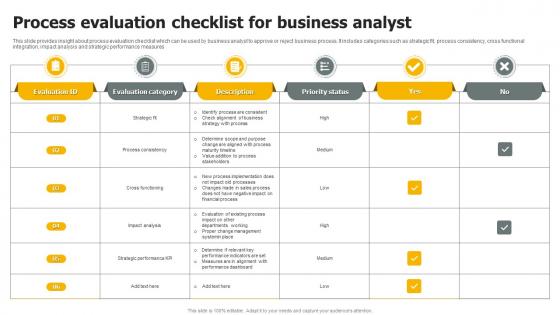
This slide provides insight about process evaluation checklist which can be used by business analyst to approve or reject business process. It includes categories such as strategic fit, process consistency, cross functional integration, impact analysis and strategic performance measures.
People who downloaded this PowerPoint presentation also viewed the following :
Process Evaluation Checklist For Business Analyst with all 6 slides:
Use our Process Evaluation Checklist For Business Analyst to effectively help you save your valuable time. They are readymade to fit into any presentation structure.





FAQs for Process Evaluation Checklist
Figure out what the process is actually supposed to do first. Interview the people who run it and the ones who use it daily - they'll give you the real story, not the official version. Map out the main business goals like cutting costs or making customers happier. Secondary objectives matter too since they usually show you where things are broken. Honestly, half the time stakeholders think they know what their process does but they're completely wrong! Document what they say it should do, then figure out what's really happening. That gap is usually where you'll find your biggest wins.
Start by figuring out everyone who's involved in each step - people giving inputs, doing the work, getting outputs, making decisions. The "invisible" ones are tricky though - like managers who sign off on stuff, IT people maintaining systems, customers getting affected. I always do a quick RACI matrix to see it visually. Walk through everything end-to-end and keep asking "who else gives a damn about this part?" Interview some key players too since they'll mention people you totally missed. Document names and roles as you go - you're gonna need their input later for the actual evaluation anyway.
Honestly, I'd start by getting baseline numbers before changing anything - otherwise you're just shooting in the dark. Track efficiency stuff like cycle time and how well you're using resources. Quality matters too - error rates, customer satisfaction, that kind of thing. Business impact is obvious (cost savings, revenue bumps). But here's what people forget - adoption rates are huge. Doesn't matter how brilliant your process is if nobody actually follows it. Pick maybe 3-5 metrics that your stakeholders genuinely care about, not just whatever's easiest to track. Focus on things that directly connect to what the business is trying to accomplish.
Quarterly reviews are usually a good starting point. But honestly, it really depends on how much your stuff changes. Monthly makes more sense if you're constantly updating processes or rolling out new tech. For stable processes that don't change much? Maybe every 6 months works fine. Don't stress too much about perfect timing - consistency matters more. You'll also want to do random check-ins whenever things go sideways. Like when performance tanks or customers start complaining more than usual. Oh, and definitely after any big system updates. Start quarterly and see how it feels for your situation.
Start with mapping your current process - that's always step one. LEAN Six Sigma is solid for spotting waste, and Visio or Lucidchart work great for visualizing everything. Value stream mapping gives you the big picture view you need. Honestly, stakeholder interviews are underrated - they catch stuff that spreadsheets totally miss. Time-motion studies too. Process Street or Monday.com are decent for tracking your progress (though Monday can be kinda clunky sometimes). Don't try using every methodology at once though. Pick what actually fits your specific problems and go from there.
Mix up how you collect feedback - do some formal surveys and interviews, but also grab people during coffee breaks or random team meetings. Honestly, the casual conversations are where you'll get the real tea because people drop their guard. Keep track of everything in one place so you can see patterns emerging. Once you've gathered input, circle back and tell people what you heard - they appreciate knowing their voice mattered. Oh, and spread this out over time instead of cramming it all into one week. People get feedback fatigue pretty quickly.
Dude, process evaluation is a game-changer for finding all the stuff that's secretly killing your business. Map out your workflows and you'll be shocked at the waste - like, people doing the same task twice or work sitting around for days. I always tell people to start with their biggest processes first since that's where the money is. Once you clean up the bottlenecks and cut the useless steps, everything moves faster and costs less. Your team stops fighting with stupid workflows too. Honestly, most companies have way more hidden inefficiencies than they realize.
Honestly, stakeholder pushback is the worst part. Nobody wants someone poking around "their" system, you know? Plus half the time the data you get is garbage - what's actually happening looks nothing like what's written down. Time pressure sucks too since you're racing to map everything while the business keeps running. Oh, and don't get me started on documentation - it's either from 2019 or doesn't exist at all. Build relationships first though, that's key. Watch what people actually do instead of just trusting what they tell you.
Set up your evaluation framework first - don't wing it halfway through. Stick to hard data and what you can actually document, not gut feelings. Get other people involved too, seriously saves you from missing obvious stuff. I learned that one the hard way lol. Timestamps and sources for everything so you can trace back your findings later. Oh and definitely cross-check your conclusions with different data points. Having someone else review your critical findings isn't optional either. The whole point is separating what you observe from what you think about it.
Okay so documentation is literally your lifeline when evaluating processes. I learned this the hard way after watching a project completely crash because nobody bothered writing anything down. You'll want to capture current workflows, where things break, your metrics, and whatever fixes you're suggesting. Make it detailed enough to actually help people but not so boring that everyone ignores it. It's proof when someone questions your findings later - and trust me, they will. Oh and start documenting right away, not at the end when you've forgotten half the important stuff.
Here's what I've learned from doing this stuff - process evaluation basically gives you a cheat sheet for next time. You get to see exactly where things went sideways and what actually worked. Most teams just jump into the next project without looking back, which is honestly kind of crazy? The bottlenecks you find become your advantage later. Like, maybe you'll discover your team always underestimates design phases or that certain workflows just don't scale. Use those insights to build better timelines and stronger cases for resources. It's way better than crossing your fingers and hoping.
Don't jump into solutions right away - huge mistake I see constantly. Talk to the people actually doing the work first, they know stuff you don't. Those "weird" processes usually exist for reasons nobody documented properly. I learned this the hard way honestly. Focus on what's really happening, not some perfect textbook version. Document everything too because your brain will dump the details in like two weeks. Oh, and ask a ton of questions before you even think about fixing anything. Start with just watching and listening.
Look for whatever's causing you the most pain right now - angry customers, money getting stuck somewhere, or stuff that has your boss stressed out. I like making a quick chart: business impact vs how hard it'll be to fix. Go for the easy wins first! Processes that cross multiple departments are gold because fixing one thing helps everywhere. Honestly though, don't overthink the perfect order. Just pick your top 3-5 based on what hurts most and what'll move the needle business-wise. You can always pivot once you get going and see what actually works.
Honestly, start simple with like 3-4 key metrics instead of going overboard. Cycle time is huge - basically how long each process takes start to finish. Then track your throughput (how much you're cranking out) and error rates. Cost per transaction is gold because executives eat that stuff up when they see savings. Oh, and definitely check resource utilization so you know if your team's actually swamped or just feels like it. Customer satisfaction scores matter too if customers are involved. Quality stuff like rework rates - nobody wants to do things twice. Pick metrics that actually match what your business cares about, then expand once you've got solid data to work with.
Tech will totally change how you handle process evaluation - just automate the data stuff first. Process mining tools show you what's actually happening vs what you think is happening (always eye-opening tbh). Real-time dashboards beat waiting around for monthly reports any day. Oh and those workflow simulation tools? They'll save your butt from expensive screwups before you roll anything out. I'd honestly just pick one manual task you're doing right now and find a tool to handle it automatically. Once you see how much time it saves, you'll want to automate everything else too.
-
Out of the box and creative design.
-
Innovative and creative templates with high-quality designs. Helped me with my presentation as the slides were easy to edit.