

Business optimization key steps ppt presentation




Try Before you Buy Download Free Sample Product
 Impress Your
Audience
 100%
Editable
 Save Hours
of Time


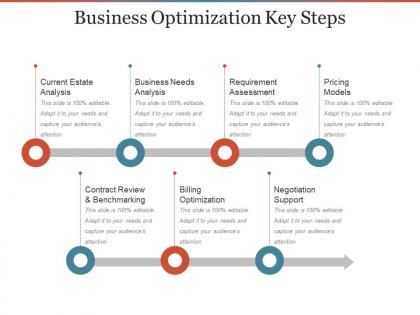
Make the best way to optimize your business process using our business optimization key steps PPT presentation. Optimizing a business process require more effort than purchasing new software. This process optimization PPT template helps you to have a look at the organization’s operations and minimizing the resources required to get things done. You can highlight steps for business process optimization to ensure that all related business tasks are done in an organized manner. With the help of this process mapping PPT, display the series assortment of business actions including inputs, methods and outputs that lead to a profitable conclusion. Essential steps responsible for carrying out any particular task, which are designed to know what to do and when to do, can be demonstrated with this design. Let your audience understand the process for product optimization and its importance in a feasible manner. So, don’t give a second thought, download this process optimization PPT template and make attractive presentations to impress your audience. Expose acts of jealousy with our Business Optimization Key Steps Ppt Presentation. Ensure the envious accept their error.
People who downloaded this PowerPoint presentation also viewed the following :
Business optimization key steps ppt presentation with all 5 slides:
Ink the deal with our Business Optimization Key Steps Ppt Presentation. Establish the impression that you can deliver.


FAQs for Business optimization key
Key performance metrics for business optimization include revenue per employee, operational efficiency ratios, customer acquisition costs, profit margins, and process cycle times. These metrics enable organizations to streamline operations, enhance resource allocation, and accelerate decision-making across departments like manufacturing, financial services, and retail, ultimately delivering improved productivity and sustainable competitive advantage.
Data analytics tools enhance business optimization strategies by identifying operational inefficiencies, predicting market trends, and automating decision-making processes across multiple departments. Through advanced algorithms and real-time monitoring, organizations streamline resource allocation, reduce operational costs, and accelerate response times, with many companies finding that strategic data integration ultimately delivers competitive advantages and measurable performance improvements.
Employee feedback serves as a critical diagnostic tool for identifying process inefficiencies, bottlenecks, and improvement opportunities that leadership might overlook from higher organizational levels. This frontline intelligence enables companies to streamline workflows, enhance operational efficiency, and reduce costs, with many organizations finding that systematic feedback collection ultimately delivers faster service delivery and improved customer experiences.
Small businesses can leverage cloud-based solutions, automation tools, free analytics platforms, open-source software, and mobile applications for cost-effective optimization. These technologies streamline operations by reducing manual tasks, improving customer management, and enhancing data insights, with many small retailers and service providers finding significant efficiency gains without major capital investments.
Common pitfalls include inadequate data analysis, resistance to change, lack of clear metrics, insufficient stakeholder buy-in, and over-optimization of isolated processes. These challenges often emerge when organizations rush implementation without proper assessment, with many businesses finding that gradual, data-driven approaches ultimately deliver sustainable efficiency gains and competitive advantage.
Customer feedback influences optimization by revealing performance gaps, identifying enhancement opportunities, and highlighting unmet needs across touchpoints. Through systematic analysis of feedback patterns, businesses streamline processes, enhance product features, and refine service delivery, with many organizations finding that customer-driven improvements ultimately deliver higher satisfaction rates and stronger competitive advantage.
Supply chain optimization strategies include demand forecasting analytics, inventory management automation, supplier relationship optimization, logistics route planning, and real-time visibility systems. These approaches streamline operations by reducing excess inventory, minimizing transportation costs, and enhancing supplier coordination, with many manufacturing and retail organizations finding that strategic implementation delivers faster delivery times and significantly lower operational costs.
Businesses can balance optimization by implementing strategic frameworks that enhance operational efficiency, automate routine processes, and leverage data analytics to identify areas where quality improvements actually reduce long-term costs. Many organizations find that investing in employee training, technology upgrades, and process standardization simultaneously delivers cost savings and quality enhancements, ultimately creating sustainable competitive advantage.
Best practices for conducting successful optimization audits include defining clear objectives, mapping current processes comprehensively, gathering stakeholder input, analyzing data systematically, and identifying bottlenecks with measurable impact. These methodologies streamline operations by establishing baseline metrics, prioritizing high-value improvements, and creating actionable roadmaps, with many organizations finding that structured audits deliver 20-30% efficiency gains while enhancing competitive positioning.
Automation can be effectively integrated by identifying repetitive tasks, mapping current workflows, selecting appropriate technologies, and implementing gradual rollouts with employee training. Organizations across manufacturing, finance, and healthcare find that strategic automation reduces operational costs, minimizes errors, and accelerates service delivery, while enabling teams to focus on higher-value strategic initiatives that drive competitive advantage.
Corporate culture significantly impacts optimization success by influencing employee adoption, change resistance, leadership commitment, and cross-departmental collaboration throughout implementation processes. Organizations with adaptive cultures that embrace continuous improvement, data-driven decision making, and transparent communication consistently achieve higher optimization outcomes, while companies with rigid hierarchies or change-averse environments often struggle to realize projected efficiency gains and competitive advantages.
Cross-departmental collaboration enhances optimization efforts by breaking down silos, sharing specialized knowledge, aligning strategic objectives, and pooling diverse resources across teams. This integrated approach enables organizations to identify inefficiencies spanning multiple departments, streamline workflows through coordinated processes, and implement comprehensive solutions, ultimately delivering faster innovation and improved operational performance.
Businesses utilize benchmarking by comparing their performance metrics, processes, and outcomes against industry leaders, competitors, and internal historical data to identify optimization opportunities. Through systematic analysis of operational efficiency, cost structures, and customer satisfaction scores, companies can pinpoint gaps in areas like manufacturing processes, service delivery, and resource allocation, ultimately enabling strategic improvements that deliver competitive advantage.
Companies are adopting AI-driven analytics, automated workflow systems, real-time performance monitoring, cross-functional integration platforms, and predictive optimization tools for continuous improvement. These innovative approaches streamline operations by eliminating bottlenecks, enhancing decision-making speed, and enabling proactive adjustments, with manufacturing and financial services organizations finding significantly improved efficiency and reduced operational costs.
Presentation tools effectively communicate optimization strategies through interactive dashboards, before-and-after visualizations, process flow diagrams, data comparison charts, and timeline roadmaps. These visual elements streamline complex information delivery by highlighting key metrics, illustrating transformation processes, and demonstrating projected outcomes, with many organizations finding that visual storytelling accelerates stakeholder buy-in and strategic implementation across departments.
-
Colors used are bright and distinctive.
-
Thanks for all your great templates they have saved me lots of time and accelerate my presentations. Great product, keep them up!