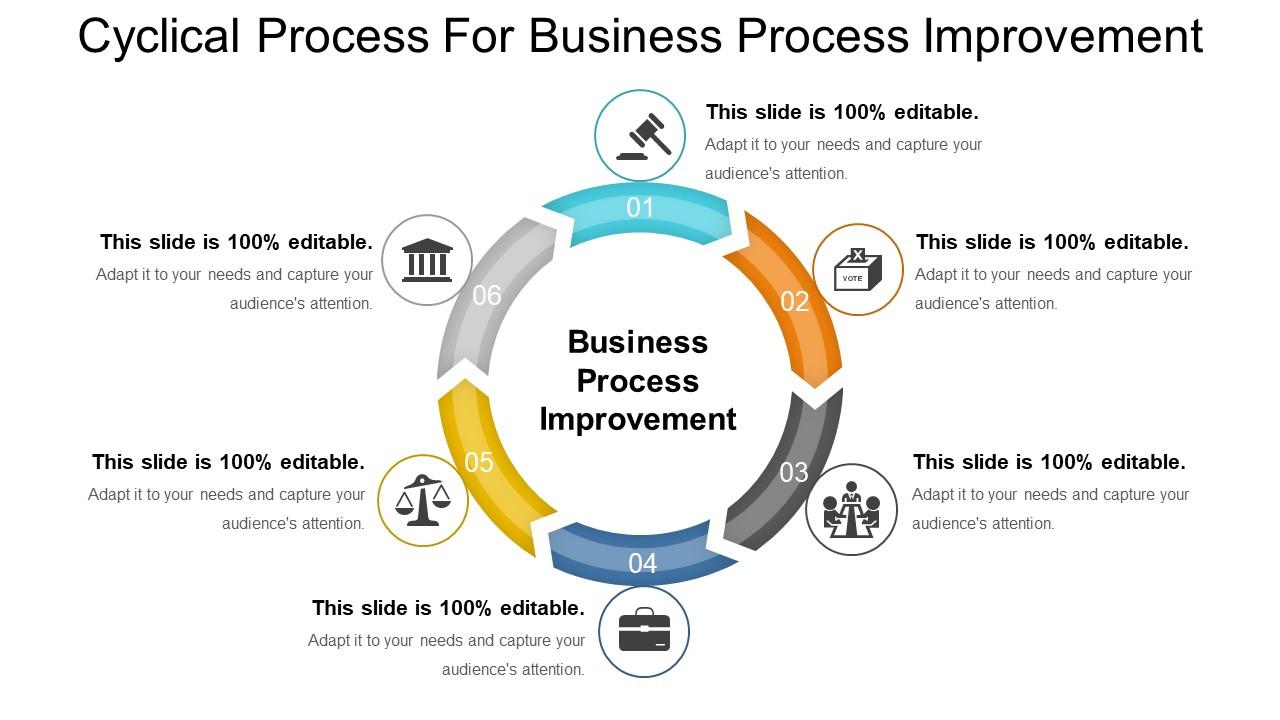
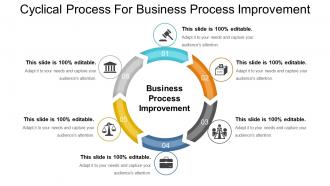
Cyclical process for business process improvement ppt example
Try Before you Buy Download Free Sample Product
Audience
Editable
of Time
Our Cyclical Process For Business Process Improvement Ppt Example enjoy diversity. They absorb the best from different cultures.
People who downloaded this PowerPoint presentation also viewed the following :
Cyclical process for business process improvement ppt example with all 5 slides:
Have an exciting adventure with our Cyclical Process For Business Process Improvement Ppt Example. You will find the experience enthralling.
FAQs for Cyclical process for business process
Oh, it's just PDCA - Plan, Do, Check, Act. So you plan whatever improvement you want to make, test it small-scale, then check if it actually worked like you thought it would. After that, you act on what you learned. The whole thing repeats because that's how you keep getting better instead of just doing it once and calling it done. Honestly, I think the cyclical part is what makes it work - each round builds on the last one. You can use it for pretty much any process at work. I'd start with something small in your department first though.
Honestly, you gotta track both the quick wins and the long-term stuff to really know what's working. Before jumping into anything, nail down your baseline numbers first. Then pick maybe 3-5 key things to watch - cycle time, error rates, customer happiness, cost savings, whatever matters most to your situation. Here's the annoying part: some improvements take forever to actually show up in your data. We're talking months sometimes! Get your team involved early on deciding what "success" even means. Monthly check-ins work well, and don't be afraid to pivot if the numbers are telling you something different than expected.
Look, data analysis cuts right through all the guesswork and shows you where things are actually falling apart. You'll spot bottlenecks and track timing issues that you'd totally miss just watching day-to-day stuff. I've watched teams spin their wheels for months fixing problems that weren't even the real issue - kinda painful to see honestly. The numbers don't lie about where you're bleeding efficiency or cash. Map out what you're currently hitting versus your targets. That gap? That's your goldmine of improvement opportunities right there.
Get your frontline people involved from day one - they're doing the actual work, so ask them what sucks during planning. Weekly check-ins work great during implementation, or just send quick surveys. Honestly? Those random conversations by the coffee machine tell you way more than formal meetings ever will. After each cycle wraps up, do retrospectives where people can actually speak up without getting in trouble. Don't overthink it though - you want something simple that happens regularly. Oh, and here's the thing everyone forgets: actually DO something with the feedback you get, otherwise people stop caring.
Honestly, the biggest pain is just getting people on board - everyone thinks their current way works fine. Why change something that isn't totally broken, right? Plus teams execute stuff so differently, which kills consistency. Measuring the right things gets messy too. When deadlines hit, people want to skip steps (been there). Oh and good luck getting resources for improvement work when daily stuff is already drowning everyone. My advice? Pick one team that's actually excited about it first. Set clear metrics from day one, and build those feedback loops early or you'll lose momentum fast.
Your industry totally dictates how you time improvements. Healthcare? You're stuck with compliance cycles and safety protocols - super narrow windows. Manufacturing follows seasonal demand or when machines need maintenance. Financial services get tied up in regulatory reporting and market chaos. Retail's obviously all about seasonal rushes and inventory cycles (that's honestly where most of the action is). Don't try forcing some cookie-cutter quarterly thing. Map your improvements to whatever rhythm your industry actually runs on. Way more effective than fighting against it.
Honestly, PDCA cycles are your best friend here - use them for testing changes systematically. Value stream mapping shows you where things get stuck in your process, which is super helpful. Then do regular retrospectives to actually learn from what happened (people skip this part way too much). Kanban boards work great for tracking your improvement projects too. Here's the thing though - pick ONE approach and stick with it instead of bouncing around between different frameworks. I'd start with monthly PDCA cycles on whatever's driving you most crazy right now. Those three tools will handle most of what you need.
Honestly, you've got to make it feel worth their time from day one. Quick wins are everything - people need to see results fast or they'll check out. I'd rotate who's leading different improvements so it doesn't get stale (improvement fatigue is totally a thing). Here's the key though: actually use their suggestions and call them out for it publicly. Nothing kills momentum faster than ignored ideas. Make sure everyone knows exactly how each change makes their daily grind easier - less annoying processes, better tools, whatever. Oh, and don't make it feel like extra work on top of everything else. Build it into what they're already doing.
Track both leading and lagging stuff - cycle time, error rates, customer satisfaction, cost per iteration. Employee buy-in is massive though. If your team hates the process, nothing sticks. Quick tip: measure how fast you spot problems vs actually fixing them. Are issues staying solved or just coming back? I've seen so many "improvements" that were just temporary Band-Aids. Keep your dashboard simple - something you can check weekly without needing a PhD in data. Start with 3-5 core metrics max, don't go crazy tracking everything at once.
Dude, automation is seriously a lifesaver for improving processes. It tracks everything in real-time, so you're not sitting around for months wondering if your changes actually worked. The data collection happens automatically - honestly, this part alone will blow your mind with how much time it saves. You can test multiple improvements at once since the tech handles all the boring repetitive tasks. I'd say start with automating your data first, then build from there. It's like having someone who never sleeps keeping an eye on your KPIs 24/7.
Honestly, the best part is watching your processes actually improve instead of staying broken forever. Start with just one thing and prove it works - that's way easier than trying to fix everything at once. Your team will get ridiculously good at catching problems early, and adapting to changes becomes automatic. I mean, who doesn't love having actual numbers to show your boss when you need more budget? The whole spotting-inefficiencies thing becomes like a habit after a few months. ROI data makes those budget conversations so much smoother too.
Honestly, just make it feel normal instead of some big corporate thing. Celebrate the small wins and tell those stories - people actually love hearing about real progress. Your leadership needs to model this too, like admitting when stuff isn't working and asking "what should we try next?" The biggest game-changer? Making failure a learning thing, not something people hide from. Give your team space to experiment and time to think between cycles. Always ask what you learned. I know it sounds simple, but the culture shifts when improving becomes just... how you work, not extra homework on top of everything else.
Honestly, if your leadership isn't bought in, you're screwed from the start. They can't just tell people to do continuous improvement and then disappear - that never works. The good leaders actually jump into the process reviews themselves and ask the tough questions. They celebrate when teams find small improvements, even boring ones. And here's the thing - they have to be okay with admitting their own processes suck sometimes. I've seen too many improvement initiatives die because executives treated it like a checkbox exercise. Get them involved in the actual work so they understand why it matters.
You've gotta run two tracks at once - grab some quick wins that actually pay for the bigger stuff you're building toward. Don't just chase random efficiency gains though, I've watched teams totally screw themselves over doing that. Make sure your short-term fixes actually support where you're headed long-term, not just whatever looks good on a dashboard. Every few cycles, do a reality check - are these quick fixes creating a mess you'll regret later? Map out which processes absolutely cannot break first, then work from there. The wins should build momentum, not undermine your actual goals.
Honestly, templates are your best friend here - same format every time so you can actually compare cycles without losing your mind. Document stuff as it happens, not weeks later when you've forgotten half the details. I learned that the hard way lol. Capture both the numbers AND what people are actually saying about the changes. Version control is clutch too. Oh, and create that shared folder structure right now and don't let anyone mess with it. Trust me on this one - consistency beats creativity when you're trying to track improvements over time.
-
Design layout is very impressive.
-
Informative design.