

8 step process roadmap timeline ppt template





Try Before you Buy Download Free Sample Product
 Impress Your
 Audience
 100%
100% Editable
 Save Hours
 of Time


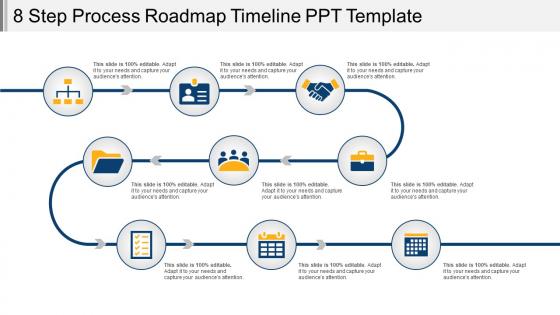
Do you want to design your yearly organizational structure timeline? Then just simply download our 8 step process roadmap timeline PowerPoint slides. It will help in indicating the yearly structural process flow of your business activities in 8 steps so that to attain the organizational objectives. This process roadmap timeline PPT design will able to represent the 8 stage business timeline for defining the different milestones of your company to attain within the stipulated period of time. You can use our business process timeline PowerPoint slide as a management tool for inscribing the necessary details about the business milestones to your existing or potential investors. Further, with our roadmap chart Presentation slide you will able to explain the benefits of such scheduled timeline. It helps in inspiring your employees to perform energetically, helps in developing the quality of work etc. Therefore, start working on our PowerPoint design for achieving the planned year based business growth. Excite grey cells with our 8 Step Process Roadmap Timeline Ppt Template. Get them bubbling with energetic ideas.
People who downloaded this PowerPoint presentation also viewed the following :
Content of this Powerpoint Presentation
One of the most common topics of debate in an organization is finding a balance between the granularity of the timeline and the deadlines it imposes. Some team members might want the timeline to be as transparent as possible, while others are looking to avoid any form of time-based commitment.
So, how do you create a process roadmap that not only satisfies the time requirement of the employees while still keeping up with the pace of the overall project to meet the deadlines?
Well, with the help of our 8-step process roadmap, specially curated to assist businesses in eliminating unwanted planning and coming up with an execution roadmap in no time, you can make changes to the PPT depending on your requirements and even add more steps.
Let’s explore.
Template 1: Eight-step Process Roadmap Timeline PPT Template
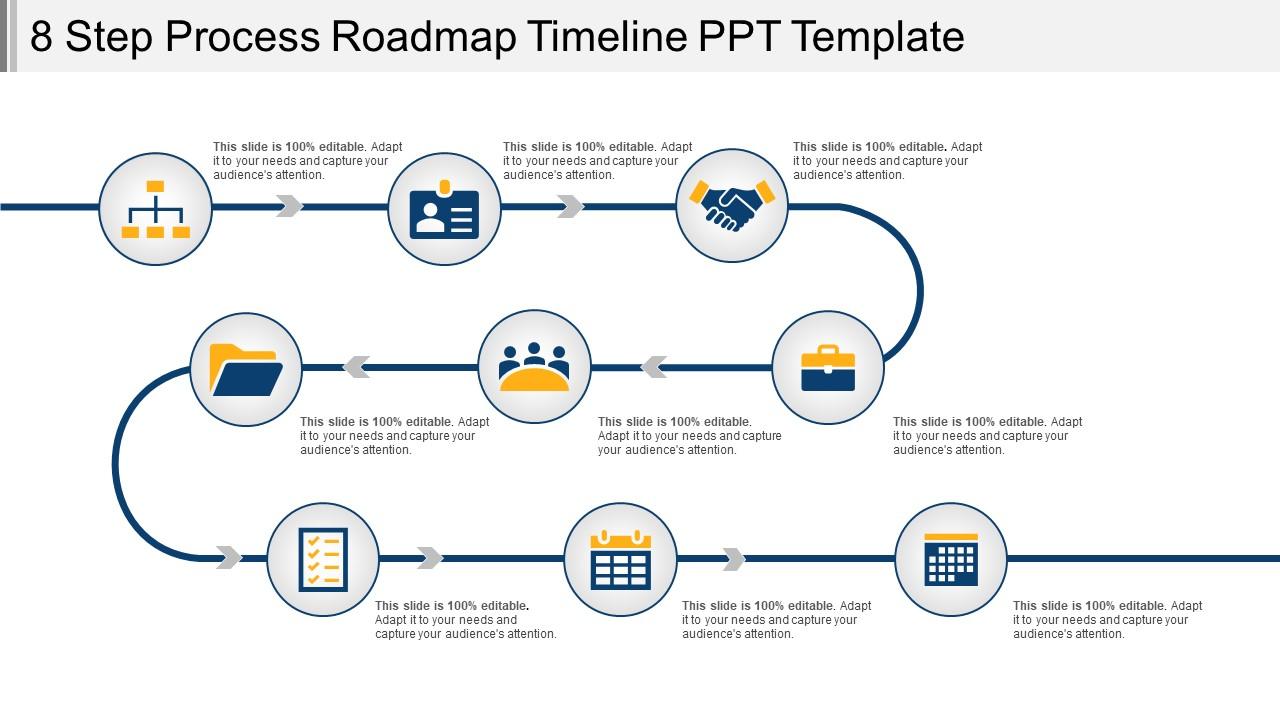
One of the first things you need to consider in the roadmap is the process's vision. By showcasing the process's vision, you are helping other team members understand your expectations from it. In addition, by keeping the vision in hindsight, you can further plan the process's outcome. Next, you need to find suitable individuals to build the right process in the shortest time. Using this roadmap, you will also find positions that are empty in your organization and need to be filled by the hiring team. You also need to gather information to determine your needs for the process roadmap timeline. For this, you should include a sales manager and a customer representative in the team. The need for careful documentation is the next step, as it helps in prioritizing aspects of your process roadmap. After taking in the information from the sales manager, add features that you feel are vital and should be part of the process roadmap timeline. This could be anything from working on a product's marketing to redesigning the services that the organization was providing to the customers. Once initial data, stats, and analytics have been gathered, the PPT gives a strategy that outlines how your organization will turn the vision outlined at the beginning into a reality. Allocation of resources is the next major part and to create a well-constructed process roadmap. The PPT shows you the way to estimate the time required and the number of team members required to complete the work. Finally, the process roadmap timelines do exactly what they are named — map the development of the process that will be handled by the multiple work streams and outcomes.
Wrapping Up
With this template, you can build and showcase the process roadmap timeline in the most strategic and easy-to-understand way. Using this template, you will have no trouble at all when it comes to adjusting the roadmap presentation for the specific audience group.
PS Check out our PPT templates, like the strategic planning framework and learning and development roadmap, to find ways to improve functioning.
8 step process roadmap timeline ppt template with all 5 slides:
Our 8 Step Process Roadmap Timeline Ppt Template are absolute gems. Fill their eyes with a lot of glitter.
FAQs for 8 step process roadmap
For your 8-step roadmap, each step needs the basics: clear objective, what you're delivering, timeline, and who owns it. Add success criteria too so people actually know when they're finished. Here's where things get messy though - dependencies will totally wreck your plan if you don't map them out properly. I've seen so many roadmaps crash because nobody figured out what's blocking what ahead of time. Resource requirements matter, and honestly? Be realistic with your timeline, not optimistic. Draft your first step with all these pieces, then just copy that format for the other seven.
Honestly, visuals are a game-changer for explaining your 8-step thing. Flowcharts work great, or even just simple numbered icons - anything beats walls of text that'll put people to sleep. I'd probably use arrows to show how steps connect, maybe different colors for different types of actions. Progress bars are clutch too since people can see exactly where they are. Oh, and visual metaphors that actually relate to what your audience does day-to-day? Pure gold. Start with one big overview showing all 8 steps, then dive into each one individually as you go.
Honestly, scope creep will kill you every time - stakeholders always want "just one tiny addition" that derails everything. Getting departments to agree on priorities is like herding cats when everyone thinks their stuff matters most. Plus you're usually stuck with the same overworked people juggling five different projects. Communication falls apart fast without clear ownership (learned that one the hard way). Build in buffer time though, seriously. And pick ONE person to make final calls on each piece - committees just talk in circles forever. Resource constraints suck but they're inevitable.
Look, getting stakeholders involved early is huge - seriously can't stress this enough. You want them bought in from the start, not finding out at step 6 when they're pissed and throwing roadblocks everywhere. Map out who matters in step 1, then keep them in the loop without drowning them in every tiny detail. They'll spot problems you totally missed and bring skills you don't have. Honestly, I've watched so many solid plans crash because someone waited too long to bring in the right people. The "when" matters just as much as the "who."
Honestly, just pick Trello or Asana and stick with it - I know that sounds basic but switching apps every week kills momentum. Set up cards for each of your 8 steps, then drag them through "Not Started," "In Progress," "Done." Super satisfying to move stuff to that final column, not gonna lie. Weekly check-ins work too - maybe Sunday nights? Just eyeball what percentage each step is at. The visual thing really helps though. I'd map out those 8 steps today if I were you, even if it's just scribbled on paper first.
So throw in some checkpoints after steps 2, 4, and 6 - plus obviously at the end. Quick syncs or even just a survey work great for getting stakeholder input. Most teams I've seen totally overthink this part and make it way too formal. Just pause, see what's actually working, then tweak your approach for what's left. Oh, and here's the thing that drives me crazy - people collect all this feedback then ignore it completely. Don't be that person! The whole point is course-correcting before you're too far down the wrong path.
So tech is honestly your best friend for this whole 8-step thing. Analytics tools help you gather data upfront - super important for validation. Then you'll need project management software (I'm obsessed with Asana but whatever works). Communication tools keep everyone on the same page during execution. Oh, and automation saves you from doing boring repetitive stuff. Later on, dashboards and feedback tools become clutch. Don't overthink the tech stack though. Pick simple tools that actually help instead of making things harder. You can always add more complicated stuff later when you need it.
Definitely add buffer time to each phase - that's non-negotiable. Weekly check-ins are a lifesaver too, honestly saved me when we spotted a delay early on my last project. Break those 8 steps into smaller chunks with mini-deadlines so you're not panicking at the end. Track your time from day one since estimates are usually garbage (speaking from experience lol). Figure out your bottlenecks now and have backup plans ready. Oh, and use some kind of visual project tool - seeing everything laid out helps way more than you'd think.
Look, you need both leading and lagging metrics to really see what's happening. Track milestone completion rates and how well you're sticking to timelines - that's your early warning system. Then measure the actual outcomes like revenue or user growth, whatever matters for your goals. Most teams get caught up tracking stuff that looks impressive but doesn't actually move the needle (been there). Stick to maybe 3-5 metrics that directly impact your business. Also keep an eye on team velocity and any blockers popping up - tells you if your process is broken. Just throw together a simple dashboard and check it weekly. Makes it way easier to pivot when things go sideways.
Honestly, the secret is breaking everything down into tiny wins and actually celebrating them. Sounds cheesy but it works. Do weekly check-ins so your team can share what's working and figure out roadblocks together. I swear, most teams burn out around step 4 because they're laser-focused on the end goal instead of the small stuff. Keep some kind of visible tracker everyone can see - even a simple board works. Oh, and small rewards matter way more than you'd think. Next meeting, just ask what micro-milestone you can knock out this week.
Execs just want the high-level stuff - what's happening and when. Don't bog them down with how you'll get there. Your team needs all the messy details though, since they're the ones actually doing the work. Middle managers are honestly the worst to present to because they want both views somehow. Visual timelines work for everyone - way easier to follow than bullet points. Technical folks need to see dependencies and where things might get stuck. Stakeholders only care about the milestones that affect them. Oh, and just ask what level of detail they want before you start. Saves everyone time.
So for complex stuff, you definitely need way more checkpoints and buffer time. Break those 8 steps down further when you're dealing with tons of stakeholders or really tricky deliverables. Simple projects? Just stick to the basic framework - honestly makes life so much easier lol. With the messy ones though, add more review points and risk checks. I'd bump your timeline up by at least 20-30% too. The whole thing comes down to matching how detailed your roadmap is with how complicated the project actually gets. First figure out how many moving pieces you're actually dealing with, then build from there.
Honestly, less is more with roadmaps. Stick to 2-3 colors max - nobody wants to look at a rainbow disaster. Make your timeline bold and labels scannable. Don't cram stuff together! I learned this the hard way when my manager squinted at my slides from across the conference room. White space actually helps people focus. Oh, and definitely test it on a projector first - colors always look weird compared to your laptop screen. Keep fonts consistent throughout. Text needs to be readable from the back row or you'll lose half your audience.
So the 8-step thing is pretty flexible actually. Tech projects? You'll probably want way more testing time. Construction focuses hard on planning and compliance stuff. Healthcare and finance are gonna need tons of extra paperwork and approvals - honestly such a pain but necessary. The basic steps don't change, but you can stretch some phases out or squeeze others depending on what you're dealing with. I'd start by figuring out where your industry usually hits roadblocks, then match those to the steps. After that, just adjust your timeline to give more breathing room where you need it most.
When stuff gets complicated, I break it into smaller chunks and map out what actually has to happen first. Mini-milestones are your friend here - way less overwhelming than staring at one massive task. Try asking "why is this so complex?" five times in a row. Sounds dumb but it works. Sometimes you can run pieces at the same time instead of doing everything step by step. The real trick? Make each part small enough that your team can actually guess how long it'll take. Nobody's good at estimating huge projects, but we're decent with bite-sized stuff. Clear progress markers keep everyone sane too.
-
The content is very helpful from business point of view.
-
Innovative and attractive designs.