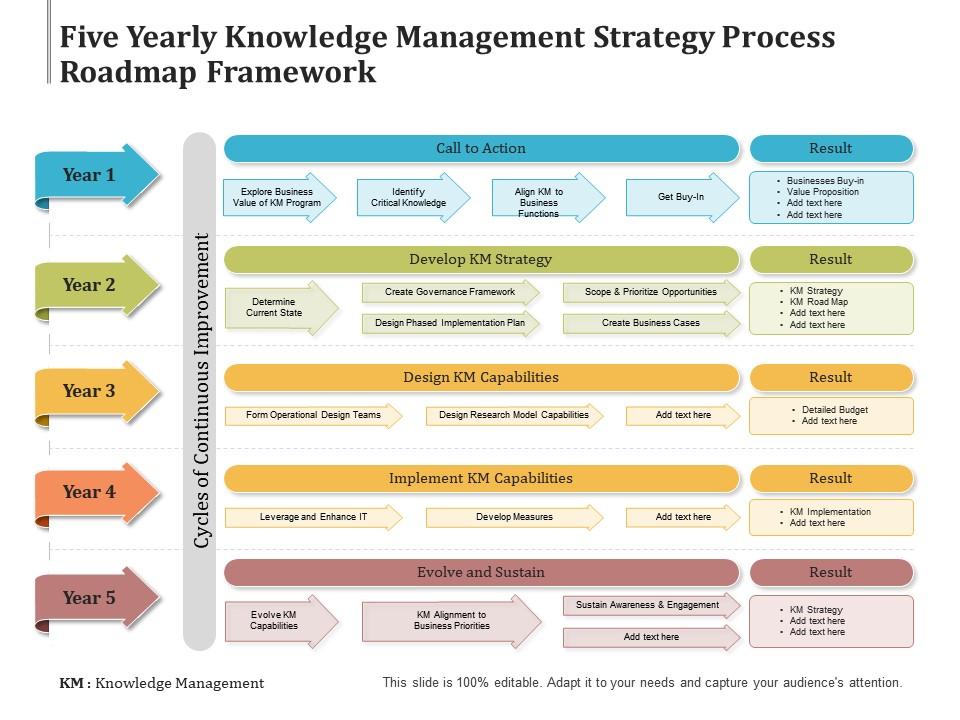
Five yearly knowledge management strategy process roadmap framework
Try Before you Buy Download Free Sample Product
Audience
Editable
of Time
Visualize your work plan and communicate your ideas impactfully with our pre designed Five Yearly Knowledge Management Strategy Process Roadmap Framework. Showcase the detailed overview of the project, the key deliverables, and the milestones to be achieved with the help of our fully customizable PowerPoint layout. You can easily emphasize on the project goals and discuss all the activities involved in an easy to comprehend manner by utilizing our professionally designed PPT theme. This roadmap PowerPoint layout is a perfect strategic planning tool that can help in keeping the project on track. With our attractive PowerPoint theme, you can articulate the workflow, track the work progress, and have a clear vision of the goal to be achieved. Download this versatile Five Yearly Knowledge Management Strategy Process Roadmap Framework and save your hours of work.
People who downloaded this PowerPoint presentation also viewed the following :
Five yearly knowledge management strategy process roadmap framework with all 2 slides:
Use our Five Yearly Knowledge Management Strategy Process Roadmap Framework to effectively help you save your valuable time. They are readymade to fit into any presentation structure.
FAQs for Five yearly knowledge management strategy
Key components of an effective knowledge management strategy include knowledge identification, capture processes, centralized repositories, sharing protocols, and performance measurement systems. These elements work together by streamlining information access, enhancing collaboration across departments, and minimizing knowledge loss during transitions, with many organizations finding that strategic implementation ultimately delivers improved decision-making and competitive advantage.
Organizations can measure knowledge management success through metrics like user adoption rates, knowledge base utilization, time-to-resolution for queries, employee satisfaction scores, and content accuracy levels. These measurements enable companies to track operational efficiency, reduce training costs, accelerate decision-making processes, and enhance collaborative workflows, with many finding that comprehensive analytics ultimately deliver improved productivity and competitive advantage.
Technology serves as the backbone of modern knowledge management by enabling automated capture, intelligent search, collaborative platforms, analytics tools, and AI-powered insights. These systems streamline knowledge discovery and sharing across organizations, with companies like Microsoft and IBM leveraging advanced platforms to reduce information silos, accelerate decision-making, and ultimately deliver competitive advantages through enhanced organizational learning.
Culture significantly impacts knowledge management implementation by influencing employee willingness to share information, adopt new technologies, and collaborate across departments. Organizations with open, collaborative cultures see higher adoption rates of knowledge sharing platforms, while hierarchical environments may struggle with information silos, ultimately requiring change management initiatives that align cultural values with knowledge sharing objectives for successful strategy execution.
Organizations can adopt mentorship programs, cross-functional team projects, knowledge repositories, regular training sessions, and incentive systems to encourage knowledge sharing among employees. These strategies enhance collaboration by breaking down silos, facilitating peer-to-peer learning, and creating structured platforms for expertise exchange, ultimately delivering improved innovation and operational efficiency across departments.
Storytelling in knowledge management transforms abstract information into memorable, relatable narratives that enhance retention, facilitate knowledge transfer, and preserve organizational wisdom through case studies, lessons learned, and best practices documentation. Through storytelling techniques, organizations streamline onboarding processes, capture tacit knowledge from experienced employees, and create engaging training materials, ultimately delivering improved learning outcomes and stronger organizational culture.
Organizations ensure knowledge accuracy through systematic verification processes, regular content audits, expert validation systems, and version control mechanisms that track updates and sources. By implementing peer review protocols, establishing subject matter expert networks, and creating feedback loops for continuous improvement, companies can maintain reliable knowledge repositories that enhance decision-making and reduce operational risks.
Effective knowledge management platforms include SharePoint, Confluence, Notion, Zendesk, and specialized solutions like Bloomfire and Guru. These tools streamline knowledge capture, organization, and retrieval through AI-powered search, collaborative editing, and automated workflows, with many organizations finding that integrated platforms reduce information silos while enhancing cross-departmental collaboration and decision-making efficiency.
Aligning knowledge management with organizational goals requires mapping knowledge assets to strategic priorities, establishing clear governance frameworks, and integrating KM metrics with business performance indicators. Organizations achieve this through cross-functional collaboration, targeted knowledge capture in critical areas, and regular assessment cycles, ultimately delivering improved decision-making, faster innovation, and enhanced competitive advantage across all business units.
Organizations typically face challenges including siloed information systems, employee resistance to knowledge sharing, lack of executive support, inadequate technology infrastructure, and difficulty measuring ROI. These obstacles often stem from cultural barriers, resource constraints, and competing priorities, with many companies finding that successful implementation requires strategic change management, cross-departmental collaboration, and sustained leadership commitment to ultimately deliver improved decision-making and operational efficiency.
Knowledge management practices support innovation by systematically capturing, organizing, and sharing institutional knowledge, expert insights, and creative solutions across teams. Through collaborative platforms and knowledge repositories, organizations accelerate research processes, reduce duplicate efforts, and enable cross-functional collaboration, with many companies finding that accessible knowledge databases foster breakthrough innovations and competitive advantage.
**INPUT**: What are the best practices for documenting and storing knowledge? **OUTPUT**: Best practices for documenting and storing knowledge include creating standardized templates, establishing clear categorization systems, implementing version control, ensuring searchable formats, and maintaining regular updates. These approaches streamline knowledge retrieval by reducing search time, enhancing accessibility, and minimizing information silos, with many organizations finding that centralized repositories ultimately deliver improved collaboration and faster decision-making across departments. [Word count: 60 words]
Organizations balance knowledge retention with employee turnover by implementing comprehensive documentation systems, cross-training programs, mentorship initiatives, and structured knowledge transfer processes during transitions. Through strategic succession planning and robust knowledge repositories, companies in sectors like consulting, healthcare, and technology minimize disruption while maintaining institutional expertise, ultimately delivering operational continuity and competitive advantage despite workforce changes.
Leadership plays a crucial role in fostering knowledge-sharing by establishing clear policies, modeling collaborative behaviors, investing in appropriate technologies, and creating reward systems that incentivize sharing. Effective leaders cultivate psychological safety where employees feel comfortable sharing insights and mistakes, while implementing structured processes that capture institutional knowledge, ultimately delivering enhanced innovation, reduced redundancy, and sustained competitive advantage across the organization.
External knowledge sources integrate through strategic partnerships with industry experts, academic institutions, and research organizations, subscription to specialized databases and market intelligence platforms, and active participation in professional networks and conferences. These approaches enhance internal capabilities by bringing fresh perspectives, competitive insights, and cutting-edge research directly into organizational workflows, with many companies finding that external integration accelerates innovation cycles while reducing research costs.
No Reviews