


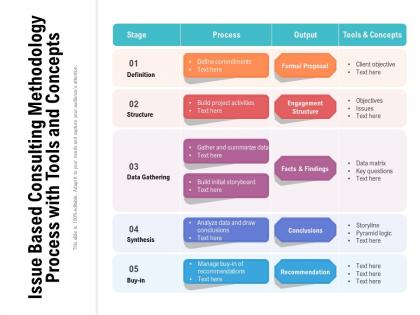
Issue based consulting methodology process with tools and concepts




Try Before you Buy Download Free Sample Product
 Impress Your
 Audience
 100%
100% Editable
 Save Hours
 of Time


Our Issue Based Consulting Methodology Process With Tools And Concepts are explicit and effective. They combine clarity and concise expression.
People who downloaded this PowerPoint presentation also viewed the following :
Issue based consulting methodology process with tools and concepts with all 2 slides:
Give your audience a fulfilling experience. They will find our Issue Based Consulting Methodology Process With Tools And Concepts elevating.

FAQs for Issue based consulting methodology process with
Issue-based consulting methodology centers on problem identification, hypothesis-driven analysis, structured problem-solving frameworks, data-driven validation, and actionable recommendations. This approach enables consultants to systematically dissect complex business challenges, develop targeted solutions through rigorous testing and evidence gathering, ultimately delivering measurable outcomes and strategic advantages for organizations across industries.
Issue-based consulting structures problems into specific, testable hypotheses and discrete questions, while traditional approaches often tackle broad problems holistically without clear frameworks. This methodology enables consultants to prioritize high-impact areas, develop targeted solutions faster, and measure progress systematically, with many consulting firms finding that clients achieve more actionable outcomes and strategic clarity.
Data analysis serves as the backbone of issue-based consulting methodology, enabling consultants to identify root causes, validate hypotheses, quantify impact, and develop evidence-based recommendations. Through advanced analytics and performance metrics, consulting teams streamline decision-making processes, enhance strategic insights, and deliver measurable outcomes, with many organizations finding that data-driven approaches ultimately accelerate problem resolution and competitive advantage.
Issue-based consulting proves particularly effective in dynamic industries like technology and healthcare, where rapid changes require structured problem-solving frameworks that can adapt quickly to evolving challenges, regulatory shifts, and market disruptions. The methodology's focus on breaking complex problems into manageable components enables consultants to deliver targeted solutions while maintaining agility, with many tech companies and healthcare organizations finding that this approach accelerates decision-making and strategic pivots.
Issue-based consulting projects typically involve problem definition, hypothesis development, data collection and analysis, solution design, and implementation planning. These stages enable consultants to systematically address complex business challenges by breaking them into manageable components, with many organizations finding that this structured approach delivers faster problem resolution, clearer strategic direction, and measurable operational improvements.
Consultants prioritize issues through impact assessment, urgency evaluation, resource requirements, and stakeholder alignment, typically using frameworks like impact-effort matrices or root cause analysis. This systematic approach enables organizations to address high-impact, quick-win solutions first, while building momentum for complex transformations, ultimately delivering measurable results and sustainable competitive advantage.
Issue-based consulting relies on structured problem-solving frameworks like MECE (Mutually Exclusive, Collectively Exhaustive), hypothesis trees, and root cause analysis tools. These methodologies enable consultants to systematically break down complex business challenges, prioritize critical issues, and develop data-driven solutions, with many organizations finding that this approach accelerates decision-making and delivers measurable operational improvements.
Stakeholder engagement serves as the foundation of issue-based consulting, involving systematic identification, mapping, and continuous communication with all parties affected by or influencing the core issue. Through structured interviews, workshops, and feedback loops, consultants gather diverse perspectives, validate problem definitions, and build consensus around solutions, ultimately ensuring buy-in and successful implementation across organizational levels.
Common challenges include resistance to change from stakeholders, difficulty in accurately defining root problems, resource constraints during implementation phases, and maintaining client engagement throughout extended analysis periods. Organizations often find that while issue-based approaches deliver comprehensive solutions, they require significant time investment and cross-functional collaboration, with many consulting firms needing to balance thorough problem-solving with client expectations for rapid results.
Success in issue-based consulting is measured through specific, quantifiable outcomes directly tied to the identified business issue, such as cost reduction percentages, revenue increases, operational efficiency gains, and timeline adherence. These engagements typically establish clear KPIs upfront, with many organizations finding that measurable improvements in areas like customer satisfaction, process speed, and resource allocation ultimately deliver sustained competitive advantage and strategic value.
Issues can be effectively communicated to clients through structured frameworks, visual presentations, data-driven evidence, interactive workshops, and collaborative problem-solving sessions. These approaches enhance understanding by simplifying complex challenges into actionable insights, while fostering partnership through transparent dialogue and shared ownership, ultimately delivering stronger client relationships and more successful project outcomes.
Essential skills for issue-based methodology consultants include structured problem-solving, stakeholder management, data analysis, strategic thinking, and adaptive communication. These consultants excel by rapidly diagnosing root causes, facilitating cross-functional collaboration, and translating complex findings into actionable recommendations, with many organizations finding that effective issue-based specialists deliver measurable outcomes while building internal problem-solving capabilities.
Issue-based consulting methodologies can be adapted for small businesses through simplified problem identification frameworks, rapid hypothesis testing, and resource-efficient solution development that focuses on immediate impact areas. Startups benefit by applying streamlined root-cause analysis and prioritized action planning to critical challenges like market positioning, operational efficiency, and customer acquisition, ultimately delivering faster decision-making and competitive advantage.
Successful issue-based consulting interventions include McKinsey's restructuring of troubled airlines, Bain's operational transformation of retail chains, BCG's digital acceleration programs for traditional banks, Deloitte's supply chain optimization for manufacturing firms, and PwC's regulatory compliance frameworks for financial institutions. These strategic engagements streamline operations, reduce costs, and accelerate decision-making, with many organizations finding that focused problem-solving approaches deliver measurable competitive advantages within months.
The effectiveness of issue-based consulting can be evaluated through quantitative metrics like ROI, cost savings, and performance improvements, alongside qualitative assessments including stakeholder feedback, process efficiency gains, and strategic objective alignment. Organizations typically measure success by comparing baseline data with post-implementation results, while conducting regular reviews with leadership teams to assess sustained impact and identify additional optimization opportunities.
No Reviews