


Project challenges ppt presentation






Try Before you Buy Download Free Sample Product
 Impress Your
 Audience
 100%
100% Editable
 Save Hours
 of Time


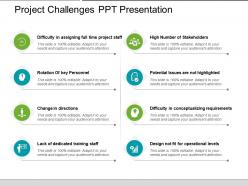
Do you want to highlight the challenges of project management in PowerPoint? If yes, then don’t worry, we are offering our fully professional, modern, innovative project challenges PPT presentation template to let you do it without any hassle. You can display major challenges in project planning process such as difficulty in assigning project stuff, rotation of key personnel, change in directions, lack of training and staff, high number of stakeholders and other conceptual and operational challenges with this wonderful project management problems and solutions PPT template. PPT design is helpful in project management and control activities. Most of the business managers, sales and quality professionals, project managers use this amazing PPT template to discuss various challenges of project management in front of clients, investors or their internal team members, so that your organizational goals can be achieved without any hassle. So, don’t wait for it, just download this business oriented PPT template and use it to display major challenges in the most amazing manner. Our Project Challenges Ppt Presentation will never disappoint. They will hold up their end of the promise.
People who downloaded this PowerPoint presentation also viewed the following :
Project challenges ppt presentation with all 5 slides:
Endure grueling days with our Project Challenges Ppt Presentation. Find it far easier to carry the burden.


FAQs for Project
Communication falls apart constantly - people miss tone in messages, time zones suck for meetings, and you can't tell when someone's actually drowning. Team culture becomes this weird performative thing on video calls. What really kills me is losing those random conversations where problems actually get solved. Without bumping into people, issues just... sit there getting worse. I'd say spam people with updates through different channels, do way more one-on-ones than feels necessary, and don't assume silence means everything's fine. Over-communication feels annoying but saves your sanity later.
Ugh, bad communication is the worst - it's like watching dominos fall. Your team starts working on completely different things because nobody's on the same page. You'll get people doing the exact same task twice while other stuff gets totally ignored. Deadlines? Forget about it. Information just sits with whoever has it instead of getting shared. Then stakeholders decide they want something completely different halfway through, but half the team doesn't even know. I swear, most project disasters I've seen start with this. Just do regular check-ins and document everything somewhere everyone can actually see it.
Honestly, you've gotta nail down that change control process right from the start. Get everything documented in your scope statement and make sure stakeholders actually sign off on it - I can't stress this enough. When new requests roll in (they always do), check them against your timeline and budget before agreeing to anything. Trust me, I used to say yes to everything early on and it bit me hard later. Regular team check-ins help catch scope drift before it spirals. Oh, and don't feel bad about pushing back when changes don't make sense for your project goals.
Look, stakeholder engagement can totally make or break your project. When people feel heard, they'll actually show up to meetings and support your decisions. You get way better requirements upfront too. Plus they become your biggest advocates when you need executive buy-in later. But ignore them? That's where things get messy. Scope creep everywhere, people fighting your every move, and projects that work perfectly but sit unused. I've seen it happen so many times. My advice? Map out your key players early. Figure out how each person likes to communicate - some want emails, others prefer quick calls. Trust me on this one.
Think of risk management as spotting trouble before it hits. You're not constantly putting out fires anymore - you're stopping them from happening. My last project taught me this lesson pretty brutally, honestly. List out what could go wrong upfront and have backup plans ready. That way when stuff inevitably breaks, you're not panicking trying to figure out solutions. Make it part of your regular routine though, not just something you do once during planning. Trust me, future you will thank present you for this. Start with your current project and just brainstorm what might tank it.
Ugh, cultural differences are such project killers. Communication styles alone can tank everything - like when some people are super blunt and others just hint at problems. Half your team thinks quiet means "we're good" while the other half reads it as total disagreement. Don't even get me started on how different cultures handle deadlines and what counts as "urgent." Honestly, time zones just pile on the chaos. But here's what actually works: get everyone talking about their work styles and communication preferences right at the start. Sounds basic but it'll save you so many disasters down the road.
Honestly? Asana or Monday.com are solid picks - their visual dashboards make it super easy to spot where things are getting stuck. Jira's great too if you're doing software stuff, though sometimes it feels like using a sledgehammer to hang a picture frame. Here's the thing though: doesn't matter how fancy the tool is if your team won't actually use it. I've watched so many people set up these elaborate systems only to abandon them for good old Google Sheets within a month. Pick whatever feels natural for your group and set up those weekly update reminders. Trust me, catching problems early beats scrambling to fix them later.
Honestly, you need to figure out what your stakeholders actually care about most and be real about what your team can handle. Rank everything by business impact and deadlines first. Then look at your capacity - like, actually look at it, not some fantasy version. You're gonna have to have awkward conversations about trade-offs, telling people "if we rush this, that other thing gets pushed back." Write this stuff down because priorities will definitely change next week. A simple matrix you review weekly helps - nothing fancy, just something that keeps everyone aligned when the chaos hits.
Dude, bad planning is basically project suicide. Your scope will creep everywhere, deadlines become suggestions, and budgets turn into wishful thinking. Nobody knows what they're supposed to do, so everyone just wanders around confused. Stakeholders will change their minds constantly (though let's be real, they do that anyway). You end up putting out fires instead of actually getting stuff done. Quality goes to hell, your team gets frustrated, and everything's late and expensive. I know it sucks when bosses want you to start immediately, but seriously - fight for planning time upfront. It'll save your sanity later.
Honestly, start with making people feel safe to speak up when stuff goes wrong - no blame games. Check in regularly, but actually ask "what's blocking you?" instead of just wanting status updates. Small wins deserve celebration because project work can be such a grind sometimes. Don't let conflicts fester - address them fast. I've seen too many teams fall apart from avoiding the awkward conversations. Stay transparent about problems while focusing on solutions. Oh, and try opening your next meeting by asking what's going well first. Sets a totally different tone than jumping straight into the mess.
Honestly, just talk to people early and often - that's like 80% of it. I learned this the hard way when I stayed quiet too long and everyone started panicking lol. Get realistic about your timelines upfront and don't sugarcoat potential issues. Regular updates help even when nothing's happening. Write down the big decisions so nobody gets confused later. When problems pop up, actually listen to what they're worried about and get them involved in fixing it. Oh and figure out who your main stakeholders are first - then set up those check-ins this week before things get crazy.
Ugh, tech changes are the worst for project management. Everything moves so fast now that your project could be outdated before you even finish it. Traditional methods just don't cut it anymore - you need way more flexibility. Your team's constantly learning new tools and skills, which throws off timelines. I learned this the hard way on my last project when we had to completely pivot halfway through. Build in extra time for learning curves and don't lock yourself into rigid plans. Short cycles are your friend here, even though they're stressful as hell.
Honestly, start with regular check-ins - doesn't have to be fancy, just quick stand-ups to keep everyone on the same page. Shared tools like Asana are game-changers for transparency. I swear by separate Slack channels for different projects too, makes finding stuff so much easier later. Oh, and don't skip the random stuff - virtual coffee breaks or team lunches actually matter more than you'd think. Clear roles help avoid that awkward "wait, I thought you were handling this" situation. But seriously, pick like two things max to start with or you'll just stress everyone out trying to do it all.
Don't wait around hoping it'll fix itself - conflicts never do. Get everyone on a call and let each person share their side without getting interrupted. Seriously, I've watched PMs try handling this stuff through email and it's a disaster every time. Skip the personality drama and focus on the actual work problem. What needs to get done? How do we make this work? Then write down whatever you decide so nobody "forgets" later. The trick is moving fast before small disagreements blow up into full team chaos.
Honestly, most failed projects come down to communication falling apart or scope creep getting out of hand. Do post-mortems but don't blame specific people - look at the bigger picture instead. Poor stakeholder alignment and unrealistic timelines are huge red flags too. Oh, and inadequate risk planning, which I've seen kill so many projects it's not even funny. The real trick is making your team comfortable enough to speak up when stuff goes sideways early on. Don't wait for retrospectives only when things blow up - do them on successful projects too.
-
Graphics are very appealing to eyes.
-
Great designs, really helpful.