


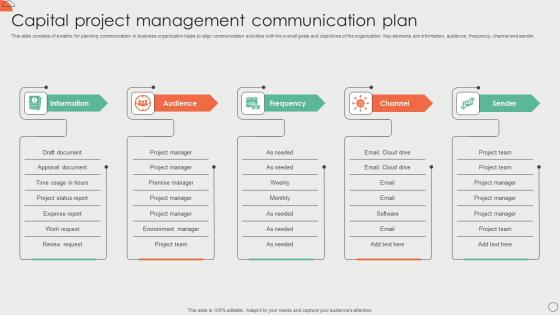
Capital Project Management Communication Plan




Try Before you Buy Download Free Sample Product
 Impress Your
 Audience
 100%
100% Editable
 Save Hours
 of Time


This slide consists of a matrix for planning communication in business organization helps to align communication activities with the overall goals and objectives of the organization. Key elements are information, audience, frequency, channel and sender.
People who downloaded this PowerPoint presentation also viewed the following :
Capital Project Management Communication Plan with all 6 slides:
Use our Capital Project Management Communication Plan to effectively help you save your valuable time. They are readymade to fit into any presentation structure.





FAQs for Capital Project
Capital project management typically includes initiation, planning, execution, monitoring, and closure phases, with each phase building upon and informing the others through continuous feedback loops. These phases interact seamlessly through iterative communication and documentation, with planning insights refining execution strategies, monitoring data adjusting project scope, and closure learnings enhancing future project initiation, ultimately delivering strategic organizational value.
Stakeholder engagement ensures capital projects align with business objectives, regulatory requirements, and operational needs through regular communication, feedback collection, and expectation management. Effective engagement helps organizations identify potential risks early, secure necessary approvals, and maintain project momentum, with many finding that proactive stakeholder involvement significantly reduces delays and cost overruns.
Risk assessment and management strategies integrate into capital project planning through systematic risk identification, quantitative impact analysis, mitigation planning, and continuous monitoring frameworks. These approaches enable organizations to proactively address potential delays, cost overruns, and resource constraints, while establishing contingency protocols and stakeholder communication processes, ultimately delivering more predictable outcomes and enhanced project success rates.
Best practices for budgeting and cost control in capital projects include detailed upfront planning, regular variance analysis, stakeholder alignment, contingency reserves, and real-time monitoring systems. These approaches streamline resource allocation by establishing clear baselines, tracking expenditures against milestones, and enabling proactive adjustments, with many organizations finding that integrated project management platforms ultimately deliver enhanced financial transparency and minimize cost overruns.
Regulatory requirements significantly impact capital project timelines through mandatory approval processes, environmental assessments, safety inspections, and documentation requirements that can extend project phases by months or years. While compliance adds complexity and costs, it ultimately delivers risk mitigation, legal protection, and operational credibility, with many organizations finding that early regulatory engagement and strategic planning minimize delays while ensuring sustainable project outcomes.
Innovative technologies shaping capital project management include AI-powered scheduling algorithms, IoT sensors for real-time monitoring, digital twins for virtual modeling, blockchain for contract transparency, and drone surveillance systems. These technologies streamline project oversight by automating progress tracking, predicting potential delays, and enhancing resource allocation, with construction and infrastructure firms finding significantly improved delivery timelines and cost control.
Project managers optimize resource allocation by implementing dynamic scheduling systems, conducting regular capacity assessments, establishing cross-functional resource pools, and utilizing real-time performance dashboards. Through strategic resource leveling and predictive analytics, organizations in construction, manufacturing, and infrastructure development streamline project timelines, minimize cost overruns, and enhance delivery efficiency, ultimately delivering competitive advantage in increasingly complex project environments.
Key capital project success metrics include budget variance, schedule adherence, quality standards compliance, return on investment (ROI), and stakeholder satisfaction scores. These measurements enable organizations to evaluate financial performance, operational efficiency, and strategic value delivery, with many companies in manufacturing, healthcare, and infrastructure finding that comprehensive metric tracking ultimately enhances future project planning and competitive positioning.
Sustainability drives capital project management through environmental impact assessments, green building certifications, renewable energy integration, and lifecycle cost analysis that considers long-term operational efficiency. Organizations increasingly evaluate projects based on carbon footprint reduction, resource conservation, and regulatory compliance, with many finding that sustainable approaches deliver lower operational costs and enhanced stakeholder value.
Common pitfalls in capital project management include inadequate scope definition, unrealistic budgeting, poor stakeholder communication, insufficient risk assessment, and weak change control processes. These challenges can be mitigated through comprehensive planning frameworks, regular milestone reviews, and robust project governance structures, with many organizations finding that investing in experienced project managers and integrated technology platforms ultimately delivers better cost control and timeline adherence.
Collaboration tools enhance capital project communication by centralizing project data, enabling real-time updates, streamlining document sharing, and facilitating cross-functional coordination among distributed teams. These platforms significantly reduce information silos and project delays, with many construction and manufacturing organizations finding that integrated collaboration systems ultimately deliver faster decision-making and improved project outcomes.
Essential skills for capital project management include financial analysis, risk assessment, stakeholder communication, regulatory compliance, and resource coordination. These competencies enable professionals to navigate complex infrastructure projects, manufacturing expansions, and technology implementations by managing multi-million dollar budgets, mitigating operational risks, and ensuring regulatory adherence, ultimately delivering strategic value and competitive advantage.
Global economic factors significantly influence capital project planning through interest rate fluctuations, currency exchange volatility, inflation pressures, supply chain disruptions, and regulatory changes across markets. These economic conditions reshape project timelines, resource allocation strategies, and investment priorities, with many organizations finding that flexible planning frameworks and diversified supplier networks enable better risk mitigation and maintain competitive advantage during uncertain periods.
Change management significantly impacts capital projects by reducing resistance, ensuring stakeholder buy-in, accelerating adoption timelines, and minimizing operational disruptions during implementation phases. Through structured communication plans, training programs, and phased rollouts, organizations in manufacturing, energy, and infrastructure sectors streamline transitions, enhance project acceptance rates, and deliver measurable ROI improvements, ultimately achieving faster time-to-value and sustained competitive advantage.
Capital project management methodologies are increasingly incorporating digital technologies, agile frameworks, and risk-based planning to address cost overruns, schedule delays, and resource constraints. These evolved approaches streamline project execution through real-time data analytics, modular construction techniques, and integrated stakeholder collaboration platforms, with many organizations in energy, infrastructure, and manufacturing finding that these methodologies ultimately deliver enhanced predictability and competitive advantage.
-
Thanks for all your great templates they have saved me lots of time and accelerate my presentations. Great product, keep them up!
-
SlideTeam is my one-stop destination for templates. Highly recommended!