

Cardiotocography Powerpoint Template Bundles Ppt Example





Try Before you Buy Download Free Sample Product
 Impress Your
Audience
 100%
Editable
 Save Hours
of Time


Our Cardiotocography Powerpoint Template Bundles Ppt Example are topically designed to provide an attractive backdrop to any subject. Use them to look like a presentation pro.
People who downloaded this PowerPoint presentation also viewed the following :
Content of this Powerpoint Presentation
Slide 1: This slide introduces Cardiotocography. State your company name and begin.
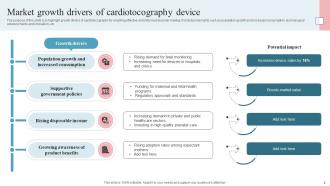
Slide 2: The purpose of this slide is to highlight growth drivers of cardiotocography for enabling effective and informed decision-making. It includes elements such as population growth and increased consumption, technological advancements and innovation, etc.
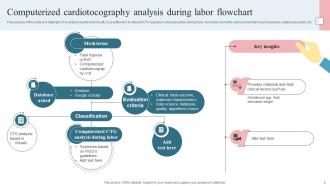
Slide 3: The purpose of this slide is to highlight CTG analysis performed visually by practitioners to interpret CTG signals in clinical practice during labor. It includes elements such as mesh terms and keywords, databases asked, etc.
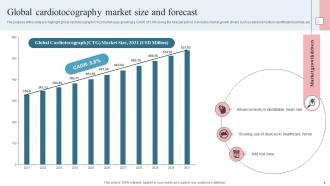
Slide 4: The purpose of this slide is to highlight global cardiotocograph (CTG) market sizes growing t a CAGR of 5.0% during the forecast period. It includes market growth drivers such as advancements in identifiable heart rate, etc.
Slide 5: The purpose of this slide is to highlight CTG classification system indications to suggest clinical conditions in interpretation of patterns. It includes elements such as normal CTG, intermediary CTG, etc.
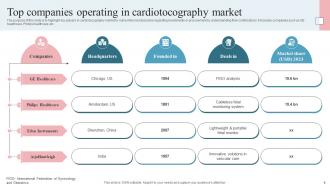
Slide 6: The purpose of this slide is to highlight key players in cardiotocography market to make informed decisions regarding investments or procurement by understanding their contributions. It includes companies such as GE healthcare, Philips healthcare, etc.
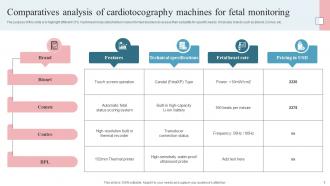
Slide 7: The purpose of this slide is to highlight different CTG machines to help stakeholders make informed decisions to assess their suitability for specific needs. It includes brands such as Bionet, Comen, etc.
Slide 8: The purpose of this slide is to highlight different CTG machines to help stakeholders make informed decisions to assess their suitability for specific needs. It includes brands such as Bionet, Comen, etc.
Slide 9: The purpose of this slide is to highlight cardiotocography working to ensure accurate monitoring of baby’s heart rate and mother’s contractions during labor. It includes steps such as external CTG monitoring, internal CTG monitoring with scalp electrode, etc.
Slide 10: The purpose of this slide is to highlight steps to read cardiotocography to ensure accurate and effective monitoring of fetal heart rate contributing to better maternal and fetal outcomes. It includes steps such as define risk, contraction, etc.
Slide 11: The purpose of this slide is to highlight methods for recording fetal heart rate ensuring informed decision-making based on clinical needs and patient comfort. It includes elements such as fetal spiral electrode, doppler, etc.
Slide 12: The purpose of this slide is to highlight applications of cardiotocography signal in supporting informed decision-making and potential improvements in patient care. It includes elements such as detection of congenital heart diseases, study effect on drugs on heart rate variability, etc.
Slide 13: This slide shows Cardiotocography icon for recording fetal heart rate.
Slide 14: This slide presents Electronic cardiotocography icon for monitoring contractions.
Slide 15: This is a Thank You slide with address, contact numbers and email address.
Cardiotocography Powerpoint Template Bundles Ppt Example with all 23 slides:
Use our Cardiotocography Powerpoint Template Bundles Ppt Example to effectively help you save your valuable time. They are readymade to fit into any presentation structure.












FAQs for Cardiotocography Powerpoint Template
So basically it tracks the baby's heart rate and mom's contractions at the same time during pregnancy and labor. You're watching for red flags - like if the heart rate drops during contractions or weird patterns that might mean the baby's not getting enough oxygen. Honestly, reading these strips is trickier than it looks. It helps doctors decide stuff like timing delivery, whether you need interventions, or if they need to do an emergency C-section. Just remember it's only part of the picture though - not the whole story by itself.
So CTG has two sensors working together on one machine. The ultrasound one goes on mom's belly to pick up baby's heartbeat using Doppler - same tech they use for regular checkups. Then there's this pressure sensor called a tocodynamometer (fancy name, right?) that sits on top of the uterus to catch contractions. Both feed into the same monitor simultaneously. The machine spits out both readings on one paper strip - heartbeat on top, contractions below. Makes it super easy to see how baby reacts during each contraction. Just make sure your sensors are positioned right or you'll get wonky readings.
So there's basically two types - external and internal CTG. Most of the time you'll use external, which just puts ultrasound things on mom's belly. Pretty straightforward. Internal is trickier since you need to attach an electrode directly to baby's scalp (yeah, sounds intense but it's standard). The membranes have to be broken first obviously. Internal gives way better readings though, especially if mom's larger or baby's in a weird position. External can get pretty crappy traces sometimes. You'd switch to internal when labor gets complicated and you really need to know what's going on. Basically use internal when precision actually matters.
So you're basically looking for three main things: fetal heart rate should stay between 110-160 bpm, good variability (which means baby's getting oxygen), and how the heart rate reacts during contractions. Accelerations with fetal movement are what you want to see - that's a good sign. Late decelerations are the scary ones that can mean fetal distress. Also track contraction frequency, duration, and strength to see how labor's progressing. The pattern recognition thing honestly just takes time - I remember feeling totally lost at first! Document everything and seriously, don't be afraid to ask for help if something looks off.
So CTG basically tracks the baby's heart rate and contractions at the same time - pretty clever system. Watch out for scary stuff like prolonged bradycardia or when you lose that baseline variability completely. Late decelerations are honestly the worst sign because they usually mean the placenta's not doing its job. The whole point is catching problems early instead of waiting around for other symptoms to show up. Oh, and severe variable decels can mean cord compression too. My attending always drilled into us - don't brush off persistent weird patterns. Real-time monitoring = your best friend for spotting fetal distress before things get dicey.
Honestly, the main issue is way too many false alarms - you'll see scary-looking patterns but baby's totally fine. Leads to tons of unnecessary C-sections. CTG also sucks at actually catching real problems, so never base decisions on it alone. Your interpretation matters huge here, and let's be real, not everyone's equally experienced reading these things. Movement, mom's weight, crappy equipment - all mess with the readings. Equipment malfunction is surprisingly common too. Always look at the whole picture, not just one wonky strip.
Yeah, both can really screw with your CTG readings. Obesity makes it harder to get decent traces - all that extra tissue blocks the signal from the transducers. Super frustrating when you're trying to get a clear reading. Diabetes is worse though, especially if it's poorly controlled. You'll see more decels and crappy variability because of increased hypoxia risk. Plus diabetic moms often have bigger babies which can mess with your baseline readings. Honestly, don't waste time fighting with shitty external monitoring - just switch to scalp electrodes early if the traces are garbage.
So cardiotocography basically *is* the non-stress test - that's what we use to monitor the baby's heart rate and contractions. Pretty straightforward actually. You stick two monitors on mom's belly, one picks up the heartbeat and the other tracks contractions. What you're looking for is the baby's heart rate speeding up when they move around - that's a good sign their oxygen levels and brain function are solid. A "reactive" test means you get at least two accelerations of 15 bpm for 15 seconds within 20 minutes. Non-reactive? Then you'd probably need more testing to be safe.
So basically you're looking at two things on CTG strips - the baby's heart rate and mom's contractions. Normal heart rate sits between 110-160 bpm, and you want to see good variability in that rhythm. Those squiggly lines are honestly a pain to read at first! Accelerations mean baby's doing well, but decelerations can mean trouble - like cord issues or the baby's stressed. You're also checking how often contractions happen and how strong they are. The scary stuff to watch for? Persistent late decelerations or barely any variability. That's when you need to move fast.
So basically you'll use continuous CTG for high-risk situations. Maternal stuff like diabetes or hypertension, fetal issues like IUGR or low fluid. Also during labor complications - oxytocin use, meconium in the water, prolonged labor. My old attending used to say trust your instincts too. If something feels off, just do it. Intermittent works fine for straightforward cases, but when you've got risk factors stacking up, continuous gives you that constant feed so you don't miss anything important. Better safe than sorry with these ones.
So the AI stuff is actually pretty incredible for CTG monitoring. These systems spot patterns way faster than docs can and catch really subtle changes that might get missed otherwise. You get instant alerts when something looks off, plus they've learned from tons of data so fewer false alarms (thank god). The wireless sensors are a huge upgrade too - better signal quality and moms can actually move around instead of being stuck in bed. Oh, and it helps different clinicians read things more consistently. Honestly, I'd look for places using AI-assisted monitors - the detection rates for fetal distress are way better from what I've seen.
So basically, bad CTG readings usually mean you're looking at a C-section or maybe forceps/vacuum if you're already pushing. Category 2 tracings? They might just need repositioning, oxygen, closer watching - not too scary. But Category 3 is where things get real and you need that baby out NOW. Timing is everything though. Like, 3cm versus fully dilated completely changes what you can do. Always check fetal scalp pH if you can get it, and honestly don't freak out over one weird strip. But if the pattern keeps being concerning? Yeah, your whole delivery plan just shifted.
CTG is solid as your main continuous monitoring, but honestly it works way better when you pair it with other stuff. Ultrasound gives you the full biophysical profile - fluid levels, movements, all that. Doppler studies are clutch because they'll catch blood flow issues that CTG totally misses. Sometimes during labor you'll need fetal scalp electrodes if the external monitors aren't picking up clearly (which happens more than you'd think). Really though, think of CTG as your foundation. Then when you see something concerning or need more detail, that's when you bring in the other techniques for a clearer picture.
You definitely need formal CTG training first - most hospitals have their own certification programs or use FIGO courses. The tracings aren't too bad once you get used to them, but having that systematic approach really matters. I'd shadow some experienced people for a few shifts if I were you - those borderline cases can be tricky and honestly kind of stressful at first. Make sure you know the emergency protocols cold before going solo. Most places want annual recerts too, which is probably smart since guidelines change. The basics stick pretty well though once you've done enough cases.
Look, just be super upfront about what CTG monitoring actually involves - the discomfort, how it limits movement, and honestly? The false positives that might lead to interventions they don't really need. Some patients get really anxious with all the beeping too, which doesn't help anyone. Talk through the real benefits vs downsides before you start. If it's not absolutely medically necessary, they can decline. Don't let defensive medicine drive your interpretations either - stick to what the evidence actually shows. Oh, and document everything you discuss because you know how that goes.
-
The quality of the templates is as fine as it could get. It was a purchase well made!
-
A beautiful, professional design paired with high-quality images and content that is sure to impress. It is a must-use PPT template in my opinion.