


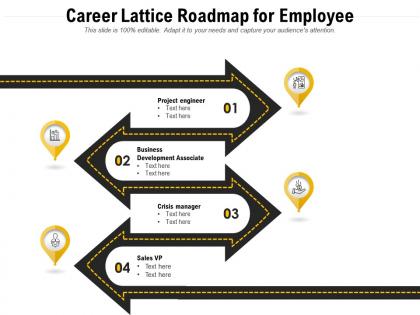
Career lattice roadmap for employee




Try Before you Buy Download Free Sample Product
 Impress Your
 Audience
 100%
100% Editable
 Save Hours
 of Time


Our Career Lattice Roadmap For Employee are explicit and effective. They combine clarity and concise expression.
People who downloaded this PowerPoint presentation also viewed the following :
Career lattice roadmap for employee with all 2 slides:
Give your audience a fulfilling experience. They will find our Career Lattice Roadmap For Employee elevating.
FAQs for Career lattice
Employers prioritize digital literacy, data analysis, emotional intelligence, adaptability, and strong communication skills in today's evolving marketplace. These competencies enable professionals to navigate remote collaboration, interpret business metrics, and drive innovation, with many organizations finding that candidates combining technical proficiency with interpersonal abilities deliver enhanced productivity and strategic value.
Professionals can effectively set career goals by defining specific objectives, conducting skills gap analyses, creating actionable timelines, seeking mentorship, and regularly reviewing progress. Through strategic networking, continuous learning, and measurable milestones, organizations increasingly find that employees with structured career planning deliver enhanced performance, greater innovation, and improved retention rates.
Networking accelerates career advancement by providing access to hidden job opportunities, industry insights, mentorship guidance, and professional referrals that often aren't available through traditional channels. Effective networking involves building genuine relationships through industry events, professional associations, and social platforms like LinkedIn, with many professionals finding that consistent, value-focused interactions ultimately deliver stronger career prospects and strategic opportunities.
Identifying unique strengths involves self-assessment through feedback tools, performance reviews, and recognizing tasks that energize you, while leveraging them requires aligning roles with these capabilities and seeking opportunities that maximize your natural talents. Many professionals find that strategic positioning around their strengths, whether analytical thinking, relationship building, or creative problem-solving, ultimately delivers faster career advancement and enhanced job satisfaction.
Standout resumes and cover letters require strategic customization, quantifiable achievements, clear formatting, compelling storytelling, and targeted keywords that align with specific job requirements. These documents enhance your professional narrative by showcasing measurable results, demonstrating cultural fit, and highlighting relevant skills, with many hiring managers finding that personalized applications significantly increase interview opportunities and career advancement prospects.
Mentorship accelerates career development by providing personalized guidance, industry insights, skill development opportunities, and strategic networking connections that enhance professional growth trajectories. Effective mentors combine relevant experience with strong communication skills, genuine investment in mentee success, and complementary expertise, with many professionals finding that strategic mentor relationships deliver faster promotions, expanded networks, and clearer career direction.
Online courses and certifications significantly enhance career growth by expanding skill sets, demonstrating commitment to professional development, increasing marketability to employers, and enabling career pivots into emerging fields. These credentials help professionals stay competitive in rapidly evolving industries like technology, healthcare, and finance, with many finding that strategic upskilling leads to promotions, salary increases, and new opportunities.
Professionals can navigate career transitions by conducting thorough market research, identifying transferable skills, building relevant networks, and pursuing targeted upskilling opportunities. Through strategic positioning and leveraging platforms like LinkedIn, many professionals successfully transition across sectors like finance to tech or healthcare to consulting, ultimately accelerating career growth.
Strategies include seeking new challenges within current roles, pursuing additional certifications, expanding professional networks, finding mentorship opportunities, and setting clear career goals with actionable timelines. These approaches enable professionals to break through plateaus by enhancing skills, increasing visibility, and creating advancement pathways, with many organizations finding that proactive employees who demonstrate growth mindset ultimately deliver greater value and secure competitive positioning.
Work-life balance significantly impacts long-term career satisfaction by reducing burnout, enhancing productivity, and enabling sustainable professional growth over decades. While achieving perfect balance presents challenges, organizations increasingly recognize that employees with flexible schedules, manageable workloads, and personal time ultimately deliver higher performance, greater creativity, and stronger loyalty, creating competitive advantages through reduced turnover.
Professional development resources include online learning platforms, industry certifications, mentorship programs, professional associations, and skill-building workshops. These tools enhance career growth by providing specialized knowledge, networking opportunities, and credentialing, with many professionals finding that strategic combinations of formal training and peer connections ultimately deliver accelerated advancement and competitive positioning in increasingly dynamic markets.
Personal branding significantly influences career opportunities by establishing professional credibility, showcasing unique expertise, and creating memorable impressions with potential employers and industry connections. Through strategic online presence, thought leadership content, and consistent professional messaging, professionals enhance their visibility in competitive markets, attract targeted opportunities, and ultimately position themselves as go-to experts in their fields.
Remote work trends include hybrid flexibility, digital collaboration tools, outcome-based performance metrics, virtual team management, and expanded global talent pools. These shifts enable professionals to develop stronger digital communication skills, time management capabilities, and cross-cultural competencies, while organizations increasingly find that remote-ready employees deliver enhanced productivity and broader market reach.
Effective interview preparation involves researching the company and role thoroughly, practicing common behavioral questions using the STAR method, and preparing specific examples that demonstrate relevant skills and achievements. This strategic approach enables candidates to articulate their value proposition confidently, address potential concerns proactively, and showcase cultural fit, ultimately delivering stronger first impressions and competitive advantage over other applicants.
Participating in professional organizations and volunteer work delivers networking opportunities, skill development, leadership experience, industry insights, and enhanced credibility within your field. These activities enable career advancement by expanding professional connections, demonstrating commitment beyond job requirements, and providing platforms to showcase expertise, with many professionals finding that active participation accelerates promotion opportunities and opens new career pathways.
No Reviews