


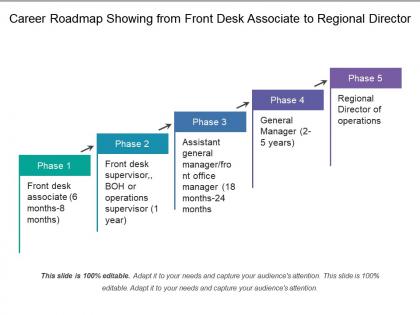
Career roadmap showing from front desk associate to regional director




Try Before you Buy Download Free Sample Product
 Impress Your
 Audience
 100%
100% Editable
 Save Hours
 of Time


Experience amazing entertainment with our Career Roadmap Showing From Front Desk Associate To Regional Director. The audience will dance to your beat.
People who downloaded this PowerPoint presentation also viewed the following :
Career roadmap showing from front desk associate to regional director with all 5 slides:
Display a high degree of astuteness with our Career Roadmap Showing From Front Desk Associate To Regional Director. Get conditions in your favour from the beginning.
FAQs for Career roadmap showing from front desk associate
Key milestones typically include entry-level skill development, specialized expertise acquisition, team leadership responsibilities, strategic decision-making roles, and executive management positions. While timelines vary significantly across sectors, professionals in finance, healthcare, technology, and manufacturing generally find that advancing through these stages requires continuous learning, cross-functional experience, and measurable performance outcomes, ultimately delivering enhanced earning potential and strategic influence.
Mentorship accelerates career advancement by providing strategic guidance, expanding professional networks, and offering insider knowledge about industry trends and organizational dynamics. Through experienced mentors, professionals gain access to leadership opportunities, skill development frameworks, and decision-making insights, while building confidence and visibility within their organizations, ultimately delivering faster promotions and enhanced career trajectory positioning.
Continuous learning drives career advancement by keeping skills relevant, expanding expertise, and demonstrating adaptability to employers seeking growth-minded professionals. In rapidly evolving industries like technology, finance, and healthcare, professionals who pursue certifications, advanced training, and cross-functional knowledge consistently secure promotions, leadership roles, and higher compensation, ultimately positioning themselves as indispensable strategic assets.
Networking strategies evolve from seeking mentorship and learning opportunities to building strategic partnerships and industry influence as careers advance. Early professionals focus on skill development and guidance, while senior leaders emphasize knowledge sharing, board positions, and cross-industry collaborations, with many finding that authentic relationship-building ultimately delivers sustainable competitive advantage throughout their progression.
Common barriers to career progression include limited skill development, inadequate networking, unclear goal setting, resistance to change, and insufficient mentorship opportunities. These challenges can be overcome by pursuing continuous learning through training programs, actively building professional relationships, setting specific career objectives with measurable milestones, embracing new responsibilities, and seeking guidance from experienced professionals, ultimately delivering enhanced performance and accelerated advancement.
Personal branding significantly impacts career advancement by establishing professional credibility, differentiating expertise, and creating visibility among industry leaders and decision-makers. Through strategic content sharing, thought leadership, and consistent professional messaging, professionals in competitive fields like consulting, finance, and technology enhance their market positioning, attract strategic opportunities, and ultimately accelerate career progression while building lasting professional relationships.
**INPUT**: What skills are most sought after for career progression in today's job market? **OUTPUT**: Most sought-after skills for career progression include digital literacy, data analysis, emotional intelligence, adaptability, and strategic thinking. These competencies enhance professional value by streamlining decision-making, improving team collaboration, and enabling strategic problem-solving, with many organizations finding that employees combining technical expertise with leadership capabilities ultimately deliver competitive advantage and drive innovation.
Performance reviews significantly influence promotion decisions by documenting achievements, identifying skill gaps, setting development goals, and providing formal feedback records that managers reference during advancement considerations. These evaluations create a structured framework for career progression, with many organizations using review scores, improvement metrics, and goal attainment as key criteria, ultimately helping employees demonstrate readiness for increased responsibilities and leadership roles.
Individuals can effectively navigate career transitions by conducting thorough market research, identifying transferable skills, building relevant networks, and pursuing targeted upskilling or certifications. Through strategic planning and leveraging existing expertise, professionals across industries like healthcare, finance, and technology successfully transition by emphasizing adaptable competencies, ultimately gaining competitive advantage and expanded opportunities.
Lateral moves offer skill diversification, cross-functional expertise, broader organizational understanding, and expanded internal networks, while upward promotions deliver increased compensation, leadership responsibilities, and formal authority. These strategic approaches work together to accelerate career development, with many professionals finding that lateral experiences ultimately strengthen their candidacy for senior roles and enhance long-term earning potential.
Company culture significantly influences career progression by shaping promotion criteria, mentorship availability, learning opportunities, and performance evaluation methods. Organizations with collaborative cultures often emphasize cross-functional development and knowledge sharing, while competitive environments may prioritize individual achievements, with many professionals finding that cultural alignment accelerates advancement through clearer expectations and stronger internal advocacy.
Best practices for setting and achieving career goals include defining specific objectives, creating measurable milestones, conducting regular skills assessments, building strategic networks, and maintaining flexibility for market changes. These approaches enhance professional development by aligning personal aspirations with industry demands, establishing clear timelines, and creating accountability systems, with many professionals finding that consistent review and adaptation ultimately delivers accelerated growth and competitive positioning.
Employees can leverage feedback by actively seeking regular input from supervisors, peers, and mentors, identifying specific skill gaps, and creating targeted development plans based on insights received. This strategic approach enables professionals to address weaknesses, amplify strengths, and align their growth with organizational expectations, ultimately accelerating promotions and career advancement opportunities.
Work-life balance is essential for sustainable career growth, preventing burnout while maintaining peak performance, creativity, and decision-making abilities over time. Professionals with balanced approaches often demonstrate greater resilience, stronger leadership capabilities, and enhanced problem-solving skills, with many organizations increasingly recognizing that employees who manage personal well-being alongside professional demands deliver superior long-term results and innovation.
Emotional intelligence contributes to career advancement by enhancing leadership capabilities, improving interpersonal relationships, and enabling better decision-making under pressure. Professionals with strong emotional intelligence excel in team management, client interactions, and organizational change, with many finding that these skills become increasingly valuable in senior roles where technical expertise alone isn't sufficient for success.
-
Great product with effective design. Helped a lot in our corporate presentations. Easy to edit and stunning visuals.
-
Enough space for editing and adding your own content.