


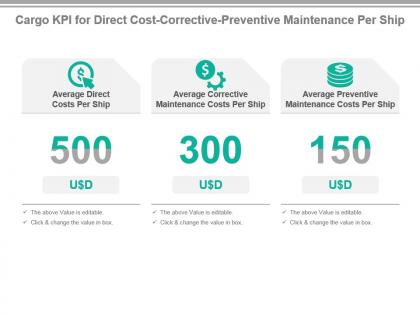
Cargo kpi for direct cost corrective preventive maintenance per ship powerpoint slide




Try Before you Buy Download Free Sample Product
 Impress Your
 Audience
 100%
100% Editable
 Save Hours
 of Time


Initiate innovation with our Cargo Kpi For Direct Cost Corrective Preventive Maintenance Per Ship Powerpoint Slide. Focus on bringing about change for the better.
People who downloaded this PowerPoint presentation also viewed the following :
Cargo kpi for direct cost corrective preventive maintenance per ship powerpoint slide with all 5 slides:
Feelings of bonhomie get a definite boost due to our Cargo Kpi For Direct Cost Corrective Preventive Maintenance Per Ship Powerpoint Slide. It adds to the existing cordiality.




FAQs for Cargo kpi for direct cost corrective preventive maintenance per
Cargo transportation efficiency KPIs include on-time delivery rates, cargo capacity utilization, cost per shipment, transit time variance, and damage/loss ratios. These metrics enable logistics companies to streamline operations by identifying bottlenecks, optimizing route planning, and enhancing resource allocation, with many freight operators finding that consistent KPI monitoring ultimately delivers reduced operational costs and improved customer satisfaction.
Cargo KPI data optimizes supply chain management by identifying bottlenecks, predicting demand patterns, and streamlining route efficiency across transportation networks. Through real-time analytics, logistics companies enhance delivery schedules, reduce operational costs, and improve inventory allocation, with many freight organizations finding that data-driven insights ultimately deliver competitive advantage and superior customer experiences.
KPIs enable freight carriers to demonstrate reliability through measurable metrics like on-time delivery rates, damage frequency, transit time consistency, and service quality scores. These performance indicators help shippers evaluate carrier partnerships objectively, with logistics companies and manufacturing firms finding that comprehensive KPI tracking streamlines vendor selection, reduces supply chain risks, and ultimately delivers more predictable freight operations.
IoT and blockchain enhance cargo KPI tracking by providing real-time monitoring, immutable data records, and end-to-end supply chain visibility. These technologies streamline operations by automating data collection, reducing manual errors, and enabling predictive analytics, with logistics companies and freight forwarders finding significantly improved delivery accuracy, reduced costs, and enhanced customer transparency.
Industry standards for cargo KPI benchmarks include on-time delivery rates of 95-98%, damage rates below 0.5%, cost per shipment optimization, and customer satisfaction scores above 90%. These benchmarks enable logistics companies to streamline operations, enhance service reliability, and maintain competitive advantage, with many transportation firms finding that consistent KPI monitoring ultimately delivers improved operational efficiency and stronger client relationships.
Companies effectively communicate cargo KPI results through visual dashboards, regular performance reports, stakeholder-specific presentations, and automated alerts for critical metrics. These communication strategies enhance transparency and accountability by presenting complex logistics data in accessible formats, enabling stakeholders across operations, finance, and customer service to make informed decisions, ultimately strengthening partnerships and operational alignment.
Common pitfalls when setting cargo KPIs include selecting too many metrics, focusing solely on lagging indicators, ignoring data quality issues, setting unrealistic targets, and failing to align KPIs with strategic objectives. While many logistics companies initially overcomplicate their measurement systems, successful organizations streamline their approach by prioritizing actionable metrics that drive operational efficiency, ultimately delivering better customer service and competitive advantage.
Seasonal variations significantly impact cargo performance metrics through fluctuating demand patterns, weather-related delays, capacity constraints, and resource allocation challenges. During peak seasons like holidays, logistics companies experience increased volumes and extended delivery times, while agricultural cycles affect freight rates and transportation efficiency, with many organizations finding that adaptive forecasting and flexible capacity planning ultimately deliver improved operational resilience.
Priority KPIs for international shipping operations include on-time delivery rates, customs clearance times, cost per shipment, cargo damage rates, and documentation accuracy percentages. These metrics enable logistics managers to streamline cross-border processes, minimize delays at ports, and reduce compliance risks, with many global retailers finding that focusing on these KPIs delivers faster transit times and enhanced customer satisfaction.
Companies ensure cargo KPI data accuracy through automated data collection systems, real-time tracking technologies, standardized measurement protocols, regular data validation processes, and integrated supply chain platforms. These approaches minimize manual errors, enhance transparency across logistics operations, and deliver consistent reporting standards, with many transportation organizations finding that automated systems significantly improve decision-making capabilities and operational efficiency.
Real-time tracking revolutionizes cargo performance metrics by enabling instant visibility into shipment locations, delivery times, temperature controls, and potential delays throughout the supply chain. This enhanced transparency allows logistics companies, manufacturers, and retailers to proactively address issues, optimize routes, and improve customer communications, ultimately delivering reduced costs and superior service reliability.
Environmental considerations significantly influence cargo KPI measurement by integrating carbon footprint tracking, fuel efficiency metrics, sustainable packaging ratios, and emission reduction targets alongside traditional performance indicators. Through green logistics frameworks, companies monitor environmental compliance, optimize route planning for reduced emissions, and measure sustainable transportation modes, with many logistics providers finding that environmental KPIs enhance operational efficiency while meeting regulatory requirements and customer sustainability expectations.
Companies should monitor delivery time accuracy, cost per shipment, cargo damage rates, fuel efficiency metrics, and customer satisfaction scores to maintain competitive advantage. These KPIs enable logistics providers to streamline operations, reduce expenses, and enhance service quality, with many freight companies finding that consistent tracking of these metrics ultimately delivers improved operational efficiency and stronger client relationships in an increasingly demanding market.
A balanced scorecard approach improves cargo KPI analysis by integrating financial, operational, customer, and learning perspectives into comprehensive performance measurement, ensuring strategic alignment across all business dimensions. This framework enables logistics companies to balance cost efficiency with service quality, delivery speed with resource optimization, and short-term performance with long-term strategic growth, ultimately delivering more informed decision-making.
Best practices for integrating cargo KPIs into existing logistics software include establishing standardized data formats, implementing real-time API connections, creating automated data validation protocols, and designing user-friendly dashboards with customizable metrics. These integrations streamline operations by enhancing visibility, reducing manual reporting errors, and enabling data-driven decision making, with many logistics companies finding that seamless KPI integration ultimately delivers improved operational efficiency and competitive advantage.
-
Presentation Design is very nice, good work with the content as well.
-
Use of icon with content is very relateable, informative and appealing.