


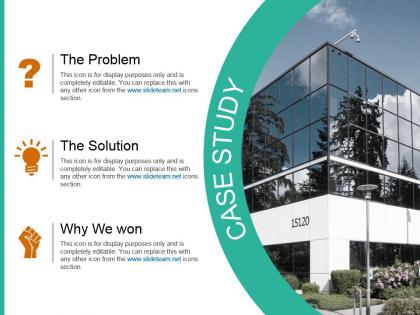
Case study for corporate strategy ppt template





Try Before you Buy Download Free Sample Product
 Impress Your
 Audience
 100%
100% Editable
 Save Hours
 of Time


You’ve already put in a lot of effort preparing a solid business case for your project. If you are now planning to present it to your team, we have a readymade case study for corporate strategy PPT template. Even the best of the plan fails if it’s not delivered perfectly. No matter how well researched and innovative your idea is, you won’t get a support unless it is convincing. That’s where this clear and straightforward corporate strategy case study PowerPoint presentation slide will help you out. This PowerPoint design can be used to design presentation on related topics such as business report, business management, strategic case study, strategic analysis, and strategic management evaluation. Case studies involve in-depth and detailed analysis of a subject and hence prove to be a great tool in training programs. Download case study for corporate strategy to triumph the critical presentation phase. Let our Case Study For Corporate Strategy Ppt Template accompany your thoughts. They are sure to go far.
People who downloaded this PowerPoint presentation also viewed the following :
Case study for corporate strategy ppt template with all 6 slides:
Goad budding entrepreneurs with our Case Study For Corporate Strategy Ppt Template. Direct them on the course to their goal.



FAQs for Case study for corporate
Honestly, most corporate strategies fail because people overcomplicate them. You need three things that actually matter: a vision everyone gets (not some fancy mission statement nobody reads), a real competitive edge that's tough to steal, and smart ways to spend your money across different parts of the business. Execution is where everything usually goes to hell though - companies love their PowerPoint decks but can't actually do the work. Keep it simple enough that your teams won't mess it up. Oh, and start by figuring out what you're genuinely good at versus what's just bleeding money.
Honestly, most companies totally blow this - they say one thing but their strategy does something completely different. First step is getting crystal clear on your mission and vision. Then audit what you're actually doing strategically. Like if you're all about sustainability but choosing the cheapest suppliers who trash the environment? Yeah, that's not gonna work. I'd do quarterly check-ins where you literally ask "does this move us toward our mission?" Sounds simple but it'll save you from that slow mission drift that happens when you're not paying attention. Keeps everyone honest too.
Look, market analysis is basically your roadmap for everything else. Without it, you're flying blind. Study your competitors first - who they target, what they charge, where they're weak. Then dig into what customers actually want (not what you think they want). Honestly, I've seen too many companies skip this step and wonder why their strategy flops. It's like trying to navigate without GPS. The trends and data will show you real opportunities instead of just wishful thinking. Start with competitor mapping and customer segments - that combo gives you the clearest direction for your next moves.
So basically, figure out what you're actually good at first - like are you cheaper, faster, have better tech, stronger brand, whatever. Then build everything around those strengths. Don't chase strategies where you're fighting uphill against people who naturally have the advantage there. Think of it like... you wouldn't try to out-swim a fish, right? Play to what you've got. Honestly though, most companies are terrible at this self-assessment part. They think they're good at stuff they're really just average at. So be brutal about what your real advantages are vs. what you wish they were.
Honestly, most companies just overcomplicate everything. They chase like 5 different opportunities at once instead of nailing one thing first. I see it all the time - teams get stuck endlessly analyzing instead of actually doing anything. Plus people fall in love with their brilliant ideas and completely ignore what customers are telling them (which is usually the opposite, lol). Oh and here's a big one: they forget to get everyone on board early, so later half the team's going one direction while the other half does something totally different. Keep it simple, test your assumptions fast, and make sure you're all rowing the same way before going all-in.
Honestly, start by figuring out who actually matters for your strategy - employees, customers, investors, the usual suspects. Then get them involved BEFORE you make decisions, not after. I totally screwed this up once and missed a huge regulatory issue that any community group could've flagged early on. Advisory panels work great, or just do surveys and town halls. The key thing is making it a real conversation. Don't just present your finished plan and call it "engagement" - people see right through that BS. Focus on the stakeholders who can make or break your objectives first.
Honestly, you gotta do both things at once - keep milking your current business while experimenting with the new stuff. Microsoft crushed this by building their cloud empire without killing their existing software goldmine. Don't fall into that trap of writing off disruptors as "not ready yet" (seen that backfire so many times). Set up separate teams to play around with pilots, maybe partner with some scrappy startups, or just buy out potential competitors before they get too big. The trick is starting this when you're still making bank, not scrambling later.
Honestly, going global will flip your whole strategy upside down. You can't just take what works here and drop it somewhere else - each market has its own weird customer habits and regulations. Currency swings alone will mess with your head. Supply chains get way more complicated too, and cultural stuff catches everyone off guard (learned that one the hard way). Your money gets spread thin across regions instead of focusing locally. Pick maybe 2-3 markets first and really test if your main idea even works there. Don't go crazy expanding everywhere at once.
Track the obvious stuff first - revenue growth, profits, market share. But here's the thing: those numbers show you what already happened, not what's coming. Customer satisfaction and employee engagement matter just as much, maybe more. Operational efficiency too. Oh, and don't forget how your innovation pipeline looks compared to competitors. Pick like 5-7 metrics that actually connect to your strategy goals. Review quarterly so you're not flying blind. The financial stuff's important but it won't save you if everything else is falling apart.
Think of scenario planning as stress-testing your strategy against different futures. Map out 3-4 ways your industry could change - tight regulations, disruptive tech, economic shifts, whatever. It's like having backup routes on GPS (okay weird analogy but you get it). Each scenario should feel realistic but different enough to actually challenge what you're assuming. The whole point is spotting blind spots in your current plan. You'll end up building way more flexibility into decisions instead of just crossing your fingers and hoping one prediction works out.
Look, culture is honestly what makes or breaks your whole strategy. When they don't match up, you'll get pushback everywhere - employees won't buy in, managers will find ways around it. It's such a headache. But flip that around? People actually want to help when the culture supports what you're doing. My advice: figure out early where your current culture might clash with your goals. Then you can tackle those gaps through better communication, training, maybe some structural tweaks. Otherwise you're just fighting an uphill battle the whole time.
M&A is basically how you execute your bigger strategy. Your corporate plan tells you *what* you want - new markets, better tech, more scale. Acquisitions are the *how*. Way faster than building stuff from scratch, honestly. You can snag competitors, grab talent you'd never hire otherwise, or fill gaps that would take years to develop internally. I've seen companies completely transform overnight through smart deals. Just don't get distracted by every opportunity that comes along. Make sure whatever you're buying actually helps your main goals. Too many deals happen because something looks cool, not because it makes strategic sense.
Make your business flexible - like, operations that can quickly shrink or grow when things get crazy. Don't put all your eggs in one basket either, diversify those revenue streams. Cash flow is everything when markets go nuts. Strong customer relationships help too, plus good data so you catch trends early. The companies that actually survive this stuff? They stay lean and can shift what they're selling without rebuilding everything from scratch. Oh, and definitely stress-test your strategy against different scenarios first - you'll be surprised what weak spots pop up.
Honestly, you've gotta connect your CSR stuff to what your business actually does well. Find that sweet spot where your company's strengths meet real social problems - tech companies doing digital literacy makes way more sense than random tree planting, you know? Pick maybe 2-3 things max that'll actually help your brand and attract good people, not just look nice in annual reports. I've seen too many companies throw money at disconnected causes and wonder why it doesn't move the needle. Map out what you're genuinely good at against issues in your space, then focus on programs that create real impact while helping your bottom line.
Honestly, innovation is what separates companies that thrive from ones that just survive. Look at Netflix - they went from mailing DVDs to streaming to making their own shows. Each move forced them to completely rethink their strategy. Companies that bake innovation into their core strategy? They're usually the ones creating new markets instead of scrambling to catch up. It's not just about cool new products either - sometimes it's reimagining how you operate or who you're targeting. Whenever I'm looking at a business case, I always check: how's their innovation strategy driving their long-term game plan?
-
Unique and attractive product design.
-
Illustrative design with editable content. Exceptional value for money. Highly pleased with the product.