


Diapositiva de PowerPoint de estudio de caso para investigación de mercados




Try Before you Buy Download Free Sample Product
 Impress Your
 Audience
 100%
100% Editable
 Save Hours
 of Time


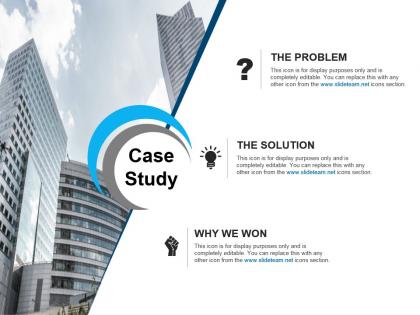
Cree presentaciones comerciales de alta calidad utilizando nuestro estudio de caso prediseñado para diapositiva de PowerPoint de investigación de mercado. Esto será útil al presentarse frente a los gerentes durante las reuniones de la junta. Puede hacer uso del diseño de fondo artístico para hacer sus propias diapositivas sobre los resultados de la investigación de mercado, investigación de mercado B2B, investigación cualitativa y cuantitativa, información de mercado, investigación publicitaria, estudio etnográfico, mezcla de investigación de mercado y ciencia de marketing. Una combinación de color gris y azul le da al visual un aspecto limpio y profesional. La ilustración PPT del estudio de caso de investigación de mercado contiene tres elementos, a saber, el problema, la solución y por qué ganamos. Aparte de esto, también se han incluido íconos comerciales relevantes que puede reemplazar con los íconos adicionales proporcionados en la última diapositiva. Descargue el diagrama de presentación del estudio de caso para la investigación de mercados, ya que será útil para tomar decisiones adecuadas relacionadas con el negocio. Lleve a casa los beneficios de ser una fuerza cohesiva con nuestro estudio de caso para la investigación de mercados Powerpoint Slide. Insista en un esfuerzo conjunto.
People who downloaded this PowerPoint presentation also viewed the following :
Caso de estudio para investigación de mercados Diapositiva de PowerPoint con las 6 diapositivas:
La gente se siente realmente feliz por usted gracias a nuestro estudio de caso para investigación de mercados en PowerPoint. Le ayuda a transmitir su alegría.
FAQs for Case study for marketing
Marketing research objectives in case studies typically include identifying target market demographics, analyzing consumer behavior patterns, evaluating brand perception and competitive positioning, and measuring campaign effectiveness across multiple channels. These objectives enable organizations to streamline strategic decision-making, enhance customer segmentation accuracy, and optimize resource allocation, with many companies finding that comprehensive research ultimately delivers improved ROI and sustainable competitive advantage.
The research methodology directly influenced study outcomes by determining data quality, sample representativeness, and analytical depth through systematic collection processes, robust validation techniques, and comprehensive analytical frameworks. Through strategic methodology choices, organizations enhanced decision-making accuracy, minimized market entry risks, and optimized resource allocation, with many companies finding that rigorous research design ultimately delivers more actionable insights and competitive advantage.
Primary data sources include customer surveys, focus groups, in-depth interviews, observational studies, and experimental research conducted specifically for this study. Secondary data sources encompass industry reports, competitor analysis, government statistics, academic publications, and existing company databases, with many organizations finding that this strategic combination delivers comprehensive market insights while minimizing research costs and accelerating decision-making processes.
Target audiences are typically defined through demographic analysis, psychographic profiling, behavioral patterns, geographic considerations, and needs-based criteria during initial research phases. Through surveys, focus groups, and data analytics, marketing researchers segment audiences by factors like age, income, lifestyle preferences, and purchase behaviors, ultimately delivering precise customer personas that enable more targeted campaigns and strategic messaging approaches.
Data collection challenges included participant non-response, survey fatigue, sampling bias, inconsistent response quality, and limited access to target demographics. These obstacles required researchers to implement multiple outreach strategies, incentive programs, and validation techniques, while many marketing teams found that diversifying collection methods and extending timelines ultimately delivered more comprehensive insights and reliable datasets.
The study strategically combined qualitative methods like focus groups and in-depth interviews with quantitative surveys and analytics data to capture both consumer sentiment and measurable behavior patterns. This balanced approach enabled researchers to understand the "why" behind purchasing decisions through qualitative insights, while quantitative data validated trends across larger market segments, ultimately delivering comprehensive findings that informed both creative strategy and budget allocation decisions.
Data analysis employed statistical software like SPSS and R, survey platforms such as Qualtrics and SurveyMonkey, visualization tools including Tableau and Power BI, and social media analytics platforms. These technologies streamline market insights by automating data collection, enhancing pattern recognition, and delivering comprehensive reporting, with many organizations finding that integrated analytics ultimately accelerate decision-making and competitive positioning.
Research findings typically influence marketing strategy by reshaping target audience segmentation, refining messaging approaches, optimizing channel selection, and adjusting product positioning based on consumer insights. Companies like retail brands and financial services leverage these insights to reallocate budgets toward higher-performing channels, enhance customer experiences, and ultimately deliver improved ROI while gaining competitive advantage in increasingly data-driven markets.
Marketing research project success is typically evaluated through response rates, sample representativeness, data quality scores, statistical significance levels, and actionable insight generation. These metrics enable organizations to assess research validity, reliability, and business impact, with many companies finding that combining quantitative accuracy measures with qualitative insight applicability delivers the most comprehensive evaluation of research effectiveness and strategic value.
The case study demonstrated how consumer insights drive strategic decision-making through behavioral analysis, preference mapping, demographic segmentation, and purchase pattern identification. These insights enabled organizations to enhance product development, streamline marketing campaigns, and optimize resource allocation, with many companies finding that data-driven consumer understanding ultimately delivers improved customer experiences and competitive advantage.
Researchers ensured validity through triangulation, using multiple data sources, standardized measurement instruments, and rigorous sampling methodologies to eliminate bias and confirm accuracy. They established reliability by conducting pilot tests, implementing inter-rater reliability checks, and using established frameworks, with many organizations finding that these systematic approaches ultimately deliver more actionable insights and strategic confidence.
Competitive analysis served as a critical framework for contextualizing market positioning, identifying industry benchmarks, pricing strategies, consumer preference gaps, and untapped opportunities within the competitive landscape. Through systematic competitor evaluation, researchers uncovered strategic insights that shaped product differentiation approaches, market entry timing, and value proposition development, ultimately enabling data-driven decisions that delivered sustainable competitive advantage.
Ethical considerations included obtaining informed consent from participants, ensuring data privacy and anonymity, avoiding leading questions that could bias responses, and maintaining transparency about research purposes and data usage. These protocols help organizations build trust with respondents while delivering reliable insights, with many companies finding that ethical research practices ultimately enhance data quality and support long-term customer relationships.
Insights from marketing research case studies can be applied to future efforts by identifying successful strategies, understanding target audience behaviors, optimizing channel performance, and refining messaging approaches. These learnings enable organizations to replicate winning tactics across different campaigns, avoid previously identified pitfalls, and enhance ROI, with many companies finding that systematic application of case study insights delivers significantly improved conversion rates and customer engagement.
Marketing research case studies reveal that successful outcomes stem from clear objective definition, robust data collection methodologies, cross-functional stakeholder involvement, and iterative testing approaches. These lessons inform best practices by emphasizing early hypothesis validation, diverse data source integration, and actionable insight translation, with many organizations finding that systematic documentation and post-campaign analysis ultimately deliver improved targeting accuracy and higher ROI.
-
Best way of representation of the topic.
-
Topic best represented with attractive design.