


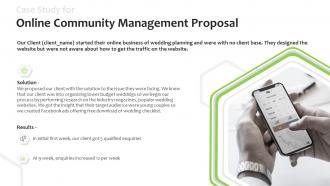
Case study for online community management proposal enquiries ppt powerpoint slides





Try Before you Buy Download Free Sample Product
 Impress Your
 Audience
 100%
100% Editable
 Save Hours
 of Time


Get folks to indulge in friendly activities with our Case Study For Online Community Management Proposal Enquiries Ppt Powerpoint Slides. It helps generate greater camaraderie.
People who downloaded this PowerPoint presentation also viewed the following :
Case study for online community management proposal enquiries ppt powerpoint slides with all 2 slides:
Camaraderie is created due to our Case Study For Online Community Management Proposal Enquiries Ppt Powerpoint Slides. People feel like expressing friendship.
FAQs for Case study for online community management proposal enquiries
Key responsibilities of an online community manager include content creation and curation, member engagement and relationship building, moderation and conflict resolution, analytics tracking, and strategic community growth initiatives. These professionals streamline brand communication by fostering meaningful conversations, addressing customer concerns promptly, and leveraging user-generated content, ultimately delivering enhanced customer loyalty and valuable market insights for organizations.
Community managers foster engagement by creating interactive content, facilitating meaningful discussions, recognizing active contributors, hosting virtual events, and responding promptly to member inquiries. Through gamification elements, exclusive content offerings, and peer-to-peer networking opportunities, organizations across industries like tech, healthcare, and finance ultimately build stronger member relationships and drive long-term community growth.
Essential online community management tools include social media management platforms, community forums, analytics dashboards, customer relationship management systems, and content scheduling applications. These technologies streamline engagement by automating responses, tracking member interactions, and monitoring sentiment across channels, with many organizations finding that integrated platforms deliver faster community growth, improved member retention, and enhanced brand loyalty.
**INPUT**: How do you measure the success of an online community? **OUTPUT**: Online community success is measured through engagement metrics like active users, post frequency, and response rates, combined with retention statistics, member growth, and content quality indicators. These metrics enable organizations to track community health, optimize member experiences, and demonstrate ROI, with many businesses finding that engaged communities ultimately deliver stronger customer loyalty and reduced support costs. [Word count: 57 words]
Effective conflict resolution strategies include active moderation, clear community guidelines, private mediation, transparent communication, and escalation protocols. Through proactive monitoring and swift intervention, community managers can address disputes before they escalate, while establishing neutral discussion spaces and consistent enforcement helps maintain positive engagement, ultimately preserving community trust and member retention.
Effective onboarding involves creating welcome sequences, providing clear community guidelines, offering introductory tutorials, facilitating mentor connections, and establishing early engagement opportunities. These strategies streamline member integration by reducing confusion, accelerating participation, and building meaningful connections, with many online communities finding that structured onboarding increases long-term retention and delivers stronger community engagement.
Content creation serves as the foundation of online community management, driving engagement through educational posts, discussion prompts, user-generated campaigns, interactive polls, and value-driven resources. This strategic approach enables community managers to maintain consistent member participation, foster meaningful conversations, and build brand loyalty, with many organizations finding that quality content ultimately delivers stronger community retention and enhanced customer relationships.
User feedback enhances community experiences by identifying pain points, revealing content preferences, highlighting feature gaps, and uncovering engagement barriers through surveys, polls, and direct conversations. Through systematic analysis of member insights, community managers can streamline navigation, customize content strategies, and implement targeted improvements, ultimately delivering more personalized experiences and stronger member retention across diverse online platforms.
Best practices for online community moderation include establishing clear community guidelines, training skilled moderators, implementing automated filtering tools, maintaining consistent enforcement policies, and fostering transparent communication channels. These approaches streamline community oversight by preventing toxic behavior, encouraging positive engagement, and building member trust, with many organizations finding that proactive moderation ultimately delivers stronger brand loyalty and healthier user interactions.
Demographics significantly influence community management strategies by shaping content preferences, communication styles, platform choices, engagement timing, and interaction methods across different age groups, cultures, and professional backgrounds. Understanding these demographic patterns enables community managers to tailor messaging, select appropriate channels, and create targeted engagement approaches, ultimately delivering more personalized experiences and stronger community loyalty across diverse member segments.
Methods to promote inclusivity include establishing clear community guidelines, implementing diverse moderation practices, creating welcoming onboarding processes, offering multilingual support, and fostering respectful dialogue through structured discussions. These approaches enhance member engagement by reducing barriers to participation, encouraging diverse perspectives, and building trust, with many organizations finding that inclusive communities deliver higher retention rates, broader user adoption, and stronger brand loyalty across demographics.
Community managers leverage analytics to drive growth by tracking engagement rates, member retention metrics, content performance data, and user behavior patterns to identify successful strategies. Through platforms like Google Analytics and social media insights, managers can optimize posting schedules, refine content strategies, and target high-value segments, ultimately delivering increased participation and community expansion.
Managing multicultural online communities presents challenges including language barriers, cultural misunderstandings, varying time zones, differing communication styles, and conflicting social norms. These complexities require strategic moderation approaches, multilingual support systems, and culturally sensitive content guidelines, with many global organizations finding that diverse perspectives ultimately enhance engagement and innovation when properly facilitated.
Creating belonging in virtual environments requires personalized welcome processes, consistent community rituals, peer-to-peer recognition systems, and shared goal initiatives that connect members meaningfully. Through interactive onboarding, regular virtual events, and member spotlight features, organizations like remote teams and online learning platforms foster deeper engagement, reduce turnover, and ultimately build thriving communities that drive sustained participation and loyalty.
Effective strategies include curated content prompts, regular themed discussions, user-generated challenges, expert AMAs, and milestone celebrations that encourage participation. These approaches work by creating consistent engagement touchpoints, fostering peer-to-peer interactions, and establishing community rituals, with many organizations finding that combining educational content with interactive elements ultimately drives sustained participation and builds stronger member relationships.
No Reviews