


Case Study On PayPal Training Ppt




Try Before you Buy Download Free Sample Product
 Impress Your
 Audience
 100%
100% Editable
 Save Hours
 of Time


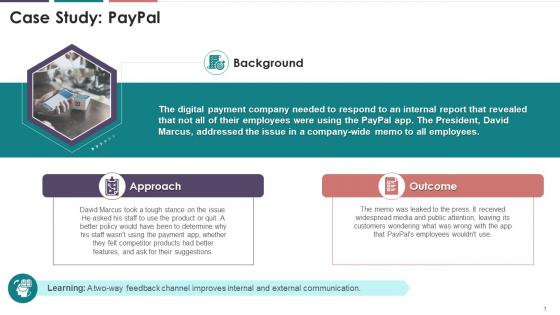
This slide illustrates a case study on PayPal. It highlights background, approach, outcome, and learning from the case study.
People who downloaded this PowerPoint presentation also viewed the following :
Case Study On PayPal Training Ppt with all 17 slides:
Use our Case Study On PayPal Training Ppt to effectively help you save your valuable time. They are readymade to fit into any presentation structure.










FAQs for Case Study On
PayPal faced significant challenges during inception including complex fraud detection systems, rapidly scaling customer support operations, regulatory compliance across multiple jurisdictions, and onboarding diverse technical teams with varying expertise levels. These challenges required specialized training solutions to streamline operations, enhance security protocols, and accelerate employee competency, with many fintech startups finding that comprehensive training programs ultimately deliver faster market adaptation and sustainable competitive advantage.
PayPal's training programs evolved through continuous curriculum updates, hands-on technology workshops, cross-functional collaboration initiatives, and real-time market response simulations. These strategic approaches enabled employees to master emerging fintech innovations, regulatory changes, and customer experience technologies, while fostering agile thinking and competitive positioning in an increasingly complex digital payments landscape.
Employee training significantly enhanced PayPal's customer service by developing comprehensive product knowledge, improving communication skills, streamlining resolution processes, and building empathy-driven interactions. Through structured programs, PayPal representatives deliver faster issue resolution, personalized support experiences, and proactive guidance, with many customers finding that well-trained agents ultimately reduce transaction concerns while increasing platform confidence.
PayPal integrated compliance training by embedding regulatory education into onboarding programs, creating role-specific modules for different departments, and implementing continuous learning pathways with real-world scenario simulations. Through interactive workshops and regular assessment cycles, employees develop practical understanding of financial regulations, data protection requirements, and fraud prevention protocols, ultimately ensuring regulatory adherence while maintaining operational efficiency across global operations.
PayPal's cybersecurity training programs emphasized threat identification, secure coding practices, incident response protocols, data protection compliance, and social engineering recognition skills. These comprehensive programs enabled employees to detect phishing attempts, implement robust authentication measures, and respond effectively to security breaches, with many financial services organizations finding that such targeted training significantly reduces cyber vulnerabilities while enhancing overall security posture.
PayPal's training methodologies promoted collaboration through cross-functional workshops, shared digital platforms, mentorship programs, and team-based problem-solving exercises. These approaches streamlined communication between engineering, finance, and customer service teams, while fostering knowledge sharing and breaking down departmental silos, ultimately delivering enhanced project coordination and faster innovation cycles across their global operations.
PayPal measures training effectiveness through performance metrics including employee productivity scores, skill assessment improvements, training completion rates, and post-training performance evaluations. These comprehensive analytics enable the company to track knowledge retention, measure behavioral changes in workplace applications, and correlate training investments with business outcomes like reduced onboarding time and enhanced customer service quality.
PayPal integrates diversity and inclusion into training through unconscious bias workshops, inclusive leadership development programs, cultural competency sessions, and mentorship initiatives for underrepresented groups. These comprehensive programs enhance decision-making, foster innovation, and strengthen team collaboration across global offices, with many financial services organizations finding that such strategic training approaches ultimately deliver improved employee engagement and competitive advantage in diverse markets.
PayPal has implemented gamified learning modules, virtual reality simulations, microlearning bite-sized sessions, peer-to-peer mentoring platforms, and interactive video conferencing workshops to engage remote employees effectively. These innovative approaches streamline knowledge retention, enhance collaborative problem-solving, and deliver personalized skill development, with many financial services organizations finding that such strategic combinations ultimately boost employee satisfaction and operational productivity.
PayPal maintains training relevance through continuous content auditing, real-time industry monitoring, partnerships with fintech innovators, and agile curriculum updates that reflect emerging payment technologies and regulatory changes. The company leverages data analytics to track skill gaps, collaborates with external experts, and implements feedback loops from employees across global markets, ultimately ensuring teams stay proficient with evolving digital payment landscapes and competitive financial services.
PayPal's training programs support leadership development through mentorship initiatives, cross-functional project assignments, executive coaching sessions, leadership competency workshops, and strategic decision-making simulations. These comprehensive approaches enable emerging leaders to build critical skills like team management, financial oversight, and stakeholder communication, while seasoned executives enhance their capabilities in digital transformation and global market expansion, ultimately delivering stronger organizational performance and competitive advantage.
PayPal has achieved significant success integrating gamification into training through interactive simulations, achievement badges, leaderboards, and scenario-based challenges that enhance employee engagement and knowledge retention. These gamified approaches have streamlined onboarding processes, improved compliance training completion rates, and accelerated skill development across teams, with many financial services organizations finding that gamification delivers measurable improvements in training effectiveness and employee performance outcomes.
PayPal has partnered with leading educational institutions, technology providers, and industry organizations to enhance its training programs through expanded curriculum development, certification pathways, and specialized skill-building modules. These strategic collaborations enable comprehensive learning experiences across fintech, cybersecurity, and digital payments, with many financial services organizations finding that such partnerships deliver enhanced employee expertise, faster onboarding processes, and ultimately stronger competitive positioning in the digital payments landscape.
PayPal leverages customer feedback and employee performance data to identify training gaps, customize learning paths, and enhance service quality across their global operations. Through advanced analytics platforms, they analyze transaction feedback, support interactions, and performance metrics to create targeted training modules, ultimately delivering improved customer experiences, faster issue resolution, and enhanced employee competency in an increasingly competitive fintech landscape.
PayPal anticipates several key training trends reshaping fintech, including AI-powered personalized learning paths, immersive virtual reality simulations for complex financial scenarios, microlearning modules for regulatory compliance, and blockchain-based credential verification systems. These innovations streamline knowledge acquisition while enhancing skill retention, with many financial institutions finding that adaptive learning technologies significantly reduce training time and improve employee performance in an increasingly digital financial landscape.
-
Graphics are very appealing to eyes.
-
This visual representation is stunning and easy to understand. I like how organized it is and informative it is.