


Challenges Of Natural Language Processing Ppt Powerpoint Presentation Layouts Images




Try Before you Buy Download Free Sample Product
 Impress Your
 Audience
 100%
100% Editable
 Save Hours
 of Time


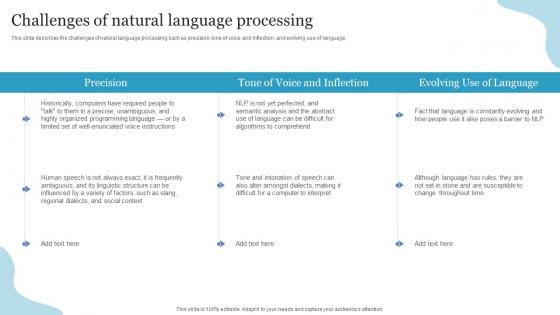
This slide describes the challenges of natural language processing such as precision, tone of voice and inflection, and evolving use of language.
People who downloaded this PowerPoint presentation also viewed the following :
Challenges Of Natural Language Processing Ppt Powerpoint Presentation Layouts Images with all 6 slides:
Use our Challenges Of Natural Language Processing Ppt Powerpoint Presentation Layouts Images to effectively help you save your valuable time. They are readymade to fit into any presentation structure.





FAQs for Challenges Of Natural Language Processing Ppt Powerpoint
Primary challenges include lexical ambiguity, syntactic ambiguity, semantic ambiguity, pragmatic ambiguity, and contextual disambiguation, which complicate accurate text interpretation and meaning extraction. These complexities present both obstacles and opportunities for organizations implementing NLP solutions, with many financial institutions and healthcare providers finding that advanced disambiguation techniques ultimately enhance customer service automation and document processing accuracy.
Language syntax diversity significantly challenges NLP models through varying grammatical structures, word order patterns, sentence constructions, and linguistic rules across different languages and dialects. These variations require models to adapt to multiple parsing frameworks, semantic interpretations, and contextual dependencies, with many organizations finding that multilingual applications demand more sophisticated training data and algorithmic approaches to maintain accuracy and deliver consistent user experiences globally.
Context plays a crucial role in NLP's interpretation of idiomatic expressions by analyzing surrounding words, sentence structure, cultural references, and situational cues to determine non-literal meanings. Through advanced contextual models, businesses in customer service, content localization, and cross-cultural communication can deliver more accurate translations and responses, ultimately enhancing global customer experiences and reducing miscommunication costs.
Improving NLP models for low-resource languages involves transfer learning from high-resource languages, multilingual pre-training, data augmentation techniques, cross-lingual embeddings, and synthetic data generation. These approaches enable organizations to expand global operations by delivering automated translation services, customer support systems, and content localization across diverse markets, ultimately enhancing international competitiveness and accessibility.
Linguistic nuances like sarcasm and irony present significant challenges for NLP systems, requiring advanced context analysis, sentiment detection algorithms, and cultural understanding frameworks to interpret meaning accurately. These complexities can impact customer service chatbots, social media monitoring tools, and automated content analysis platforms, with many organizations finding that addressing these nuances enhances user experiences and delivers more reliable automated communications.
Cultural references significantly impact NLP accuracy by creating interpretation gaps, context misunderstandings, and localized meaning challenges that standard models struggle to decode effectively. Financial services firms and healthcare organizations increasingly find that culturally-aware NLP systems deliver enhanced customer interactions, reduced miscommunications, and improved service quality, ultimately providing competitive advantage in diverse markets.
Data privacy and ethical concerns challenge NLP deployment through stringent compliance requirements, consent management complexities, algorithmic bias risks, and cross-border data transfer restrictions. These challenges create both operational hurdles and strategic opportunities, with many organizations finding that proactive privacy-by-design approaches and ethical AI frameworks ultimately deliver competitive advantage while building customer trust in an increasingly regulated landscape.
Current sentiment analysis approaches struggle with contextual nuance, sarcasm detection, cultural language variations, mixed emotions within single texts, and domain-specific terminology interpretation. While these limitations present challenges, organizations in customer service, social media monitoring, and market research are increasingly combining multiple AI models with human oversight, ultimately delivering more accurate emotional insights and enhanced customer understanding across diverse communication channels.
Addressing NLP bias requires diverse, representative training datasets, regular algorithmic auditing, and inclusive development teams with varied perspectives. Organizations implement bias detection tools, continuous model monitoring, and fairness metrics throughout development cycles, with companies like Google and Microsoft establishing dedicated AI ethics teams to ensure equitable outcomes across different demographic groups, ultimately delivering more trustworthy automated systems.
Processing multilingual content presents challenges including language-specific grammar rules, cultural context variations, limited training data for less common languages, character encoding differences, and cross-lingual semantic understanding complexities. These obstacles require sophisticated translation models, extensive multilingual datasets, and cultural adaptation frameworks, with many global organizations finding that strategic investment in diverse language processing ultimately delivers broader market reach and enhanced international customer experiences.
NLP models can better handle domain-specific language through transfer learning, custom training datasets, contextual embeddings, and continuous fine-tuning on specialized vocabularies. Healthcare systems, legal firms, and financial institutions increasingly leverage domain-adapted models that learn industry terminology through targeted training, ultimately delivering more accurate text analysis and improved automated customer interactions.
Noisy data and spelling errors significantly reduce NLP accuracy by causing misinterpretation of text, incorrect entity recognition, flawed sentiment analysis, and compromised language understanding across applications. While these challenges present obstacles, many organizations are implementing robust preprocessing techniques, advanced error correction algorithms, and machine learning models that adapt to variations, ultimately delivering improved text processing capabilities and more reliable automated language services in customer support, content analysis, and document processing systems.
Ensuring NLP accessibility requires implementing voice recognition alternatives, screen reader compatibility, multilingual support, simplified language options, and adaptive interfaces that accommodate various disabilities. These systems enhance inclusivity by providing speech-to-text capabilities, audio descriptions, and customizable interaction modes, with many healthcare and educational institutions finding that accessible NLP delivers broader user engagement and improved service quality.
**INPUT**: What are the scalability challenges of implementing NLP solutions in real-time applications? **OUTPUT**: Scalability challenges include computational resource demands, latency constraints, data processing bottlenecks, model complexity management, and infrastructure costs. While these present operational hurdles, organizations in financial services, customer support, and healthcare are finding that strategic cloud integration, optimized algorithms, and distributed processing architectures ultimately deliver faster response times and enhanced user experiences. [Word count: 55 words]
Deep learning advancements significantly transform NLP through enhanced transformer architectures, improved contextual understanding, and more sophisticated language models like GPT and BERT. These technologies enable organizations to deliver more accurate translation services, automated content generation, and intelligent customer support systems, with many enterprises finding that modern frameworks streamline operations while reducing processing costs and improving user experiences.
-
Such amazing slides with easy editable options. A perfect time-saver.
-
Wide collection of templates available. SlideTeam has made it easier to create presentations in just a few minutes.