


Change Management Evaluation Powerpoint Presentation Slides





Try Before you Buy Download Free Sample Product
 Impress Your
 Audience
 100%
100% Editable
 Save Hours
 of Time


Encourage folks to extend a hand of friendship with our Change Management Evaluation Powerpoint Presentation Slides. Handle feelings of isolation.
People who downloaded this PowerPoint presentation also viewed the following :
Content of this Powerpoint Presentation
Slide 1: This slide introduces CHANGE Management Analysis. State Your Company Name and get started.
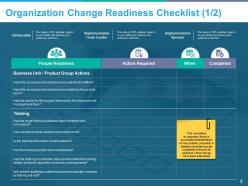
Slide 2: This slide showcases Organization Change Readiness Checklist (1/2) with these of the following parameters- Deliverable, Implementation Team Leader, Implementation Sponsor.
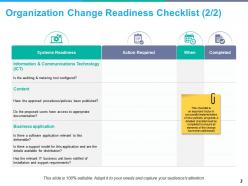
Slide 3: This slide presents Organization Change Readiness Checklist (2/2).
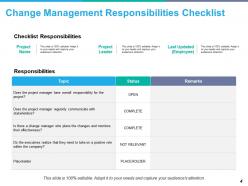
Slide 4: This slide showcases Change Management Responsibilities Checklist.
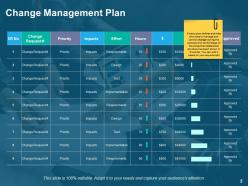
Slide 5: This slide presents Change Management Plan.
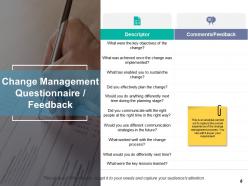
Slide 6: This slide showcases Change Management Questionnaire / Feedback.
Slide 7: This slide presents Change Management Icons Slide.
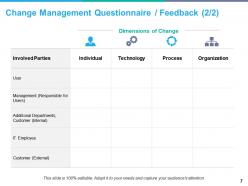
Slide 8: This slide shows Change Management Questionnaire / Feedback (2/2).
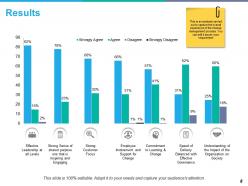
Slide 9: This slide presents Results.
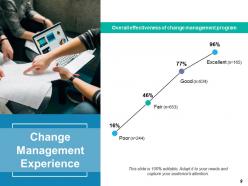
Slide 10: This slide showcases Change Management Experience
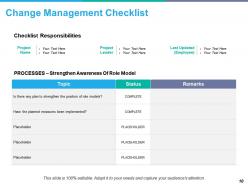
Slide 11: This slide presents Change Management Checklist.
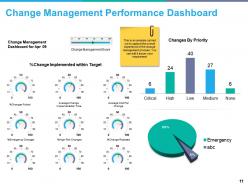
Slide 12: This slide showcases Change Management Performance Dashboard which further presents Change Management Score.
Slide 13: This slide is titled Additional Slides.
Slide 14: This is a Vision, Mission and Goals slide. State them here.
Slide 15: This is an Our Team slide with name, image &text boxes to put the required information.
Slide 16: This is an About Us slide showing Our Company, Value Client, and Premium services as examples
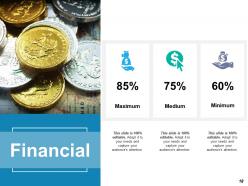
Slide 17: This is a Financial score slide. State financial aspects etc. here.
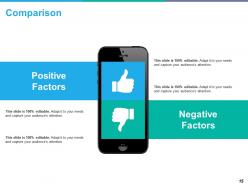
Slide 18: This slide shows Comparison of Positive Factors v/s Negative Factors with thumbs up and thumb down imagery.
Slide 19: This slide shows Our Goals for your company.
Slide 20: This is a Quotes slide to highlight, or state anything specific.
Slide 21: This slide shows Project Events Timeline with icons and text boxes.
Slide 22: This slide presents Column Chart.
Slide 23: This slide showcases Area Chart.
Slide 24: This slide presents Scatter Chart.
Slide 25: : This is a Thank You slide with image.
Change Management Evaluation Powerpoint Presentation Slides with all 24 slides:
Disseminate important inputs with our Change Management Evaluation Powerpoint Presentation Slides. Allow folks to build a composite image.






FAQs for Change Management Evaluation
Key performance indicators for change management evaluation include employee adoption rates, training completion percentages, productivity metrics, stakeholder engagement scores, and timeline adherence measurements. These KPIs enable organizations to assess transformation effectiveness through quantifiable data, with many companies finding that tracking both behavioral and operational metrics simultaneously delivers comprehensive insights into change success and identifies areas requiring additional support or adjustment.
Organizations can assess employee readiness through surveys measuring change attitudes, focus groups identifying concerns, skills gap analyses, and leadership assessments evaluating change champions across departments. These evaluation methods enable companies to tailor communication strategies, provide targeted training, and address resistance proactively, with many finding that thorough readiness assessment significantly improves implementation success rates.
Stakeholder feedback provides critical insights into change adoption, resistance patterns, communication effectiveness, and operational impacts across different organizational levels. This input enables leaders to identify implementation gaps, adjust strategies in real-time, and measure cultural transformation success, with many organizations finding that regular feedback loops significantly improve change sustainability and employee engagement outcomes.
Organizations can effectively gather data on change impact through employee surveys, performance metrics analysis, stakeholder interviews, focus groups, and system analytics tracking. These methods enable comprehensive assessment by measuring adoption rates, productivity changes, and employee sentiment, while financial analysis and operational benchmarks provide quantitative insights, ultimately delivering actionable intelligence for continuous improvement.
Change management evaluation methodologies include stakeholder feedback surveys, key performance indicator tracking, adoption rate analysis, resistance assessment tools, and return on investment calculations. These approaches enable organizations to measure behavioral shifts, operational efficiency improvements, and cultural transformation progress across departments, with many companies finding that combining quantitative metrics with qualitative insights delivers comprehensive understanding of implementation success.
Balancing qualitative and quantitative data in change management evaluation involves combining measurable metrics like productivity rates, cost savings, and timeline adherence with employee feedback, cultural assessments, and stakeholder interviews. This strategic combination delivers comprehensive insights by capturing both hard performance data and human experiences, with many organizations finding that integrating both perspectives enables more accurate evaluation of transformation success and sustainable adoption.
Common pitfalls include inadequate stakeholder engagement, insufficient data collection, focusing solely on quantitative metrics while ignoring qualitative feedback, and rushing evaluation timelines. Organizations in healthcare and manufacturing often find that overlooking employee resistance patterns, failing to measure cultural shifts, and neglecting long-term sustainability assessments ultimately undermines their transformation efforts and competitive positioning.
Change management evaluations inform future initiatives by identifying successful strategies, communication methods, resistance patterns, and implementation timelines from previous efforts. Through systematic analysis of what worked and what didn't, organizations can refine their change approaches, enhance stakeholder engagement techniques, and develop more effective training programs, ultimately building organizational change capability and reducing implementation risks for subsequent transformations.
Digital analytics platforms, survey automation tools, real-time dashboard systems, AI-powered sentiment analysis, and workflow tracking software can significantly enhance change management evaluation processes. These technologies streamline data collection, automate feedback analysis, and provide comprehensive visibility into adoption patterns, with many organizations finding that integrated evaluation systems deliver faster insights, improved decision-making capabilities, and ultimately more successful transformation outcomes.
Organizations should approach cultural change evaluation through multi-dimensional assessment methods including employee sentiment surveys, behavioral observation metrics, leadership effectiveness measures, and performance indicator tracking across different organizational levels. These evaluation frameworks enable comprehensive monitoring by establishing baseline cultural assessments, implementing regular pulse checks, and measuring adoption rates, while many organizations find that combining quantitative metrics with qualitative feedback ultimately delivers more accurate insights into cultural transformation progress.
Successful change integration indicators include employee adoption rates, performance metrics alignment, reduced resistance feedback, operational efficiency improvements, and sustained behavioral changes. Through surveys, productivity analytics, and milestone tracking, organizations can measure these indicators by monitoring user engagement levels, process completion times, and error reduction rates, ultimately delivering quantifiable ROI and competitive advantage.
Organizations ensure continuous improvement by conducting post-implementation reviews, gathering stakeholder feedback, analyzing performance metrics, documenting lessons learned, and establishing regular assessment cycles. Through systematic evaluation frameworks, companies can identify process gaps, refine communication strategies, and enhance training programs, with many finding that structured feedback loops ultimately deliver more agile responses to future organizational changes.
Involving frontline employees in change management evaluation is crucial, as they experience implementation realities firsthand and can identify gaps between planned and actual outcomes. Their insights enable organizations to assess user adoption rates, operational bottlenecks, and customer impact more accurately, while fostering buy-in and continuous improvement, ultimately delivering more effective change initiatives and sustainable transformation across the organization.
Organizational communication significantly influences change management evaluation success by ensuring stakeholder alignment, facilitating transparent feedback collection, and enabling accurate progress tracking throughout transformation initiatives. Effective communication channels help organizations identify resistance patterns, measure adoption rates, and gather meaningful data from employees across departments, ultimately delivering more comprehensive evaluations that guide strategic adjustments and enhance overall change effectiveness.
Case studies of past change initiatives provide valuable benchmarks for evaluating new changes by revealing successful strategies, common pitfalls, and implementation timelines across similar organizational contexts. These historical insights enable leaders to anticipate resistance patterns, resource requirements, and stakeholder responses, while identifying proven communication approaches and training methodologies, ultimately delivering more accurate risk assessments and strategic planning for upcoming transformations.
No Reviews