


Change Management Process For Successful Business Transformation Complete Deck




Try Before you Buy Download Free Sample Product
 Impress Your
 Audience
 100%
100% Editable
 Save Hours
 of Time


Implementing complex organizational changes requires a change management plan that engages new processes through a strategic approach. Grab Our Change Management Process for Successful Business Transformation template. It is professionally designed to help businesses understand technology transformation models and successfully implement change management strategies. Our Implementation management deck includes information about the companys present revenues, costs, issues caused by outdated technologies, and solutions for a successful digital transformation plan. It also showcases different technology change management models, like Kotters 8 Step Change Model, ADKAR model, and Lewins model, and compares them for better technology transformation. Further, our Administrative change PPT covers change management phases, budget allocation, and tools comparison for implementing technology transformation and their impact on business revenues and costs. Finally, the Business transformation module displays a dashboard and KPIs to track sales performance and measure the effectiveness of digital transformation. Access this powerful template now to learn more.
People who downloaded this PowerPoint presentation also viewed the following :
Content of this Powerpoint Presentation
Slide 1: This slide introduces Change Management Process for Successful Business Transformation. Commence by stating Your Company Name.
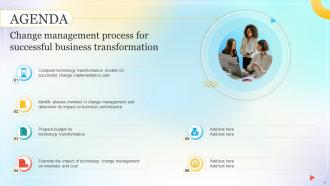
Slide 2: This slide depicts the Agenda of the presentation.
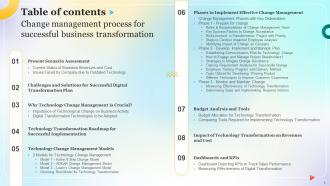
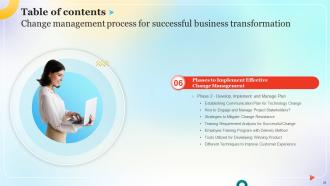
Slide 3: This slide incorporates the Table of contents.
Slide 4: This slide highlights the Title for the Topics to be covered further.
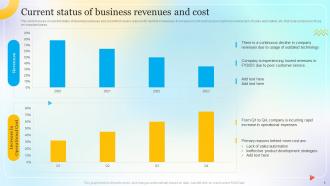
Slide 5: This slide focuses on current status of business revenues and cost.
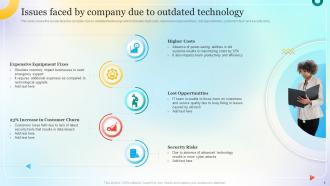
Slide 6: This slide shows the issues faced by company due to outdated technology.
Slide 7: This slide depicts the Heading for the Contents to be discussed next.
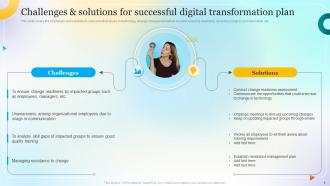
Slide 8: This slide covers the challenges and solutions to overcome that arises in technology change management.
Slide 9: This slide displays the Title for the Ideas to be covered in the following template.
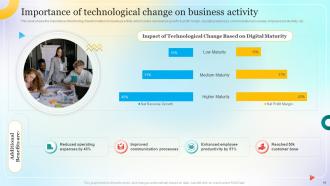
Slide 10: This slide shows the importance of technology transformation on business activity.
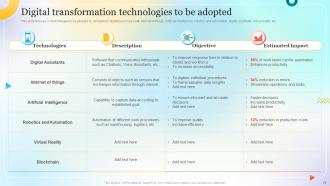
Slide 11: This slide focuses on technologies to be adopted by company.
Slide 12: This slide depicts the Heading for the Contents to be discussed further.
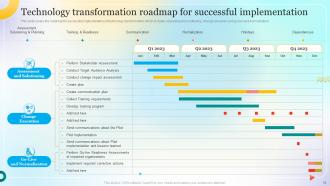
Slide 13: This slide presents the roadmap for successful implementation of technology transformation.
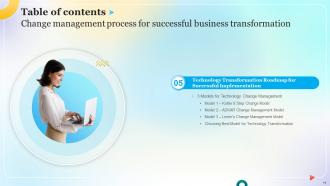
Slide 14: This slide displays the Title for the Ideas to be covered in the forth-coming template.
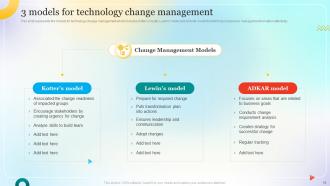
Slide 15: This slide represents the models for technology change management.
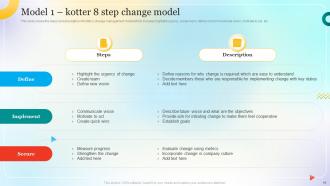
Slide 16: This slide mentions the steps and description of Kotter’s change management model.
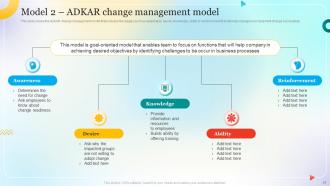
Slide 17: This slide shows the ADKAR change management model that includes five stages.
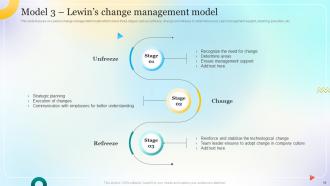
Slide 18: This slide focuses on Lewin’s change management model.
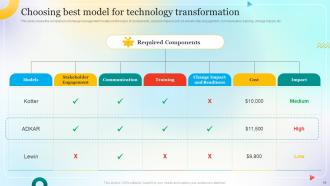
Slide 19: This slide talks about Choosing best model for technology transformation.
Slide 20: This slide indicates the Heading for the Ideas to be discussed in the next template.
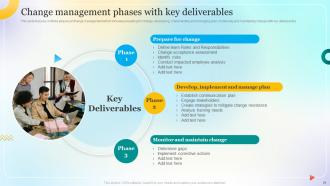
Slide 21: This slide emphasizes on three phases of change management.
Slide 22: This slide incorporates the Title for the Components to be covered further.
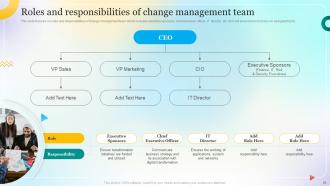
Slide 23: This slide exhibits the roles and responsibilities of change management team.
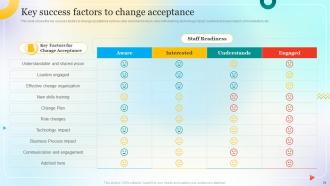
Slide 24: This slide highlights the Key success factors to change acceptance.
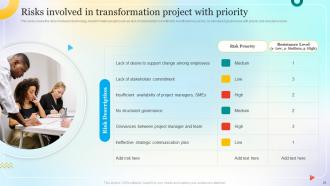
Slide 25: This slide states the Risks involved in transformation project with priority.
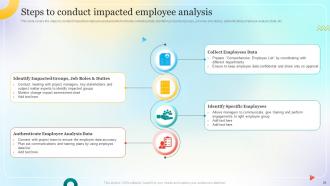
Slide 26: This slide covers the steps to conduct impacted employee analysis.
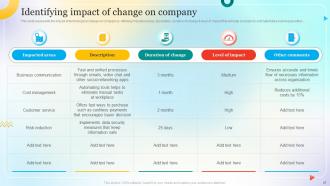
Slide 27: This slide deals with Identifying impact of change on company.
Slide 28: This slide includes the Heading for the Topics to be discussed in the following template.
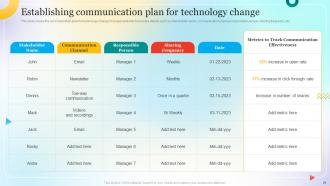
Slide 29: This slide presents the Metrics to Track Communication Effectiveness.
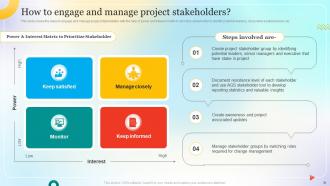
Slide 30: This slide shows the steps to engage and manage project stakeholders.
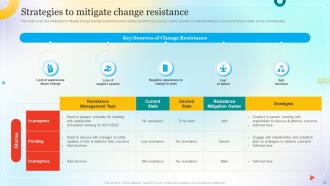
Slide 31: This slide covers the strategies to mitigate change resistance.
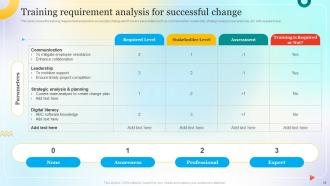
Slide 32: This slide elucidates the training requirement analysis for successful change.
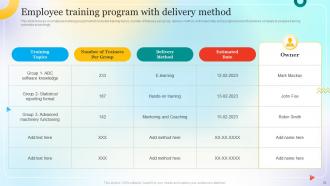
Slide 33: This slide displays the Employee training program with delivery method.
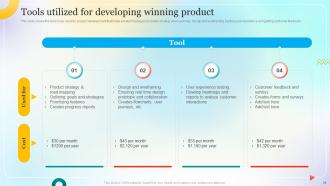
Slide 34: This slide reveals the Tools utilized for developing winning product.
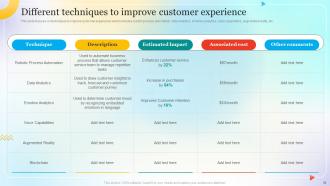
Slide 35: This slide mentions the Different techniques to improve customer experience.
Slide 36: This slide includes the Title for the Topics to be covered further.
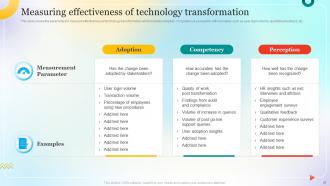
Slide 37: This slide shows the parameters to measure effectiveness of technology transformation.
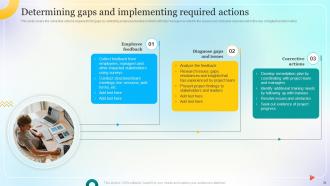
Slide 38: This slide deals with Determining gaps and implementing required actions.
Slide 39: This slide indicates the Heading for the Contents to be discussed in the upcoming template.
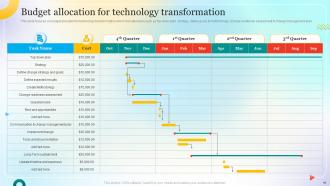
Slide 40: This slide focuses on budget allocation for technology transformation .
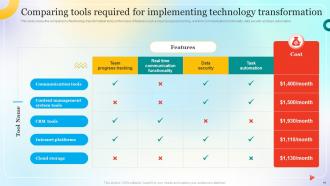
Slide 41: This slide talks about Comparing tools required for implementing technology transformation.
Slide 42: This slide reveals the Title for the Ideas to be covered in the next template.
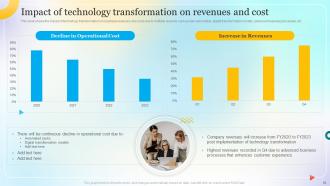
Slide 43: This slide shows the impact of technology transformation on business revenues and costs.
Slide 44: This slide displays the Heading for the Ideas to be discussed further.
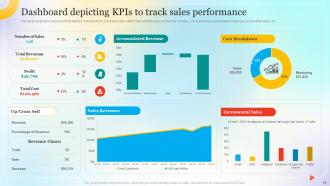
Slide 45: This slide highlights the dashboard that depicts metrics to track company sales performance.
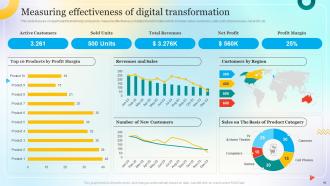
Slide 46: This slide deals with Measuring effectiveness of digital transformation.
Slide 47: This is the Icons slide containing all the Icons used in the plan.
Slide 48: This slide is used for depicting some Additional information.
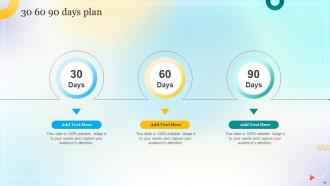
Slide 49: This slide showcases the 30 60 90 days plan for effective planning.
Slide 50: This slide contains the Post it notes for reminders and deadlines.
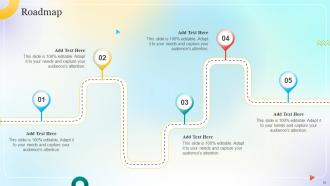
Slide 51: This slide elucidates the organization's Roadmap.
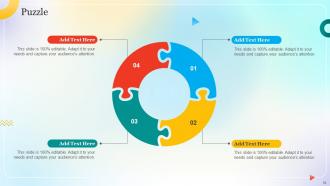
Slide 52: This is the Puzzle slide with related imagery.
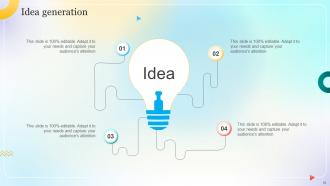
Slide 53: This is the Idea generation slide for encouraging fresh ideas.
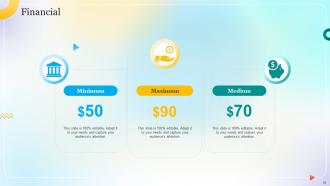
Slide 54: This slide mentions information related to the Financial topic.
Slide 55: This is the Venn diagram slide.
Slide 56: This is Our goal slide. State your firm's goals here.
Slide 57: This is the Thank You slide for acknowledgement.
Change Management Process For Successful Business Transformation Complete Deck with all 62 slides:
Use our Change Management Process For Successful Business Transformation Complete Deck to effectively help you save your valuable time. They are readymade to fit into any presentation structure.









FAQs for Change Management Process For Successful Business
Effective change management principles include clear communication, stakeholder buy-in, robust training, dedicated resources, and consistent reinforcement. These approaches streamline transitions by minimizing disruption, maximizing adoption, and fostering resilience, with many organizations finding that proactive engagement ultimately delivers enhanced operational efficiency and a competitive advantage.
Organizations can assess change readiness by evaluating leadership support, resource availability, and employee engagement, alongside a clear vision and communication strategy. These assessments help identify gaps in skills and processes, with many institutions finding that proactive planning streamlines implementation, ultimately delivering reduced disruption and enhanced adoption rates, while presenting both challenges and opportunities.
Communication forms the bedrock of successful change management, encompassing transparent updates, active listening, and consistent messaging across all levels. While delivering crucial information about shifts in strategy, it also addresses employee concerns, fosters trust, and minimizes resistance to adoption, with many organizations finding that open dialogue accelerates buy-in and ultimately delivers smoother transitions and enhanced operational efficiency.
Change management strategies involve transparent communication, active listening, and collaborative planning, ensuring employees understand the “why” behind shifts. While acknowledging disruption, leaders can foster buy-in by highlighting opportunities for skill development and career growth, with many organizations finding that empowered teams deliver faster adoption and ultimately, enhanced operational efficiency.
The Kübler-Ross Change Curve—denial, anger, bargaining, depression, and acceptance—can be applied to organizational change by recognizing employee emotional responses to disruption. While initially unsettling, understanding these stages helps leaders tailor communication, provide support, and manage resistance, with many institutions finding that proactive empathy streamlines transitions. This ultimately delivers enhanced adoption rates and minimized productivity loss, enabling a more seamless integration of new processes across industries like healthcare and financial services.
Change management initiatives often stumble due to inadequate communication, resistance from stakeholders, and a lack of clear vision. These challenges present both opportunities and obstacles, however, organizations can mitigate risks by fostering transparent dialogue, actively involving employees, and defining measurable goals. With many institutions finding that proactive planning, coupled with robust training, streamlines transitions, ultimately delivering enhanced adoption and sustained operational efficiency.
Organizational culture impacts change management efforts by shaping employee perceptions, influencing adoption rates, and determining overall success through shared values, beliefs, and norms. While a flexible culture helps embrace innovation, a rigid one presents both challenges and opportunities, requiring tailored communication and stakeholder engagement. With many institutions finding that aligning change initiatives with existing cultural elements streamlines implementation, ultimately delivering enhanced employee buy-in and sustained operational efficiency.
Change management tools and technologies include communication platforms, project management software, training modules, and feedback surveys, alongside organizational network analysis. These technologies streamline workflows by facilitating transparent communication, enabling efficient resource allocation, and fostering employee engagement, ultimately delivering smoother transitions and enhanced adoption rates with many institutions finding that proactive engagement minimizes resistance.
Organizations should leverage employee satisfaction scores, adoption rates of new processes, and quantifiable gains in operational efficiency to evaluate change initiative success. These metrics help assess both the human and process-related impacts, with many financial services institutions finding that tracking these indicators streamlines resource allocation and ultimately delivers enhanced productivity and competitive advantage.
Change fatigue can be mitigated by prioritizing initiatives, fostering transparent communication, and providing adequate training, ultimately ensuring employees aren’t overwhelmed by constant disruption. While continuous improvement is vital, organizations must strategically sequence changes, with many institutions finding that phased rollouts and dedicated support resources enhance adoption and minimize resistance, ultimately delivering increased efficiency and sustained engagement.
Change management approaches include communication plans, stakeholder engagement, training programs, and incentive structures, all designed to foster acceptance. While acknowledging disruption, these strategies streamline transitions by addressing concerns, building buy-in, and demonstrating value, with many organizations finding that proactive engagement minimizes friction and ultimately delivers enhanced operational efficiency and improved employee experiences.
Organizations can ensure sustainable change by embedding new processes into daily workflows, fostering continuous learning, and establishing robust feedback mechanisms. These technologies streamline communication by enabling regular check-ins, data-driven adjustments, and skill development programs, with many institutions finding that consistent reinforcement ultimately delivers lasting behavioral shifts and competitive advantage.
Training and development plays a crucial role in change management by equipping employees with the skills, knowledge, and confidence needed to embrace new processes, technologies, and strategies. While addressing skill gaps, it also fosters a positive attitude towards change, reducing resistance and enhancing adoption rates across organizations. With many institutions finding that targeted programs streamline transitions in sectors like healthcare and finance, ultimately delivering increased operational efficiency and improved customer experiences.
Employee feedback can be effectively integrated into change strategies through surveys, focus groups, and one-on-one interviews, ensuring diverse perspectives are considered. While collecting this data presents both challenges and opportunities, analyzing sentiments helps organizations refine implementation plans, minimize resistance, and enhance adoption across industries like healthcare and finance, ultimately delivering smoother transitions and improved employee experiences.
Transformational and incremental change management differ in scope, impact, and approach, encompassing everything from fundamental shifts to continuous improvements. Transformational change involves radical redesigns—like a bank adopting AI—while incremental focuses on refining existing processes, such as a hospital streamlining patient check-in. While incremental change delivers quick wins, transformational change ultimately enables organizations to revolutionize operations, enhance competitive advantage, and achieve long-term strategic goals.
-
Well-designed and informative templates. Absolutely brilliant!
-
I was never satisfied with my own presentation design but SlideTeam has solved that problem for me. Thank you SlideTeam!