


Channel Partner Program For Business Expansion Strategy CD V





Try Before you Buy Download Free Sample Product
 Impress Your
 Audience
 100%
100% Editable
 Save Hours
 of Time


Check out our professionally designed Channel Partner Program for Business Expansion. This Channel Partner Program PowerPoint presentation gives an informative overview section, offering insights into the organization and introducing channel partners, accompanied by an exploration of their benefits and key statistical data. Moreover, the Partner Plan section provides an in-depth understanding of various types of channel partners, encompassing their distinctive features and characteristics. Further, within this Partner Strategy deck, the core elements include PR strategy development the process of selecting and attracting the right partners by establishing specific criteria. Further, the Channel Plan presentation features dedicated slides on the incentives and reward structures designed to motivate channel partners. Lastly, in this Channel Sales Strategy module, there are several slides dedicated to annual and training budget considerations, along with key performance indicators for evaluating the impact of the channel partner strategy. Download this 100 percent editable presentation and get access to our highly researched and skillfully designed product.
People who downloaded this PowerPoint presentation also viewed the following :
Content of this Powerpoint Presentation
Slide 1: This slide introduces Channel Partner Program for Business Expansion.
Slide 2: This slide states Agenda of the presentation.
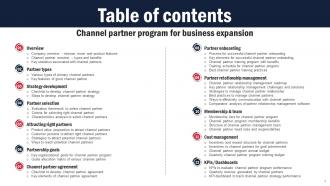
Slide 3: This slide shows Table of Content for the presentation.
Slide 4: This slide highlights title for topics that are to be covered next in the template.
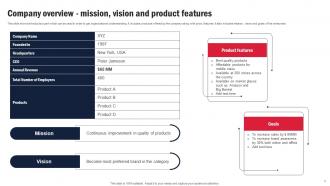
Slide 5: This slide shows introductory part which can be used in order to get organizational understanding.
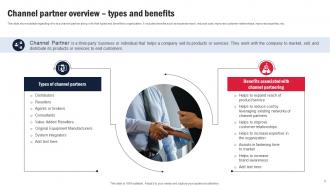
Slide 6: This slide shows details regarding who is a channel partner along with their types and benefits to organization.
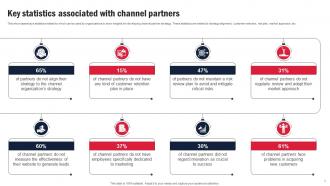
Slide 7: This slide presents Key statistics associated with channel partners.
Slide 8: This slide shows Table of Content for the presentation.
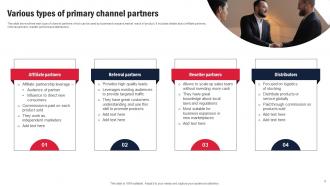
Slide 9: This slide presents Various types of primary channel partners.
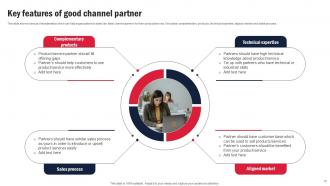
Slide 10: This slide displays Key features of good channel partner.
Slide 11: This slide shows Table of Content for the presentation.
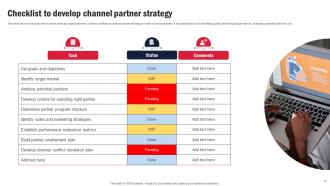
Slide 12: This slide represents Checklist to develop channel partner strategy.
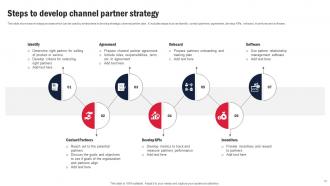
Slide 13: This slide showcases Steps to develop channel partner strategy.
Slide 14: This slide highlights title for topics that are to be covered next in the template.
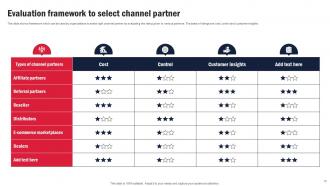
Slide 15: This slide shows Evaluation framework to select channel partner.
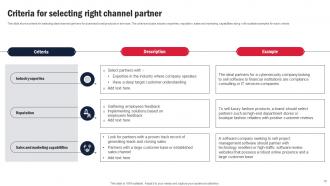
Slide 16: This slide presents Criteria for selecting right channel partner.
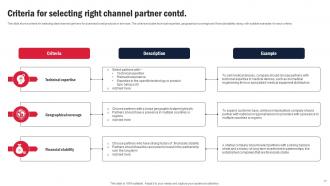
Slide 17: This slide displays Criteria for selecting right channel partner contd..
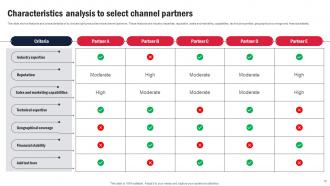
Slide 18: This slide represents Characteristics analysis to select channel partners.
Slide 19: This slide shows Table of Content for the presentation.
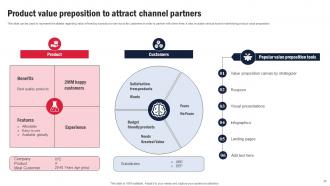
Slide 20: This slide presents Product value preposition to attract channel partners.
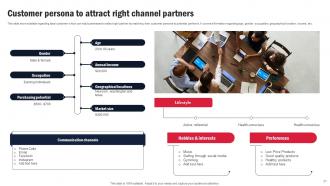
Slide 21: This slide displays Customer persona to attract right channel partners.
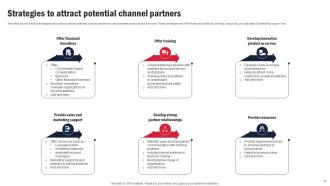
Slide 22: This slide represents Strategies to attract potential channel partners.
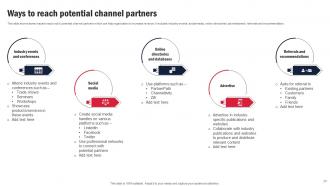
Slide 23: This slide showcases Ways to reach potential channel partners.
Slide 24: This slide shows Table of Content for the presentation.
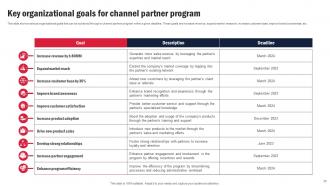
Slide 25: This slide presents Key organizational goals for channel partner program.
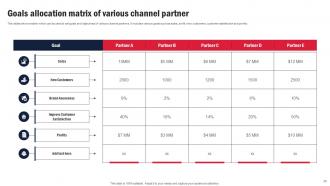
Slide 26: This slide displays Goals allocation matrix of various channel partner.
Slide 27: This slide highlights title for topics that are to be covered next in the template.
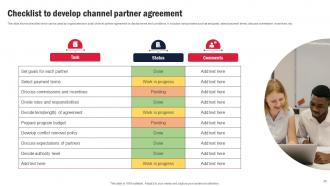
Slide 28: This slide represents Checklist to develop channel partner agreement.
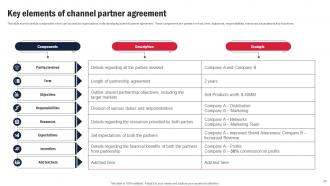
Slide 29: This slide showcases Key elements of channel partner agreement.
Slide 30: This slide highlights title for topics that are to be covered next in the template.
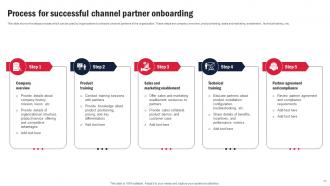
Slide 31: This slide shows Process for successful channel partner onboarding.
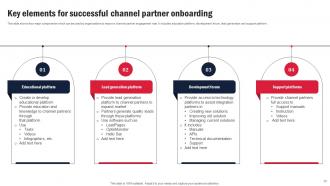
Slide 32: This slide presents Key elements for successful channel partner onboarding.
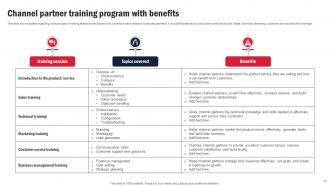
Slide 33: This slide displays Channel partner training program with benefits.
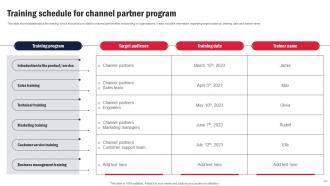
Slide 34: This slide displays Training schedule for channel partner program.
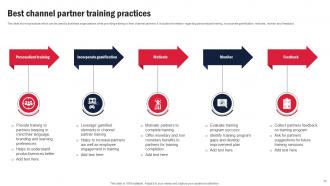
Slide 35: This slide represents Best channel partner training practices.
Slide 36: This slide highlights title for topics that are to be covered next in the template.
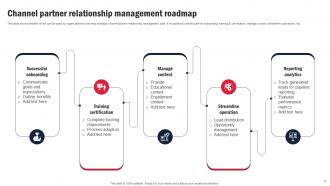
Slide 37: This slide showcases Channel partner relationship management roadmap.
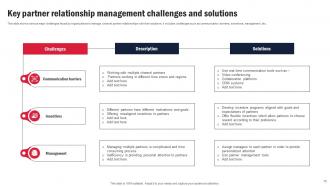
Slide 38: This slide shows Key partner relationship management challenges and solutions.
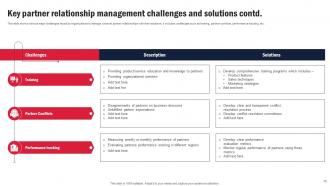
Slide 39: This slide presents Key partner relationship management challenges and solutions contd..
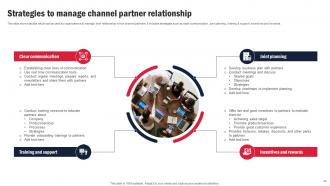
Slide 40: This slide displays Strategies to manage channel partner relationship.
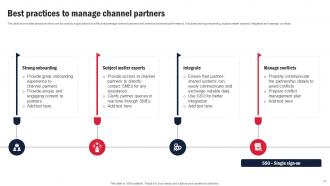
Slide 41: This slide represents Best practices to manage channel partners.
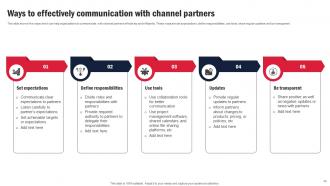
Slide 42: This slide showcases Ways to effectively communication with channel partners.
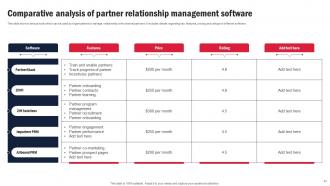
Slide 43: This slide shows Comparative analysis of partner relationship management software.
Slide 44: This slide highlights title for topics that are to be covered next in the template.
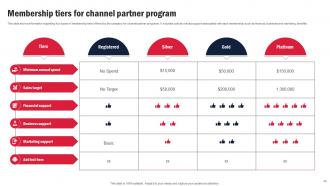
Slide 45: This slide presents Membership tiers for channel partner program.
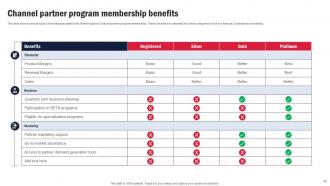
Slide 46: This slide displays Channel partner program membership benefits.
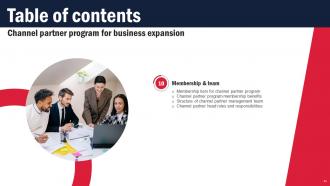
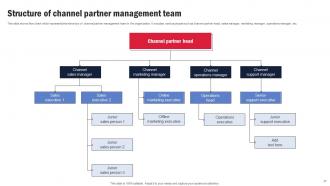
Slide 47: This slide represents Structure of channel partner management team.
Slide 48: This slide showcases Channel partner head roles and responsibilities.
Slide 49: This slide highlights title for topics that are to be covered next in the template.
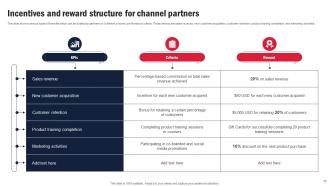
Slide 50: This slide shows Incentives and reward structure for channel partners.
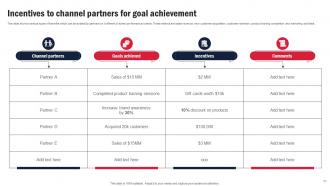
Slide 51: This slide presents Incentives to channel partners for goal achievement.
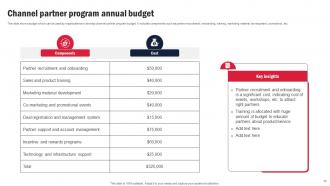
Slide 52: This slide displays Channel partner program annual budget.
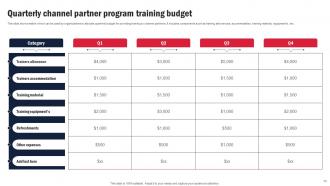
Slide 53: This slide represents Quarterly channel partner program training budget.
Slide 54: This slide highlights title for topics that are to be covered next in the template.
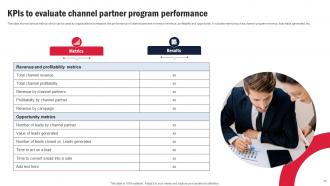
Slide 55: This slide showcases KPIs to evaluate channel partner program performance.
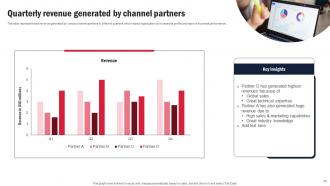
Slide 56: This slide shows Quarterly revenue generated by channel partners.
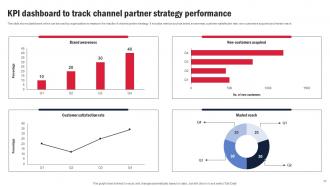
Slide 57: This slide presents KPI dashboard to track channel partner strategy performance.
Slide 58: This slide contains all the icons used in this presentation.
Slide 59: This slide is titled as Additional Slides for moving forward.
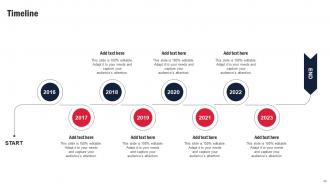
Slide 60: This is a Timeline slide. Show data related to time intervals here.
Slide 61: This is Our Team slide with names and designation.
Slide 62: This slide shows Post It Notes. Post your important notes here.
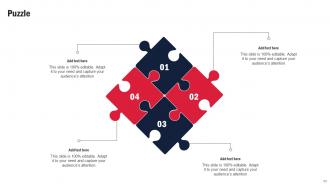
Slide 63: This slide contains Puzzle with related icons and text.
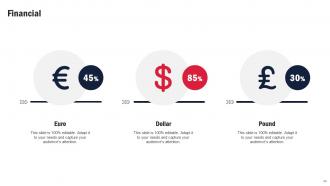
Slide 64: This is a Financial slide. Show your finance related stuff here.
Slide 65: This is Our Mission slide with related imagery and text.
Slide 66: This slide shows SWOT describing- Strength, Weakness, Opportunity, and Threat.
Slide 67: This is an Idea Generation slide to state a new idea or highlight information, specifications etc.
Slide 68: This is a Thank You slide with address, contact numbers and email address.
Channel Partner Program For Business Expansion Strategy CD V with all 76 slides:
Use our Channel Partner Program For Business Expansion Strategy CD V to effectively help you save your valuable time. They are readymade to fit into any presentation structure.




















FAQs for Channel Partner Program For Business Expansion
Channel partner programs deliver expanded market reach, reduced sales costs, accelerated revenue growth, enhanced customer support, and increased competitive advantage through strategic alliances. These partnerships enable businesses to leverage partner expertise, local market knowledge, and established relationships, with many organizations finding that channel programs can generate 60-80% of total revenue while significantly reducing direct sales expenses.
Companies effectively recruit channel partners by identifying complementary businesses with shared target markets, strong reputations, and adequate resources through industry networks, referrals, and strategic outreach. Successful onboarding involves comprehensive training programs, clear communication protocols, and dedicated support systems, with many organizations finding that structured certification processes and regular performance reviews ultimately enhance partner relationships and accelerate market expansion.
Key criteria include market reach and customer base, technical expertise and support capabilities, sales track record and reputation, financial stability, and strategic alignment with your business goals. These factors help ensure partners can effectively represent your brand, deliver quality customer experiences, and drive sustainable revenue growth, with many companies finding that partners meeting these standards consistently outperform expectations.
A well-structured channel partner program accelerates customer acquisition by expanding market reach, leveraging partners' established relationships, and accessing new geographic territories through trusted local presence. Through strategic partnerships, businesses can penetrate diverse markets more efficiently, reduce acquisition costs, and deliver faster customer onboarding, ultimately achieving broader market coverage while partners provide credibility and localized expertise.
Training and support serve as foundational pillars for channel partner success, encompassing product knowledge, sales methodologies, technical certifications, marketing resources, and ongoing operational guidance. These comprehensive programs enable partners to effectively represent solutions, accelerate deal cycles, and deliver superior customer experiences, with many organizations finding that well-trained partners generate significantly higher revenue and maintain stronger long-term relationships.
Technology facilitates better communication with channel partners through automated reporting systems, real-time data sharing platforms, collaborative portals, and integrated messaging tools. These solutions streamline information flow by providing instant access to sales data, inventory levels, and performance metrics, while enabling seamless coordination across multiple partners, ultimately delivering enhanced transparency and stronger strategic partnerships.
Businesses should track partner acquisition rates, revenue attribution per partner, deal registration volumes, partner engagement scores, and time-to-productivity for new partners. These metrics enable organizations to identify high-performing partnerships, optimize resource allocation, and streamline partner onboarding processes, with many companies finding that consistent measurement ultimately delivers improved partner satisfaction and accelerated revenue growth.
Companies can align marketing strategies with channel partners through shared campaign calendars, co-branded content development, joint lead generation programs, and unified messaging frameworks. This strategic coordination enables consistent brand positioning across all touchpoints, streamlines resource allocation, and maximizes market penetration, with many organizations finding that aligned partnerships deliver significantly higher conversion rates and improved customer experiences.
Organizations face challenges including partner alignment with brand standards, performance monitoring across diverse channels, communication consistency, training standardization, and conflict resolution between competing partners. These complexities often result in inconsistent customer experiences, revenue leakage, and relationship management difficulties, with many companies finding that streamlined partner onboarding processes and automated performance tracking systems significantly enhance program effectiveness and partner satisfaction.
Businesses ensure consistent brand messaging through comprehensive partner training programs, standardized marketing materials, regular communication protocols, and clear brand guidelines with enforcement mechanisms. Through dedicated partner portals and ongoing support, organizations like technology companies and retail franchises maintain unified messaging across diverse channels, while implementing feedback systems and performance monitoring, ultimately delivering cohesive customer experiences and stronger brand recognition.
Effective channel partner incentives include financial rewards like tiered commissions and volume bonuses, marketing support through co-branded campaigns and lead generation, training programs for skill development, and exclusive territory rights. These incentives enhance partner engagement by aligning business goals, reducing operational costs, and accelerating market penetration, with many organizations finding that strategic incentive combinations ultimately deliver stronger partner loyalty and increased revenue growth.
The competitive landscape significantly impacts channel partner effectiveness by influencing partner loyalty, market positioning, and resource allocation strategies. In highly competitive sectors like technology and financial services, companies must offer superior partner support, training programs, and incentive structures to retain top-performing partners, ultimately delivering enhanced market reach and accelerated revenue growth.
**INPUT**: What strategies can be employed to maintain long-term relationships with channel partners? **OUTPUT**: Effective channel partner relationship strategies include regular communication touchpoints, joint business planning sessions, tiered incentive programs, co-marketing support, and dedicated partner success management. These approaches streamline collaboration by aligning mutual goals, providing ongoing training resources, and recognizing top performers, with many organizations finding that consistent relationship investment ultimately delivers enhanced market penetration and sustained revenue growth. [Word count: 60 words]
Channel partner feedback can be integrated through regular surveys, partner advisory boards, collaborative development sessions, and dedicated feedback platforms that capture market insights directly from the field. These mechanisms enable companies to incorporate real-world customer demands, competitive intelligence, and regional market nuances into their product roadmaps, ultimately delivering solutions that resonate better with end users while strengthening partner relationships.
Emerging trends in channel partner programs include AI-driven partner analytics, outcome-based incentive models, digital-first enablement platforms, ecosystem integration capabilities, and co-innovation partnerships. These approaches streamline partner onboarding, enhance performance visibility, and accelerate market reach, with many organizations finding that strategic partner ecosystems deliver faster revenue growth and competitive differentiation.
-
My team has been relying on SlideTeam’s professional PPT designs for a while now. It has greatly sped up quality work at my organization. So thanks!
-
“Excellent service from the customer support team when I wanted a slide that was a bit different from those on their standard menu. Super helpful.”