


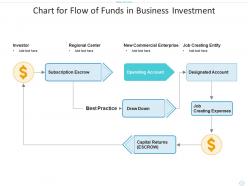
Chart for flow of funds in business investment





Try Before you Buy Download Free Sample Product
 Impress Your
 Audience
 100%
100% Editable
 Save Hours
 of Time


Our Chart For Flow Of Funds In Business Investment are topically designed to provide an attractive backdrop to any subject. Use them to look like a presentation pro.
People who downloaded this PowerPoint presentation also viewed the following :
Chart for flow of funds in business investment with all 2 slides:
Use our Chart For Flow Of Funds In Business Investment to effectively help you save your valuable time. They are readymade to fit into any presentation structure.

FAQs for Chart for flow of funds
Key components of flow of funds in financial ecosystems include household savings and investments, corporate financing and capital expenditures, government fiscal flows, banking intermediation, and capital market transactions. These components work together by channeling surplus funds from savers to borrowers, facilitating business expansion and economic growth, with financial institutions finding that effective fund flows ultimately enhance liquidity and operational efficiency.
Flow of funds significantly impacts investment decisions by determining capital availability, interest rates, and sector-specific liquidity across markets. When funds flow toward technology or healthcare sectors, these areas experience lower borrowing costs and increased venture capital, while traditional industries like manufacturing may face tighter credit conditions, ultimately influencing strategic resource allocation and competitive positioning.
Businesses can optimize their flow of funds through accelerated receivables collection, strategic payment timing, inventory management, cash forecasting, and automated reconciliation processes. These approaches streamline working capital by reducing collection cycles, negotiating favorable supplier terms, and implementing real-time monitoring systems, ultimately delivering improved liquidity, operational efficiency, and enhanced financial flexibility for strategic investments.
Financial institutions serve as intermediaries that channel funds from savers to borrowers, facilitate payment systems, and provide risk management services through banking, insurance, and investment products. Through deposit collection, loan origination, and securities trading, banks, credit unions, and investment firms streamline capital allocation, enhance liquidity, and minimize transaction costs, ultimately delivering efficient resource distribution and enabling economic growth across industries.
Flow of funds analysis contributes to risk assessment by tracking capital movements between sectors, identifying concentration risks, and revealing interconnected exposures across financial institutions. Through systematic monitoring of credit flows, liquidity patterns, and sectoral imbalances, banks and investment firms can anticipate market stress, adjust portfolio allocations proactively, and strengthen risk management frameworks, ultimately delivering enhanced stability and competitive positioning.
Changes in government policy significantly impact private sector fund flows through altered interest rates, tax structures, regulatory requirements, and fiscal spending priorities. These policy shifts influence investment decisions, credit availability, and capital allocation across industries, with sectors like banking, real estate, and manufacturing experiencing redirected liquidity patterns, ultimately reshaping competitive positioning and strategic resource deployment throughout the economy.
Technology significantly enhances fund flow efficiency through real-time payment systems, automated clearing houses, blockchain networks, artificial intelligence, and digital banking platforms. These innovations streamline transactions by reducing settlement times, minimizing manual processing errors, and enabling 24/7 operations, with many financial institutions finding that automated systems deliver faster cross-border transfers and lower operational costs.
International markets face regulatory compliance complexities, currency volatility risks, cross-border payment delays, anti-money laundering requirements, and varying taxation frameworks when managing fund flows. These challenges create operational inefficiencies and increased costs, with many financial institutions finding that strategic technology investments in automated compliance systems and real-time payment networks ultimately streamline processes while ensuring regulatory adherence.
Businesses can leverage data analytics to track and improve their flow of funds through real-time monitoring dashboards, predictive cash flow modeling, automated variance analysis, and comprehensive financial reporting systems. These technologies streamline treasury operations by identifying payment patterns, optimizing working capital cycles, and predicting liquidity needs, with many organizations finding that enhanced visibility ultimately delivers improved cash management and strategic financial planning capabilities.
Understanding the flow of funds is crucial for financial planning and forecasting as it reveals cash timing patterns, liquidity requirements, and capital allocation needs across different business cycles and scenarios. This comprehensive view enables organizations to optimize working capital management, anticipate financing gaps, and make strategic investment decisions, with many financial institutions and corporations finding that detailed fund flow analysis ultimately delivers more accurate budgeting and enhanced operational efficiency.
Capital markets function as intermediaries that connect investors seeking returns with businesses requiring capital through stock exchanges, bond markets, and investment banks. These markets streamline fund allocation by enabling price discovery, providing liquidity, and facilitating risk assessment, with many financial institutions finding that efficient capital markets ultimately deliver faster access to funding, reduced transaction costs, and enhanced economic growth across industries.
Common pitfalls in managing flow of funds include inadequate cash flow forecasting, poor timing of receivables and payables, insufficient liquidity buffers, over-reliance on short-term financing, and lack of real-time visibility into cash positions. These challenges often lead to missed opportunities, strained vendor relationships, and increased borrowing costs, with many organizations finding that proactive cash management systems deliver significant operational advantages and financial stability.
ESG factors significantly influence fund flows by redirecting capital toward sustainable businesses through investor preferences, regulatory compliance requirements, and risk assessment changes. Companies with strong ESG practices attract more investment from pension funds, institutional investors, and ESG-focused portfolios, while those with poor ratings face capital constraints, ultimately reshaping industry financing patterns and competitive positioning.
Effective flow of funds visualization methods include flowcharts, Sankey diagrams, waterfall charts, network diagrams, and interactive dashboards with real-time data feeds. These tools enhance financial transparency by mapping complex fund movements, tracking multi-source allocations, and identifying bottlenecks, with many financial institutions finding that visual presentations streamline stakeholder communication and accelerate decision-making processes.
Startups can ensure healthy cash flow while scaling through strategic financial planning, diversified revenue streams, efficient working capital management, and maintaining adequate cash reserves for operational flexibility. By implementing robust forecasting systems, negotiating favorable payment terms with suppliers and customers, and securing multiple funding sources, growing companies can navigate expansion challenges while maintaining liquidity and operational stability.
-
Excellent work done on template design and graphics.
-
Excellent products for quick understanding.