


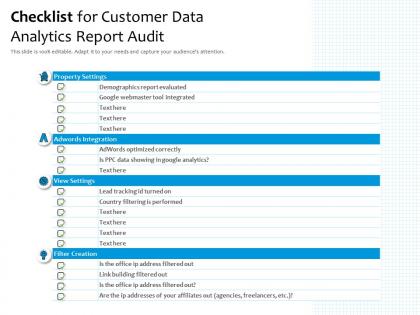
Checklist for customer data analytics report audit




Try Before you Buy Download Free Sample Product
 Impress Your
 Audience
 100%
100% Editable
 Save Hours
 of Time


No matter how much data you have, if it's not analyzed and put to use, it's just wasted. When you're getting ready to do your customer data analysis, make sure you audit the entire process first using this handy checklist. Not only will this help ensure accuracy and quality of your results, but it can also help avoid potential mess-ups down the road. So take a few minutes to go through these items before you get started - it could save you a lot of time and headaches in the long run.SlideTeam’s data analytics ppt templates can help you easily get insights from your customer data. Our slide designs are easy to use and customize, so you can quickly create a report that meets your needs. Plus, our team is always updating our templates to make sure you have the latest and greatest designs at your fingertips. So what are you waiting for? Grab our data analytics ppt templates now and start getting insights into your customer data today.
People who downloaded this PowerPoint presentation also viewed the following :
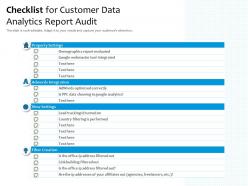
Checklist for customer data analytics report audit with all 2 slides:
Use our Checklist For Customer Data Analytics Report Audit to effectively help you save your valuable time. They are readymade to fit into any presentation structure.
FAQs for Checklist for customer data
Key objectives include assessing data quality and accuracy, evaluating analytics processes and methodologies, ensuring compliance with privacy regulations, identifying gaps in data collection, and measuring ROI of analytics investments. These audits enable organizations to optimize customer insights, streamline data workflows, and enhance decision-making capabilities, with many retail and financial services companies finding that comprehensive audits ultimately deliver improved customer experiences and competitive advantage.
Evaluating customer data accuracy involves conducting data profiling to identify duplicates, inconsistencies, and missing values, implementing validation rules at collection points, and performing regular completeness audits across all touchpoints. Organizations typically use automated data quality tools to monitor accuracy rates, cross-reference information against external sources, and establish data governance protocols, ultimately ensuring reliable insights for strategic decision-making.
Customer data analytics audits typically include CRM systems, transaction databases, website analytics, social media platforms, and customer service interactions. These sources work together by providing behavioral insights, purchase patterns, and engagement metrics, with many organizations finding that integrating diverse touchpoints delivers comprehensive customer understanding and competitive advantage.
**INPUT**: How do you ensure compliance with data protection regulations during the audit? **OUTPUT**: Ensuring compliance involves implementing comprehensive data governance frameworks, conducting regular privacy impact assessments, maintaining detailed audit trails, and establishing clear consent management protocols throughout the analytics process. These measures enable organizations to streamline regulatory adherence while enhancing customer trust, with many financial services and healthcare institutions finding that proactive compliance ultimately delivers competitive advantage and operational efficiency.
Data integration assessment methodologies include data mapping and lineage analysis, system compatibility evaluations, API connectivity testing, data flow monitoring, and cross-platform validation protocols. These approaches streamline operations by identifying integration gaps, ensuring seamless data movement, and maintaining consistency across platforms, with many organizations finding that comprehensive assessments ultimately deliver enhanced operational efficiency and more reliable analytics outcomes.
Customer segmentation analysis during audits involves examining demographic clustering, behavioral patterns, purchase history alignment, engagement metrics, and conversion rate variations across segments. Auditors validate these segments by testing predictive accuracy, measuring revenue performance differences, and ensuring statistical significance, with many organizations finding that properly validated segments deliver 15-20% improved marketing ROI and enhanced customer targeting precision.
Key metrics include data accuracy rates, customer segmentation precision, predictive model performance scores, time-to-insight measurements, and customer lifetime value improvements. These analytics effectiveness indicators streamline decision-making by enhancing targeting accuracy, reducing churn rates, and optimizing marketing spend, with many organizations finding that comprehensive measurement frameworks ultimately deliver measurable ROI increases and sustained competitive advantage.
Customer data analytics audits should be conducted quarterly for comprehensive reviews, with monthly monitoring of key metrics and annual strategic assessments. This frequency enables organizations to identify data quality issues, ensure compliance with evolving regulations, and optimize analytics performance, while many financial services and healthcare institutions find that quarterly audits deliver improved customer insights and competitive advantage.
Common pitfalls include inadequate data governance frameworks, insufficient cross-departmental collaboration, overlooking data quality issues, neglecting privacy compliance requirements, and failing to establish clear audit objectives. Organizations frequently underestimate the complexity of integrating disparate data sources, while many retail and financial services companies find that rushing the audit process without proper stakeholder alignment ultimately compromises accuracy and strategic value.
Assessing data analytics tools involves evaluating their integration capabilities, scalability, processing speed, user accessibility, and alignment with business objectives. Organizations should examine how these technologies handle real-time data processing, support cross-departmental collaboration, and deliver actionable insights, with many finding that comprehensive tool audits reveal optimization opportunities that streamline operations and enhance competitive advantage.
Stakeholder feedback enables organizations to identify blind spots, validate audit findings, and align analytics processes with business objectives across departments like marketing, sales, and customer service. Through regular input from executives, analysts, and end-users, companies can refine their audit methodologies, enhance data quality standards, and ensure analytics deliver actionable insights, ultimately improving decision-making accuracy and competitive advantage.
Audit insights drive customer engagement by identifying behavioral patterns, preference gaps, and touchpoint inefficiencies, enabling targeted personalization strategies, optimized communication timing, and enhanced customer journey mapping. Through strategic segmentation and predictive analytics, organizations streamline marketing campaigns, improve retention rates, and deliver more relevant experiences, ultimately increasing customer lifetime value and competitive advantage.
Team members involved in data analytics should receive training on data governance protocols, statistical analysis methodologies, visualization tools, privacy regulations, and audit documentation standards. This comprehensive approach ensures analysts can effectively interpret customer behavioral patterns, create actionable insights for marketing and sales teams, and maintain compliance standards, while ultimately delivering accurate reporting that drives strategic decision-making across organizations.
Prioritizing audit recommendations involves assessing business impact, implementation complexity, regulatory requirements, and resource availability to create a strategic roadmap. Organizations typically address critical compliance gaps first, followed by high-impact, low-effort improvements like data quality enhancements, then tackle complex initiatives such as advanced analytics infrastructure, ultimately delivering improved customer insights and competitive advantage.
Benchmarking customer data analytics against industry standards reveals performance gaps, identifies optimization opportunities, and ensures competitive positioning through comparative analysis of metrics like conversion rates, customer lifetime value, and engagement patterns. This strategic comparison enables organizations to adopt best practices, set realistic targets, and prioritize investments, with many companies finding that regular benchmarking drives measurable improvements in customer acquisition costs and retention rates.
-
I discovered this website through a google search, the services matched my needs perfectly and the pricing was very reasonable. I was thrilled with the product and the customer service. I will definitely use their slides again for my presentations and recommend them to other colleagues.
-
Wonderful templates design to use in business meetings.
-
Excellent work done on template design and graphics.
-
Use of icon with content is very relateable, informative and appealing.
-
Top Quality presentations that are easily editable.
-
Great experience, I would definitely use your services further.