


Chief Strategy Officer Playbook Five Step Framework For Effective Strategic Execution




Try Before you Buy Download Free Sample Product
 Impress Your
 Audience
 100%
100% Editable
 Save Hours
 of Time


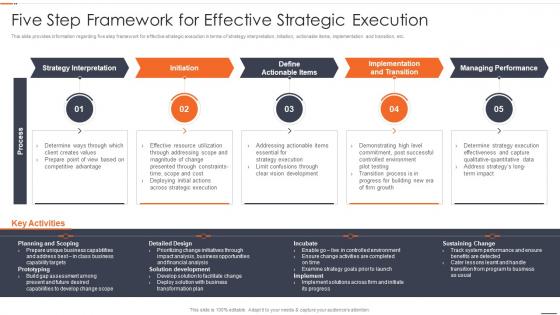
This slide provides information regarding five step framework for effective strategic execution in terms of strategy interpretation, initiation, actionable items, implementation and transition, etc.
People who downloaded this PowerPoint presentation also viewed the following :
Chief Strategy Officer Playbook Five Step Framework For Effective Strategic Execution with all 6 slides:
Use our Chief Strategy Officer Playbook Five Step Framework For Effective Strategic Execution to effectively help you save your valuable time. They are readymade to fit into any presentation structure.





FAQs for Chief Strategy Officer Playbook Five Step Framework For
Chief Strategy Officers oversee strategic planning, competitive analysis, market research, growth initiatives, and cross-functional alignment to drive organizational direction. In today's rapidly evolving landscape, they navigate digital transformation, merger opportunities, and emerging market trends, with many organizations finding that effective CSOs ultimately deliver sustainable competitive advantage and accelerated revenue growth.
A CSO aligns strategic vision with operational execution by establishing clear strategic priorities, creating cascading objectives across departments, implementing robust performance metrics, and fostering cross-functional collaboration. Through regular strategic reviews and adaptive planning processes, organizations streamline decision-making, enhance resource allocation, and ensure tactical initiatives directly support long-term goals, ultimately delivering measurable business outcomes.
CSOs can utilize frameworks like SWOT analysis, Porter's Five Forces, BCG Matrix, scenario planning, and balanced scorecards for comprehensive strategic assessment. These tools streamline decision-making by evaluating competitive positioning, resource allocation, and market opportunities, with many organizations finding that combining multiple frameworks delivers enhanced strategic clarity and sustainable competitive advantage.
A Chief Strategy Officer can measure strategic initiative success through key performance indicators, financial metrics, milestone tracking, stakeholder feedback, and competitive benchmarking. These measurement frameworks enable organizations to assess progress systematically, identify implementation gaps, and adjust strategies proactively, with many companies finding that regular performance reviews ultimately deliver enhanced operational efficiency and sustainable competitive advantage.
CSOs should employ techniques including cross-functional innovation teams, dedicated innovation time policies, experimentation budgets, innovation workshops, and reward systems for creative problem-solving. These approaches streamline cultural transformation by encouraging risk-taking, breaking down silos, and celebrating both successes and intelligent failures, with many organizations finding that structured innovation processes ultimately deliver sustained competitive advantage and employee engagement.
CSOs effectively communicate strategic objectives through clear messaging frameworks, regular stakeholder updates, data-driven presentations, visual storytelling tools, and cross-functional alignment sessions. These approaches streamline organizational understanding by connecting high-level strategy to departmental goals, ensuring consistent execution across teams, and fostering stakeholder buy-in, with many organizations finding that transparent communication ultimately delivers stronger strategic outcomes and enhanced competitive positioning.
Data analytics enables CSOs to make informed strategic decisions by providing market insights, competitive intelligence, performance metrics, customer behavior patterns, and predictive forecasting capabilities. Through advanced analytics platforms, CSOs can identify emerging opportunities, assess strategic risks, and optimize resource allocation across initiatives, ultimately delivering data-driven strategies that enhance competitive positioning and accelerate organizational growth in increasingly complex business environments.
CSOs assess and manage strategic risks through comprehensive risk mapping, scenario planning, stakeholder impact analysis, financial modeling, and continuous monitoring frameworks. These approaches enable organizations to identify potential obstacles early, develop contingency plans, and maintain strategic agility, with many Fortune 500 companies finding that proactive risk management ultimately delivers more resilient strategic outcomes and sustainable competitive advantage.
Chief Strategy Officers can leverage scenario planning, competitive intelligence gathering, strategic partnerships, diversification initiatives, and agile framework implementation to navigate market disruptions. Through continuous market monitoring and stakeholder engagement, organizations streamline decision-making processes, accelerate pivot capabilities, and enhance resource allocation, with many companies finding that proactive adaptation strategies ultimately deliver sustained competitive advantage in increasingly volatile business environments.
Collaboration with other C-suite executives enhances CSO effectiveness by aligning strategic initiatives with operational capabilities, financial constraints, and market realities across all business functions. Through integrated planning sessions and cross-functional committees, CSOs leverage insights from CFOs, COOs, and CMOs to develop more comprehensive strategies, while ensuring seamless execution and stakeholder buy-in throughout the organization.
CSOs should focus on KPIs including revenue growth rate, market share expansion, customer acquisition cost, strategic initiative completion rates, and return on strategic investments. These metrics enable comprehensive tracking by measuring financial performance, competitive positioning, and operational efficiency, with many organizations finding that balanced scorecards combining leading and lagging indicators ultimately deliver clearer strategic visibility and faster course corrections.
A Chief Strategy Officer ensures alignment by establishing clear strategic roadmaps that connect quarterly milestones to long-term objectives, implementing regular cross-functional reviews, and creating metrics that measure both immediate performance and strategic progress. Through integrated planning frameworks, many organizations find that linking resource allocation decisions to long-term vision while maintaining operational flexibility ultimately delivers sustained competitive advantage.
CSOs face challenges including stakeholder alignment across departments, resource allocation constraints, market volatility, organizational resistance to change, and balancing short-term pressures with long-term vision. These obstacles require strategic navigation through cross-functional collaboration, data-driven decision making, and adaptive frameworks, with many organizations finding that agile planning processes and transparent communication ultimately deliver better strategic outcomes and competitive advantage.
A CSO drives stakeholder engagement by facilitating cross-functional workshops, establishing clear communication channels, creating transparent feedback mechanisms, and implementing regular strategic updates throughout the planning cycle. Through structured collaboration sessions and data-driven presentations, organizations enhance buy-in, accelerate decision-making, and ensure strategic alignment, with many companies finding that inclusive planning processes ultimately deliver stronger execution and measurable business outcomes.
CSOs should establish clear transformation objectives, secure executive alignment, communicate vision consistently, and implement phased rollout plans with measurable milestones. Through structured change management and cross-functional collaboration, organizations streamline operations, enhance decision-making capabilities, and accelerate market responsiveness, with many companies finding that strategic transparency and stakeholder engagement ultimately deliver sustainable competitive advantage.
-
I downloaded some of the presentations for work. They were simple to modify and saved me a lot of time and effort.
-
I can always count on your designs for my professional needs. I believe I found a one-stop-shop for PPTs.