


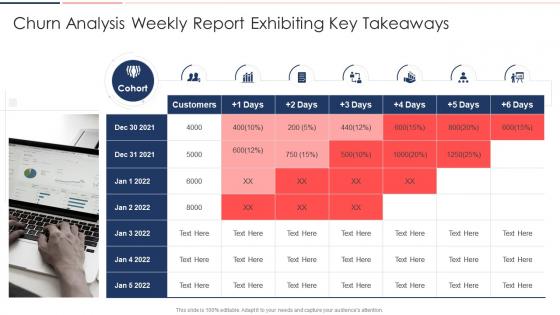
Churn analysis weekly report exhibiting key takeaways




Try Before you Buy Download Free Sample Product
 Impress Your
 Audience
 100%
100% Editable
 Save Hours
 of Time


Our Churn Analysis Weekly Report Exhibiting Key Takeaways are topically designed to provide an attractive backdrop to any subject. Use them to look like a presentation pro.
People who downloaded this PowerPoint presentation also viewed the following :
Churn analysis weekly report exhibiting key takeaways with all 9 slides:
Use our Churn Analysis Weekly Report Exhibiting Key Takeaways to effectively help you save your valuable time. They are readymade to fit into any presentation structure.








FAQs for Churn analysis weekly report
So the big ones are churn rate (how many customers you lose monthly/yearly), customer lifetime value, and retention rate. SaaS companies go crazy tracking monthly churn - sometimes feels like they check it every hour lol. Telecom usually does annual since people are locked into longer contracts. Cohort analysis is super helpful too - shows you how different customer groups stick around. Oh, and definitely track revenue churn vs just customer count. Losing one whale customer hits way harder than a bunch of small accounts leaving. Honestly? Pick like 2-3 that actually matter for your business instead of drowning in data.
Dude, churn analysis is like having a window into why customers are bailing on you. Track it monthly and you'll start seeing patterns that help you make way smarter decisions about your product roadmap and marketing spend. Should you focus on getting new customers or keeping the ones you have? The data tells you. I've seen teams waste so much money on shiny new features when they should've been fixing retention issues first. It also shows you which customer segments are worth investing in - some might look profitable but churn like crazy. Connect your churn data directly to whatever initiatives you're running so you can actually see what's working.
Random Forest and Gradient Boosting work great for this stuff. I'd also throw in logistic regression since you can actually explain the results to your boss. Focus on behavioral data - how often they log in, support tickets, late payments, that kind of thing. Time features are clutch too, like days since last activity. But honestly? Feature engineering beats picking some fancy algorithm every time. Start simple with logistic regression, then try XGBoost if you want. The key is catching people before they're already out the door - once they've decided to cancel, you're kinda screwed anyway.
So it totally depends on what business you're in. Telecom companies see younger people bail way faster, but if you're in finance, income levels matter way more. Women stick around longer in retail but bounce quicker from gaming platforms - honestly wasn't expecting that one. For B2B stuff, company size and what industry they're in are your best bets for predicting who'll leave. Consumer businesses should look at family setup and where people live instead. Don't just assume the usual patterns work for you though. Pull your churn data and break it down by 3-4 demographics first. You'll probably find some surprises.
Oh man, feedback is like your churn crystal ball - seriously. It shows you exactly why people are pissed off before they ghost you. I'd set up surveys and actually watch those support tickets (boring but necessary). The patterns in complaints will blow your mind - you'll find problems you never knew existed. When customers feel heard, they don't bail as much. Wild concept, right? But here's the thing - you've gotta actually fix what they're telling you, not just collect complaints and let them sit there. Create those feedback loops so you can move fast.
Yeah, ML will definitely beat traditional methods for churn prediction. Random forests and gradient boosting are solid picks - they catch those weird non-linear patterns that simpler models totally miss. XGBoost is probably your best starting point since it's pretty straightforward to set up and usually performs well right away. Neural networks work too but honestly might be overkill at first. The cool thing is these algorithms handle tons of variables at once and find connections between features you wouldn't even think of. LightGBM is another good option if you want something fast.
Start with the big picture - overall churn trends that'll grab their attention. Then break it down by segments they actually care about (high-value customers, different product lines, whatever). Heatmaps are your friend here - execs go crazy for those colorful grids, I swear it's like showing shiny objects to toddlers. Don't just dump data on them though. Add annotations explaining the "why" behind spikes or dips. If churn jumped in Q3, tell them what caused it and your plan to fix it. Always end with concrete next steps, not just pretty charts.
So basically you want to set up automated risk scoring in your CRM that watches for red flags - stuff like people not opening emails, tons of support tickets, or usage suddenly dropping off. Salesforce and HubSpot make this pretty easy with custom fields and workflows. Once someone hits a certain churn score, boom - your sales team gets an alert and you can automatically kick off retention campaigns. Honestly, the real-time alerts are a game changer. I'd start simple though - pick your top 3 warning signs and build basic rules around those first. You can always get fancier later.
Dude, your biggest issues are probably crappy customer service and pricing that's all over the place. Product selection matters too - customers hate when you don't have what they want. Honestly, personalization is huge these days but most places suck at it. Start with some solid staff training and get your pricing competitive. Use your data to actually understand what people want instead of just guessing. Oh, and fix your loyalty program if it's garbage. Here's what I'd do: send out surveys to figure out what's really bugging customers, then tackle the worst problems first. Don't try to fix everything at once though.
Honestly, personalized marketing is a game-changer for keeping customers around. You're basically showing people you get what they actually want instead of blasting everyone with the same boring stuff. Look at how Netflix nails their recommendations - that's the vibe you want. Dig into your customer data and figure out why people usually bail, then hit those pain points directly. Maybe it's targeted discounts for price-sensitive folks or tutorials for people who seem confused about features. The whole point is making your outreach feel relevant, not like spam. Trust me, customers can smell generic marketing from a mile away and they hate it.
So B2B churn is all about relationships - you're tracking contract renewals, how healthy accounts look, whether multiple people at companies are actually engaged. Losing one client? That's gonna sting since they're worth way more. B2C is totally different - you're drowning in data from individual users. App usage, how often they buy stuff, subscription changes. Each person's not worth as much, but there's tons of them. For B2B, watch contract dates like a hawk and flag usage drops early. B2C needs those instant behavioral alerts and massive segmentation. First figure out which bucket you're in, then build metrics around either relationship health or usage patterns.
So basically you group customers by when they signed up, then see how many are still around months later. Monthly cohorts work well - just track retention for like 6-12 months. What's cool is you'll spot stuff like "wow, everyone from that Black Friday promotion churned super fast" or notice retention always tanks around month 3. Honestly beats staring at spreadsheets all day. The magic happens when you compare different cohorts side by side - makes problem periods obvious. That's where you'll find your biggest leaks and can actually do something about them.
Win-back rate is huge - that's literally how many churned customers you can get back. Time-to-churn patterns help catch warning signs early. The CLV comparison between churned vs retained customers? Honestly brutal when you see those numbers, but super useful. Exit surveys tell you why people are bailing (though getting responses is its own challenge). Track where churned customers end up going too - competitor intel is gold. Oh, and start with recent high-value churns for your win-back campaigns since they're easiest to re-engage.
Yeah, there's definitely a connection between happy employees and keeping customers around. When your staff actually likes their job, they treat customers better and spot problems early. Makes total sense, right? I'd compare your employee satisfaction scores with churn rates - see if there are any obvious patterns by department or time periods. Honestly, I've seen companies throw tons of money at marketing when the real issue was just that their employees were miserable. Sometimes fixing the internal stuff works way better than trying to win customers back after they've already left. Worth checking those employee surveys first.
SaaS and tech companies are getting destroyed right now - like 5-10% monthly churn, which is insane. Streaming services too. Everyone's cutting subscriptions because money's tight, plus there's just way too much competition. Businesses are basically auditing every software tool they pay for. With streaming, people just hop around chasing whatever show they want to binge that month. Oh, and telecom's always been a mess with churn anyway. Focus hard on those first 30-60 days - that's when you'll lose people if you don't prove you're worth keeping around.
-
Top Quality presentations that are easily editable.
-
Great designs, really helpful.
-
Visually stunning presentation, love the content.
-
Illustrative design with editable content. Exceptional value for money. Highly pleased with the product.