


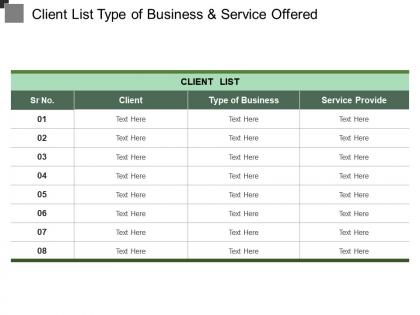
Client list type of business and service offered




Try Before you Buy Download Free Sample Product
 Impress Your
 Audience
 100%
100% Editable
 Save Hours
 of Time


Our Client List Type Of Business And Service Offered will create the climate. Your thoughts will flow like a breeze.
People who downloaded this PowerPoint presentation also viewed the following :
Client list type of business and service offered with all 5 slides:
Enjoy a bonanza with our Client List Type Of Business And Service Offered. Get a chance to indulge your dreams.


FAQs for Client list type of business
Oh man, tons of businesses do this! Real estate agents and insurance brokers are obsessed with their contact lists - honestly makes sense since they need repeat clients. Financial advisors and consultants too. Most professional services like lawyers, accountants, marketing agencies all keep detailed client databases for targeted outreach. Healthcare practices do it but they're super careful about privacy stuff obviously. Even some retail businesses with expensive products maintain lists for personalized marketing. The common thread? These are all businesses where customers either buy repeatedly or need ongoing services, so staying in touch actually makes them money.
Your CRM client list is honestly a game-changer. Track everything - what services they get, how often, their weird preferences. I'd start by sorting your current clients into groups based on service type and frequency. You'll spot patterns right away that'll help with outreach. The cool part? You can reach out before they even know they need something again. Set up reminders for their usual cycles. Plus you can see upselling opportunities way easier when it's all laid out. It's basically like having notes for every conversation - which, let's be real, saves you from those awkward "remind me what we did last time" moments.
Focus on client acquisition cost, lifetime value, and retention rates first - that's where the real money insights live. Revenue per client matters too, plus how often they actually buy from you. Repeat customers are honestly my favorite thing to see in the data because that's pure gold. Don't forget client concentration (like how much your top 10 clients bring in) and referral rates. The magic happens when you find client segments that are cheap to acquire but stick around forever. Pull these monthly and watch for patterns over 6-12 months - that's when you'll spot the good stuff.
So I'd definitely break down your client list by service type and company size - those two give you the best bang for your buck. Engagement history matters too because your big spenders obviously need way different messaging than smaller accounts. Industry vertical is solid if you've got specialized stuff to offer. Oh, and don't sleep on geographic location if you're doing local services. Honestly though, keep it simple at first - maybe 3 or 4 segments tops? Pick your most profitable group and run a test campaign there. See what clicks before you go crazy with it.
Dude, don't put all your eggs in one basket - seriously learned this the hard way. When you're too dependent on one industry and they tank, you're screwed. I spread across tech, healthcare, retail, whatever. Economic hits affect everyone differently - tech might crash while healthcare stays solid. Different payment cycles help too, smooths out the feast-or-famine thing. Oh and track your revenue percentages! Try keeping each sector under 40% of your total. Saved me when my biggest client's industry went through that weird restructuring phase last year.
B2B lists are way more complicated than B2C - you're tracking company size, industry, who actually makes decisions, contract values. B2C is simpler since it's just individual buyers and their shopping habits. The tricky part with B2B? Sales cycles drag on forever with multiple people involved. Your list needs to capture the real decision-maker (not just who you talked to first), budget timing, their specific problems. It's honestly a lot more work than B2C lists. I'd start by sorting your current clients into deal size buckets and how strong those relationships actually are. That'll give you a good foundation.
Honestly, tech is a total game-changer for managing your client lists. CRM systems track everything - who bought what, preferences, interaction history. Works whether you're running a law firm or selling stuff online. The AI prediction tools are getting scary good at spotting which clients might bail or which leads will actually buy. What really makes it powerful is connecting your client data to your marketing emails, sales process, all that stuff. Here's the thing though - most people pick a fancy CRM then never actually use it properly. Just grab one decent system and stick with it.
Dude, your client list is literally your secret weapon. Big companies can't remember everyone's dog's name or actually care about their problems - you can. I'd start by figuring out which clients love you most, then go all-in on those relationships. Set up referral programs, ask for real feedback (not just "how are we doing?" surveys), and create services that fit them perfectly. It's kinda crazy how much personal connection beats corporate efficiency. Oh, and segment your list first - you'll waste time otherwise. Trust me, being small isn't a disadvantage here.
Honestly, you'll want to get some automated stuff running first - CRM tools that flag old info, email platforms catching bounces. But don't rely on that alone. I do quarterly audits (total snoozefest but whatever) where I go through and clean out duplicates, check contact details. Your team should ask for updated info during regular calls too. Oh, and those "please update your details" emails? Send them yearly. Works better than you'd think. The trick is making it routine instead of scrambling once everything's already a mess.
Honestly, client feedback is your best friend for smarter list segmentation. Every time someone compliments a service or complains about a pain point, update their profile with that info. It's like turning their words into targeting data. I do quarterly feedback reviews - sounds boring but you'll start noticing patterns. Like when three retail clients suddenly want the same thing? That's your cue to create a sub-list. Way better than randomly guessing what people want. Just add feedback tags in your CRM so you can filter easily later. Makes your outreach way more targeted.
Dude, just think of it like your own personal stuff - you wouldn't want some company being sketchy with your info, right? Get permission before collecting anything. Be upfront about what you're doing with it. Only grab data you actually need for business stuff. Never sell client lists without asking first - that'll torch your reputation so fast. Keep everything locked down with decent security and encryption. Oh, and make it super easy for people to unsubscribe or change their details. I learned this the hard way when a client got pissed because they couldn't figure out how to update their email. Basic respect goes a long way.
Your service type completely changes how you should handle client lists. Subscription businesses need to watch usage patterns and renewal dates like hawks. Wedding planners? They're all about referrals and tracking big milestones. Professional services keep detailed notes on every interaction - what clients need, their expertise gaps, all that stuff. Retail's different though, focusing on buying habits and what people actually want. I've watched so many people screw this up by just grabbing some random CRM template. Don't do that. Structure your lists around how you actually deliver your service, otherwise you'll drown in useless information.
Honestly, the worst thing you can do is let your contact info go stale - people switch jobs like crazy now. Don't dump everyone into one massive list either. Different clients need different approaches, trust me on that. Oh, and back up your data! I lost half my contacts once when my laptop died. Never again. Clean house every quarter - set phone reminders or whatever works. Group people by industry or how you work with them. Keep multiple backups somewhere safe. Sounds boring but it'll save your butt later.
So I pull reports every few months on clients who haven't bought anything in like 6-12 months - you'd be shocked how many good leads you're just sitting on. Check for people who bought your basic stuff but never upgraded, those are goldmines for upselling. Also look at clients who used to be super engaged but went quiet. I set up different email sequences depending on where they are in the process, though honestly it's kinda tedious at first. Oh, and use your best clients' profiles to find similar prospects. Game changer.
So if you're running a small business, HubSpot's free CRM is solid - same with Mailchimp. Both won't kill your wallet. Salesforce and Pipedrive work better for mid-size companies since they've got more bells and whistles. Enterprise level? You're looking at Microsoft Dynamics or Oracle CX. Oh, and industry totally matters - real estate people are obsessed with Top Producer, while consultants dig Airtable because it's super flexible. Honestly though, figure out your budget first, then just trial like 2-3 options. Don't overthink it.
-
It saves your time and decrease your efforts in half.
-
Commendable slides with attractive designs. Extremely pleased with the fact that they are easy to modify. Great work!