


Common Types Of Cyber Bullying Activities




Try Before you Buy Download Free Sample Product
 Impress Your
 Audience
 100%
100% Editable
 Save Hours
 of Time


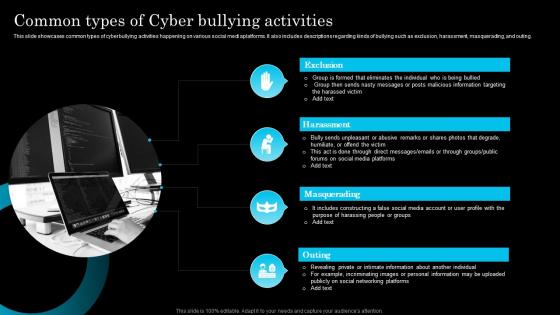
This slide showcases common types of cyberbullying activities happening on various social medi aplatforms. It also includes descriptions regarding kinds of bullying such as exclusion, harassment, masquerading, and outing.
People who downloaded this PowerPoint presentation also viewed the following :
Common Types Of Cyber Bullying Activities with all 6 slides:
Use our Common Types Of Cyber Bullying Activities to effectively help you save your valuable time. They are readymade to fit into any presentation structure.





FAQs for Common Types Of
Cyberbullying involves repetitive online harassment through digital platforms, anonymity or pseudonymity, permanent digital evidence, 24/7 accessibility, and wider audience reach compared to traditional face-to-face bullying. These characteristics enable perpetrators to harass victims continuously across social media, messaging apps, and gaming platforms, while digital permanence amplifies psychological impact, ultimately creating more pervasive trauma experiences.
Social media platforms have significantly amplified cyberbullying among teenagers by expanding reach, enabling anonymous harassment, and creating persistent digital environments where harmful content spreads rapidly. These platforms facilitate 24/7 accessibility to victims, with many educational institutions and mental health organizations finding that cyberbullying incidents increase substantially during peak social media usage periods, ultimately requiring comprehensive digital literacy programs.
Cyberbullying creates immediate psychological effects including anxiety, depression, social withdrawal, and decreased academic performance, while long-term impacts encompass chronic mental health issues, trust difficulties, and reduced self-esteem. These effects significantly impact personal development and professional relationships, with many victims finding that early intervention and support systems help minimize lasting psychological damage and enhance resilience building.
Legal frameworks for cyberbullying include federal civil rights laws, state anti-bullying statutes, workplace harassment policies, and Title VII protections for employment settings. These regulations enable institutions to implement comprehensive prevention programs, conduct thorough investigations, and enforce disciplinary measures, with many schools and organizations finding that proactive policy frameworks significantly reduce incidents while enhancing overall safety.
Parents can effectively address cyberbullying through open communication, regular device monitoring, and documented incident reporting to schools and platforms. By establishing clear digital boundaries, teaching children to screenshot evidence, and working collaboratively with educators and counselors, families create comprehensive protection strategies that enhance online safety, build digital resilience, and ultimately deliver stronger parent-child trust in increasingly connected environments.
Bystanders play a crucial role in cyberbullying situations by either enabling harassment through inaction or becoming powerful advocates for change through intervention, reporting, and peer support. Research across educational institutions and workplace environments shows that active bystander intervention significantly reduces cyberbullying incidents, with many organizations finding that comprehensive bystander training programs ultimately create safer digital environments and stronger community accountability.
Schools can implement comprehensive digital citizenship curricula, peer mentorship programs, interactive workshops with real-world scenarios, regular awareness assemblies, and collaborative sessions involving parents and educators. These educational strategies enhance student understanding by promoting empathy, teaching responsible online behavior, and establishing clear reporting mechanisms, with many educational institutions finding that proactive education significantly reduces incidents while fostering safer digital environments.
Technology companies can enhance cyberbullying prevention through advanced AI detection systems, real-time content moderation, improved reporting mechanisms, user empowerment tools, and cross-platform collaboration initiatives. These approaches streamline incident response by automating threat identification, enabling faster interventions, and providing comprehensive user controls, with many social media platforms finding that proactive policy enforcement ultimately delivers safer online environments and enhanced user trust.
Anonymity significantly increases cyberbullying likelihood by reducing personal accountability, enabling disinhibition effects, and minimizing fear of consequences or social judgment. This digital shield emboldens individuals to engage in aggressive behaviors they would typically avoid in face-to-face interactions, with many online platforms finding that anonymous environments require enhanced moderation and reporting systems to maintain safe community standards.
Cyberbullying victims can seek support through school counselors, mental health professionals, trusted adults, online crisis hotlines, and specialized anti-bullying organizations that provide counseling and recovery resources. Many educational institutions and healthcare systems now offer comprehensive support programs combining peer counseling, therapeutic intervention, and digital safety education, ultimately helping victims rebuild confidence and develop resilience strategies for long-term emotional recovery.
Signs include withdrawal from technology, declining academic performance, emotional distress, secretive online behavior, and unexplained changes in social circles or mood patterns. These behavioral indicators help educators, parents, and counselors identify cyberbullying situations early, enabling timely intervention strategies that protect victims while addressing perpetrator behaviors, ultimately creating safer digital environments for students and online communities.
Cultural differences significantly shape cyberbullying perceptions through varying communication norms, authority structures, and conflict resolution approaches. While individualistic cultures often emphasize direct reporting and self-advocacy, collectivistic societies frequently prioritize group harmony and indirect intervention methods, with many educational institutions finding that culturally-tailored prevention programs deliver more effective outcomes and student engagement.
Effective cyberbullying intervention strategies include establishing clear digital citizenship policies, implementing immediate response protocols, creating anonymous reporting systems, conducting regular classroom discussions about online behavior, and collaborating with parents on consistent messaging. These approaches work by fostering proactive prevention, enabling swift action, and building supportive environments, with many schools finding that comprehensive strategies significantly reduce incidents while enhancing student safety.
Creating a positive online community reduces cyberbullying by establishing clear behavioral guidelines, implementing proactive moderation systems, and fostering peer accountability through supportive engagement. These community-building approaches enable platforms, educational institutions, and organizations to minimize harmful interactions, encourage constructive dialogue, and create safer digital environments, with many finding that positive reinforcement ultimately delivers stronger user engagement and reduced administrative intervention costs.
Empathy plays a crucial role in cyberbullying prevention by helping individuals recognize the emotional impact of online actions, fostering understanding of victims' experiences, and encouraging bystander intervention. Educational programs that develop empathetic thinking enable students, parents, and educators to create supportive digital environments, ultimately reducing harmful behaviors while promoting positive online interactions and emotional resilience.
-
You guys are life-saver when it comes to presentations. Honestly I cannot do much without your services. Thank you!!!
-
The service is fast, and I could access any presentation after buying the subscription. I don’t think I’ll ever have to worry about a presentation in my life.