


Communication goals powerpoint templates




Try Before you Buy Download Free Sample Product
 Impress Your
 Audience
 100%
100% Editable
 Save Hours
 of Time


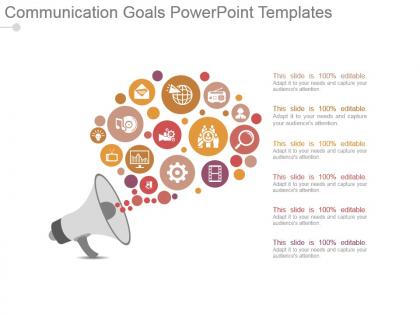
Planning to create an impressive presentation on communication goals and achievements? Not sure how to start? Do not worry! Download our editable communication goals PowerPoint template. Discuss various goals and time management ideas in your presentations using this communication goal PowerPoint template. Graphic of the speaker with different icons has been used to design this PPT template diagram. This communication goals presentation template diagram explains the concept of communication management. Use this comm. management PPT template slide for crafting a stunning presentation on a related topic such as communication management, communication goals and objectives, marketing communication, goal setting, and business management. Use this communication process template outline to make an attentive procedure motivation to guarantee that team meets targets and leaves next to no to risk. This is a simple approach to achieve your business objectives and targets. The readymade PPT visual offers to alter the substance and include the content according to your desire. Arrive at the best formula with our Communication Goals Powerpoint Templates. Discover the exact combination of elements.
People who downloaded this PowerPoint presentation also viewed the following :
Communication goals powerpoint templates with all 7 slides:
Interlink your thoughts with our Communication Goals Powerpoint Templates. Your message will stand out loud and clear.
FAQs for Communication
Okay so first figure out exactly who you're talking to and what you want them to actually DO. Like, be super specific here - "increase awareness" is garbage compared to "get 200 people to sign up." You need a real deadline too, not some wishy-washy "eventually" timeline. Pick something you can actually measure - surveys, clicks, whatever makes sense. Oh and make sure it connects to bigger company stuff, otherwise what's the point? I always write mine like: "By March 15th, new customers will complete onboarding as measured by tutorial completion rates." Sounds corporate but it works.
Honestly, templates are lifesavers because you don't have to start from scratch every damn time. Problem-solution-benefit works great for persuasive stuff. For updates, I always do status-impact-next steps - keeps me from going off on tangents (which I definitely do otherwise). They cut your prep time in half, which is huge when you've got back-to-back presentations. The trick is picking the right one for what you're trying to do. Want to inform people? That's different from convincing them or getting approval. I usually stick with one template per goal, then just swap out the content. Way less stressful than winging it.
So audience analysis is huge - it literally drives what you're even trying to accomplish. Once you know their expertise level, what bugs them, and how they like to communicate, you can actually set goals that make sense. Why aim to "educate" experts? That's backwards. Better to focus on persuading them or getting everyone aligned. Their schedule matters too, plus whether they can actually make decisions or just influence them. Oh and honestly? Some audiences need time to warm up to ideas while others want you to cut to the chase. Always start by figuring out what they actually need from you first.
Your body language needs to match what you're actually trying to do. Building trust? Keep good eye contact and don't cross your arms. Want to persuade someone? Lean in a bit and copy how they're sitting - sounds manipulative but honestly it works. Need to look authoritative? Stand up straight, use bigger gestures. I always forget this part but it's huge - your body can totally sabotage what you're saying if you're not thinking about it. Before big conversations, I'll literally do a quick mental check of how I want to come across physically. Makes a weird difference.
Honestly, feedback is like your reality check for communication. It shows you whether your message actually landed or if you totally whiffed it (we've all been there). Without it, you're basically just talking to yourself and crossing your fingers. The smart move? Build in ways to get that feedback - ask people directly, watch their faces, see if they actually did what you asked. Then use what you learn to switch things up. Maybe you need clearer words, better timing, or a completely different approach. It's kind of annoying but also super helpful.
Honestly, start with something like Asana or Monday for tracking your communication deadlines - they're lifesavers. For the data side, analytics dashboards will actually show you open rates and response times instead of you just wondering if things are working. Calendly is clutch for regular stakeholder meetings (I swear by it). Recording your video calls helps too since you can watch back and see where you stumbled. Here's the thing though - don't go crazy with tools. Pick maybe 2 or 3 max and actually use the data to change what you're doing, not just collect numbers that make you feel productive.
Ugh, the worst thing you can do is be super vague with your goals. Like saying "I want to inform people" - that tells you literally nothing when you're planning what to say. Don't try cramming five different objectives into one presentation either. You'll just confuse everyone, yourself included. Also? Be realistic about timing. You can't teach rocket science to newbies in a 10-minute slot - I've seen people try and it's painful to watch. Instead, get specific: "Everyone will leave knowing our three pricing options and which one fits their client type." Now you actually have something concrete to work toward.
Oh man, this is so true from my experience. Japanese clients want relationship-building first - direct pitches feel rude to them. Germans? Total opposite. They want you to cut to the chase. Timing's weird too... some cultures think instant replies are pushy (I definitely bombed with a client once over this). You might need to switch between highlighting individual wins versus team success depending on who you're talking to. Honestly, just ask someone local about their communication style before jumping in. It'll save you from looking like an idiot - trust me on this one.
Honestly, start with what success actually looks like for your goal, then figure out how to measure it. Engagement stuff is pretty standard - open rates, clicks, responses. Brand recall surveys work great for awareness campaigns. But conversion rates are where it's at! Those numbers hitting means people are actually doing what you wanted. Also track reach like impressions and audience growth, though that's more vanity metrics tbh. Don't go crazy measuring everything - pick 2-3 things that directly connect to your goal. I learned this the hard way when I was drowning in data but couldn't tell if anything was working.
Think of your presentation goals like a story - start with a problem, build up the tension, then boom, your solution saves the day. Way more engaging than boring bullet points, trust me. Frame it like "by the end, you'll see how Company X went from disaster Y to success Z." Throw in real people - actual customers, your teammates, whoever. Makes it feel less corporate and more human. People remember stories way better than lists anyway (there's probably some psychology reason but whatever). Your goals become plot points instead of just... goals.
Okay so here's what I wish someone told me earlier - be crazy specific about what you want. Like don't just say "better engagement," write down "boost email opens by 15%" or whatever your actual number is. I used to be so vague and projects would go nowhere, it was honestly embarrassing. Before you start messaging people, run your goal past someone else first. They'll spot the confusing parts you can't see. Oh and always mention upfront how you'll measure success - it forces you to figure out if your goal even makes sense. Sometimes when I do this step I realize my idea was kinda dumb lol.
Honestly, emotional appeals are like your secret weapon for getting through to people. Facts alone? Pretty boring. But when you hit someone with the right feeling - fear, hope, whatever fits - that's when your message actually sticks. Here's the thing though: you gotta match the emotion to what you're trying to do. Need people to act fast? Make them feel urgency. Building trust? Go for empathy or find common ground. Just don't lay it on too thick or you'll sound fake. I'd test a few different approaches with smaller groups first - saves you from bombing when it really counts.
Get everyone together and actually nail down what "good communication" means for your project - honestly, people have wildly different ideas about this. Ask each person how they like getting updates, what channels work best, and how much detail they actually want. Write it all down somewhere people can see it. Then do regular check-ins to see if it's working or if you need to tweak things. Don't just create some document and forget about it though. Your communication needs will probably shift as the project moves along, so be ready to adjust.
Think of visuals as your backup - they make whatever you're saying hit harder. Red colors scream urgency way better than just telling people "this is urgent." Charts stick in people's heads while numbers just go in one ear and out the other (seriously, who actually remembers stats?). Don't just throw pretty pictures on slides though. Pick images that make people feel something. Colors should match your vibe. Guide their eyes where you want them looking. Honestly, half the presentations I see have random stock photos that add nothing. Your visuals need a job, not just decoration.
SMART goals totally change the game for communication. You're not just saying "I'll communicate better" - you're getting specific like "I'll do 15-minute check-ins with each team member weekly for a month." Way more doable, right? The measurable part is clutch because you can track response times, engagement, whatever matters to your situation. Plus having that deadline creates real accountability instead of just... hoping things improve eventually. Honestly, the framework feels a bit corporate-y at first, but it actually works. Pick one communication thing that's bugging you and try making it SMART this week.
-
Great designs, Easily Editable.
-
Qualitative and comprehensive slides.