


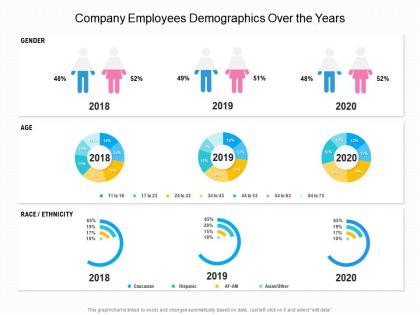
Company employees demographics over the years




Try Before you Buy Download Free Sample Product
 Impress Your
 Audience
 100%
100% Editable
 Save Hours
 of Time


Our Company Employees Demographics Over The Years are topically designed to provide an attractive backdrop to any subject. Use them to look like a presentation pro.
People who downloaded this PowerPoint presentation also viewed the following :
Company employees demographics over the years with all 2 slides:
Use our Company Employees Demographics Over The Years to effectively help you save your valuable time. They are readymade to fit into any presentation structure.
FAQs for Company employees demographics
Oh totally, demographics make a huge difference in how teams work together. You've got different generations who communicate totally differently, plus people from various backgrounds bringing their own approaches to problem-solving. It's actually pretty cool for innovation - mixing all those perspectives usually leads to way better ideas. But real talk, it can get messy if people don't get where others are coming from. I'd focus on making sure everyone feels safe speaking up. Also establish some basic communication ground rules that actually work for your specific group. Trust me, that psychological safety thing isn't just buzzword nonsense.
Look at your team's demographics first - that's where the magic happens. Younger folks usually want mobile feedback tools and flexible career paths. Meanwhile, experienced workers love mentoring others and sharing what they know. Communication styles are totally different too - Gen Z lives on Slack while others still prefer good old email (honestly, both work fine). Survey each group about what they actually want instead of guessing. Then test different approaches. I made the mistake of assuming everyone wanted the same perks at my last job - spoiler alert, they didn't! Your specific mix will be unique anyway.
Honestly, generational differences can be your team's secret weapon if you don't let them turn into drama. Boomers love their face-to-face meetings, Gen Z lives for digital everything - and that's actually pretty cool when you think about it. Mix up how you communicate instead of forcing everyone into the same box. Pair different generations on projects because the knowledge sharing is incredible. Short version: create space for different work styles and make sure everyone feels heard. Oh, and don't try to make a 60-year-old use Slack the same way a 25-year-old does - trust me on that one.
So demographic analysis is basically your reality check - shows you exactly which groups are missing at different levels. Most companies honestly just wing it without pulling the actual numbers first (big mistake). You'll spot patterns in hiring and promotions that might surprise you. The trick is picking one area to tackle instead of spreading yourself thin everywhere. I'd start by just grabbing your current data and seeing what jumps out. It's way easier to track if your efforts are working when you know where you started. Makes setting realistic goals so much clearer too.
Honestly, the workforce is changing big time. You've got older people working way past 65 now, plus Gen Z coming in expecting remote work and way better work-life balance than we ever got. Diversity is expanding everywhere - race, gender, educational backgrounds, the whole deal. More women are finally getting leadership positions, which is overdue if you ask me. But here's the kicker - there's this massive skills gap happening. Tons of jobs need tech skills that seasoned workers just don't have. My advice? Build flexible policies and really solid training programs to bridge all these gaps between generations and skill levels.
Oh totally - mixed educational backgrounds are goldmines for innovation. You'll get wildly different problem-solving approaches. Like, a liberal arts person thinks about user experience way differently than someone with an engineering background. I've watched teams full of similar degrees just bounce the same ideas around in circles, which honestly gets boring fast. The trick isn't just having diversity though - you need to actually use it. Give people room to speak up and challenge stuff based on their training. Otherwise you're just checking boxes on paper.
So here's what I've noticed - age is huge. Workers under 30 bail way more often than older folks. Same deal with tenure - first two years are rough for retention. Entry-level jobs? Total revolving door compared to senior positions. The remote thing is wild now too, honestly changes everything since COVID. Sales and customer service teams always seem to lose people faster than engineering or finance departments. Gender and education correlate a bit but not nearly as much. Oh, and definitely focus your energy on new hires and younger employees first - that's your biggest bang for the buck right there.
Honestly, you'll want to track stuff both before and after - like employee surveys about how included people feel, promotion rates by group, who's staying vs leaving. Focus groups work great too since people will actually tell you if the training was useful or just BS busy work. Set your baselines first, then check in quarterly instead of waiting a whole year. That way you can pivot if something's not working. Oh, and don't forget exit interviews - departing employees tend to be way more honest about this kind of thing.
Looking at employee demographics can actually show you some wild stuff about who's happy at work and who isn't. Maybe your remote team is way more satisfied than the office people - go figure! Different age groups or departments might have totally different vibes going on. It's pretty useful for catching problems early, like if new hires are feeling lost or certain teams are struggling. The cool part is you can use this info to actually have real conversations with people instead of just guessing what's wrong. Way better than those generic "pizza party fixes everything" solutions.
Your diverse team's gonna face some communication hurdles, no doubt about it. Direct cultures clash with indirect ones, and language barriers mean awesome ideas sometimes never make it out of people's heads - which is honestly the worst part. I've watched super talented people just stay quiet in meetings because English isn't their first language. But flip side? You're getting problem-solving approaches and perspectives that homogeneous teams miss completely. Set up spaces where different communication styles actually work. Maybe grab some translation tools or do cultural training. Oh, and don't assume the quietest person doesn't have the best ideas.
Age and income definitely matter when you're putting together benefits. Younger folks usually want student loan help and flexible time off. Older employees? They care more about solid health insurance and retirement stuff. Single people don't need family coverage but they might want mental health support or training money - depends what they're into. Remote work has honestly made this whole thing trickier than it used to be. Survey your team anonymously instead of guessing what they want. Ask what they'd actually use vs what you offer now.
Honestly, the analytics tools are game-changers for this stuff. They'll automatically pull data and build dashboards that show you everything - skills gaps, diversity patterns, who's leaving and why. Way better than drowning in Excel hell (been there, done that). You can quickly see which teams need more diversity, spot retention issues, or catch if certain groups aren't getting promoted fairly. The real trick though? Actually doing something about what you find. Maybe tweak your recruiting, beef up mentorship programs, or - this one's huge - fix pay gaps you didn't even know existed.
Ugh, don't do this - it always bites you in the ass. When you assume stuff about people based on their age, gender, whatever, you're probably gonna be totally wrong about their skills or what they want career-wise. I've seen this happen so many times. It creates unfair situations and honestly just makes work suck for everyone. You could end up with discrimination issues too, which is a whole mess you don't need. Way better to actually get to know people individually. Focus on how they perform and what they tell you directly about their goals. Treat people like people, not stereotypes.
So from what I've seen, remote workers are usually older - like 30s and 40s - compared to the younger office crowd. They've got more experience and education too. A lot of them are parents who need that flexibility, which honestly makes perfect sense. Cost of living plays a huge role here - remote folks often live in smaller cities or rural areas where it's cheaper, while office workers are stuck paying crazy metro area prices. When you're hiring, just think about how this affects who you can attract and what they'll expect salary-wise.
Oh totally - you've gotta adjust how you lead based on who's on your team. Gen Z folks usually want feedback like every five minutes and tons of flexibility. Meanwhile your seasoned employees? They just want you to leave them alone to do their thing. Cultural stuff matters too - some people are super direct, others dance around topics for ages (which honestly drives me crazy but whatever). Don't do the same approach with everyone - actually sit down and ask how they prefer working. Trust me, it makes such a difference.
-
Really like the color and design of the presentation.
-
Really like the color and design of the presentation.
-
Content of slide is easy to understand and edit.
-
Great quality product.
-
Presentation Design is very nice, good work with the content as well.