


Company Introduction Instacart Investor Funding Elevator Pitch Deck





Try Before you Buy Download Free Sample Product
 Impress Your
 Audience
 100%
100% Editable
 Save Hours
 of Time


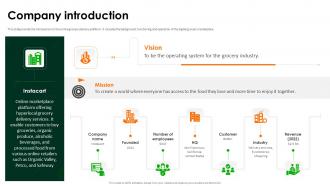
This slide provide the introduction to the online grocery delivery platform. It includes the background, functioning and operation of the digital grocery marketplace.
People who downloaded this PowerPoint presentation also viewed the following :
Company Introduction Instacart Investor Funding Elevator Pitch Deck with all 9 slides:
Use our Company Introduction Instacart Investor Funding Elevator Pitch Deck to effectively help you save your valuable time. They are readymade to fit into any presentation structure.








FAQs for Company Introduction Instacart Investor Funding
Instacart's key advantages include same-day delivery, time savings, contactless shopping, extensive retailer partnerships, and flexible scheduling options. Through its platform, busy professionals, families, and mobility-limited individuals streamline grocery procurement while accessing multiple stores simultaneously, ultimately delivering convenience and efficiency that traditional in-store shopping cannot match in today's fast-paced environment.
Instacart's pricing model combines membership fees, service fees, delivery fees, and optional tips, while competitors like Amazon Fresh emphasize subscription bundles and Walmart Grocery focuses on lower base costs. While Instacart offers greater store variety and faster delivery options, other services often provide more predictable pricing structures, with many consumers finding that choosing depends on shopping frequency, preferred retailers, and willingness to pay for convenience versus cost optimization.
Instacart has implemented AI-powered product recommendations, real-time inventory tracking, smart shopping algorithms, predictive analytics for demand forecasting, and computer vision for quality assessment. These technologies streamline grocery delivery by optimizing shopper routes, reducing out-of-stock incidents, and personalizing customer experiences, with many retailers finding that integration ultimately delivers faster fulfillment and enhanced customer satisfaction.
Instacart ensures grocery freshness through trained personal shoppers who inspect produce, check expiration dates, and communicate with customers about substitutions or quality concerns. The company partners with major retailers like Kroger, Costco, and Whole Foods to maintain cold chain logistics, offers satisfaction guarantees with refunds or credits, and increasingly leverages real-time inventory systems to minimize storage time, ultimately delivering restaurant-quality freshness.
Instacart faces challenges including inventory accuracy across multiple retailers, coordinating shopper availability during peak demand, managing delivery route optimization, and maintaining cold chain integrity for perishables. While these logistics complexities can strain operational efficiency, many grocery delivery platforms are leveraging AI-driven demand forecasting and dynamic routing systems, ultimately delivering faster fulfillment times and enhanced customer satisfaction.
Instacart customers demonstrate more deliberate purchasing patterns, frequently using search functions, creating detailed lists, and showing higher brand loyalty compared to in-store impulse buying. Through digital interfaces, shoppers spend more time researching products, comparing prices, and reading reviews, while retailers gain valuable data insights into customer preferences, ultimately enabling more personalized marketing strategies and inventory optimization.
Partnerships with local grocery stores serve as Instacart's core revenue foundation, providing inventory access, delivery fulfillment capabilities, and commission-based income streams. These strategic alliances enable retailers like Kroger, Costco, and regional chains to expand their digital presence while Instacart scales efficiently across markets, ultimately delivering enhanced customer convenience and competitive advantage for both partners.
Instacart rapidly scaled its workforce, expanded grocery partnerships, and enhanced contactless delivery options during COVID-19, adding over 500,000 shoppers while partnering with retailers like Costco and Target. The company streamlined safety protocols, prioritized essential items, and optimized order fulfillment systems, ultimately delivering faster services and better customer experiences during unprecedented demand surges.
Instacart's customer retention strategies include personalized shopping experiences, subscription-based Instacart+ memberships, strategic retailer partnerships, AI-driven product recommendations, and seamless delivery optimization. These approaches enhance customer loyalty by streamlining grocery shopping, reducing delivery costs, and improving convenience, with many households finding that personalized curation and faster fulfillment ultimately deliver superior shopping experiences.
Instacart's marketing strategy appeals to various demographics through targeted messaging, personalized promotions, and strategic partnerships across different channels and platforms. The company leverages data-driven advertising, social media campaigns for younger consumers, convenience-focused messaging for busy professionals, and health-conscious positioning for wellness-oriented shoppers, ultimately delivering relevant experiences that resonate with each demographic's specific needs and shopping preferences.
Instacart addresses labor conditions through flexible scheduling, earnings transparency, safety protocols, and shopper support resources, while navigating the complexities of gig economy classification. The company balances operational efficiency with worker welfare by providing insurance options, in-app safety features, and responsive customer service, though many labor advocates continue pushing for enhanced benefits and more traditional employment protections.
Instacart has diversified beyond groceries by partnering with pharmacies like CVS and Walgreens, alcohol retailers, pet supply stores, and beauty brands, while launching advertising services for brands and white-label fulfillment solutions for retailers. These strategic expansions enable the platform to capture broader consumer spending, increase order frequency, and deliver multiple revenue streams, with many retailers finding that Instacart's infrastructure significantly enhances their digital commerce capabilities.
Instacart has transformed local grocery businesses by expanding their digital reach, enabling curbside and delivery services, and connecting them with broader customer bases. While smaller retailers gain access to e-commerce capabilities they couldn't develop independently, larger chains benefit from enhanced operational efficiency, with many communities finding improved food access and convenience, particularly benefiting elderly and mobility-limited residents.
Instacart leverages data analytics to analyze purchasing patterns, browsing behavior, seasonal trends, and demographic preferences, enabling personalized product recommendations and targeted marketing campaigns. Through machine learning algorithms, the platform streamlines inventory management, optimizes delivery routes, and enhances customer experiences, with many retailers finding that these insights drive higher conversion rates and customer loyalty.
Common user feedback trends regarding Instacart include appreciation for convenience and time-saving benefits, concerns about product substitutions and quality control, mixed experiences with shopper communication and delivery timing, and pricing transparency issues including fees and markups. These insights help retailers and the platform enhance operational efficiency, streamline shopper training protocols, and optimize customer experiences, with many grocery businesses finding that addressing these feedback patterns ultimately delivers improved satisfaction rates and stronger competitive positioning.
-
The visual appeal of the templates is just unparalleled! I was so worried about the design of my presentation but SlideTeam made it all so easy.
-
Awesome presentation, really professional and easy to edit.