


Company Plan To Implement Safety Management System Implementation Of Safety Management Workplace Injuries




Try Before you Buy Download Free Sample Product
 Impress Your
 Audience
 100%
100% Editable
 Save Hours
 of Time


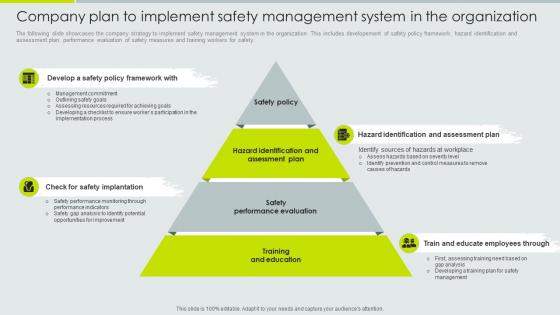
The following slide showcases the company strategy to implement safety management system in the organization. This includes developement of safety policy framework, hazard identification and assessment plan, performance evaluation of safety measures and training workers for safety.
People who downloaded this PowerPoint presentation also viewed the following :
Company Plan To Implement Safety Management System Implementation Of Safety Management Workplace Injuries with all 6 slides:
Use our Company Plan To Implement Safety Management System Implementation Of Safety Management Workplace Injuries to effectively help you save your valuable time. They are readymade to fit into any presentation structure.





FAQs for Company Plan To Implement Safety Management System Implementation Of Safety
Key components of an effective Safety Management System include safety policy and objectives, risk management processes, safety assurance protocols, safety promotion programs, and emergency response procedures. These components work together by establishing clear accountability frameworks, enabling proactive hazard identification, and streamlining incident reporting, with organizations across manufacturing, aviation, and construction finding that integrated SMS approaches ultimately deliver reduced workplace injuries and enhanced operational efficiency.
Organizations can assess current safety culture through employee surveys, incident analysis, management walkthroughs, safety perception interviews, and behavioral observations across all operational levels. These comprehensive assessment methods enable companies in aviation, manufacturing, and healthcare to identify cultural gaps, communication barriers, and leadership effectiveness, ultimately establishing baseline metrics that guide targeted SMS implementation strategies and enhance organizational safety performance.
Leadership drives SMS implementation through strategic commitment, resource allocation, and cultural transformation initiatives that establish safety priorities across organizational levels. Effective leaders champion safety policies, facilitate cross-departmental collaboration, and model safety behaviors, with many organizations finding that engaged leadership ultimately delivers sustained safety performance improvements and regulatory compliance while enhancing operational efficiency.
Technology enhances SMS effectiveness through real-time monitoring systems, predictive analytics, automated reporting tools, mobile safety applications, and integrated data platforms. These solutions streamline hazard identification, accelerate incident response, and improve compliance tracking across organizations, with industries like aviation, manufacturing, and construction finding that digital SMS platforms deliver faster risk assessment, enhanced operational visibility, and ultimately stronger safety outcomes.
Common Safety Management System implementation challenges include resistance to cultural change, inadequate resource allocation, insufficient leadership commitment, poor communication strategies, and lack of employee training programs. Organizations often struggle with integrating new safety protocols into existing workflows, establishing effective reporting mechanisms, and measuring meaningful performance metrics, with many finding that sustained leadership engagement and comprehensive training ultimately deliver improved safety outcomes and regulatory compliance.
Organizations ensure SMS employee engagement through comprehensive training programs, clear communication of safety benefits, and involving workers in hazard identification and risk assessment processes. By establishing safety committees, recognizing safety achievements, and demonstrating leadership commitment, companies create a culture where employees actively participate in safety initiatives, ultimately delivering reduced incidents and enhanced operational efficiency across all organizational levels.
Safety Management System success metrics include incident frequency rates, near-miss reporting volumes, safety audit scores, employee training completion rates, and regulatory compliance percentages. These measurements enable organizations to track operational improvements, identify risk patterns, and demonstrate safety culture maturity, with many companies finding that comprehensive metric tracking ultimately delivers reduced insurance costs, enhanced workforce confidence, and stronger regulatory positioning in increasingly scrutinized industries.
Safety Management Systems should undergo comprehensive reviews annually, with quarterly assessments of key performance indicators, incident trends, regulatory changes, and operational modifications. Many organizations in aviation, manufacturing, and healthcare find that this structured approach enables proactive hazard identification, ensures regulatory compliance, and maintains operational excellence, while continuous monitoring between formal reviews helps identify emerging risks and streamline safety protocols.
Essential training for SMS personnel includes hazard identification techniques, risk assessment methodologies, incident investigation procedures, regulatory compliance requirements, and emergency response protocols. Through comprehensive safety management courses, organizations enable staff to conduct thorough risk analyses, implement preventive measures, and maintain regulatory standards, while fostering a proactive safety culture that ultimately delivers reduced incidents and enhanced operational reliability.
Safety Management Systems can be tailored by adapting risk assessment protocols, regulatory compliance frameworks, incident reporting structures, and training programs to industry-specific hazards and operational requirements. Manufacturing facilities focus on machinery safety and chemical handling, while healthcare organizations emphasize patient safety protocols and infection control, ultimately delivering targeted protection and regulatory compliance across diverse operational environments.
Legal and regulatory considerations for SMS implementation include compliance with OSHA standards, industry-specific regulations, documentation requirements, employee training mandates, and incident reporting protocols. These frameworks ensure organizations meet safety obligations while minimizing liability exposure, with companies in manufacturing, construction, and healthcare finding that proactive compliance ultimately delivers reduced regulatory penalties and enhanced operational credibility.
Risk assessment integrates into Safety Management Systems through systematic hazard identification, regular risk evaluation protocols, and continuous monitoring mechanisms across all operational levels. Through automated risk scoring tools and predictive analytics, organizations in manufacturing, aviation, and construction can proactively identify potential safety issues, streamline compliance reporting, and ultimately reduce incident rates while enhancing operational efficiency.
Incident reporting and investigation form the backbone of SMS effectiveness by identifying hazards, analyzing root causes, and preventing recurrence through systematic data collection and corrective actions. These processes enable organizations across aviation, manufacturing, and healthcare to enhance safety protocols, reduce operational risks, and build proactive safety cultures, ultimately delivering improved compliance and competitive advantage.
Continuous improvement within Safety Management Systems requires regular performance monitoring, employee feedback integration, data-driven analysis, and systematic process refinement. Through predictive analytics and real-time reporting, organizations streamline incident prevention, enhance compliance tracking, and accelerate corrective actions, with many manufacturing and aviation companies finding that proactive safety cultures ultimately deliver reduced operational risks and sustained competitive advantage.
Best practices for communicating safety policies include using multiple channels like digital platforms, visual displays, regular training sessions, and multilingual materials to ensure comprehensive reach. These approaches enhance understanding by incorporating interactive elements, real-world scenarios, and feedback mechanisms, with many organizations finding that consistent, clear communication significantly reduces incidents while improving employee engagement and compliance rates.
-
I am so thankful for all of the templates I've found on your site. They have saved me hours every week and helped make my presentations come alive. Keep up with these amazing product releases!
-
You guys are life-saver when it comes to presentations. Honestly I cannot do much without your services. Thank you!!!