


Company Software Design Proposal Powerpoint Presentation





Try Before you Buy Download Free Sample Product
 Impress Your
 Audience
 100%
100% Editable
 Save Hours
 of Time


In this technological world, every company requires software for complex business operations. The software improves the quality of daily routine functions and maximizes business efficiency. So if you started a new venture, you need a software designing company to help you develop software that suits your business needs. IT companies can seize the advantage by preparing a convincing proposal that instantly grabs the viewer's attention. Take advantage of our Company Software Design Proposal PowerPoint Presentation and promote your offerings in a creative yet professional manner. Give a startling introduction to your proposal with the help of an aesthetically-designed cover letter. With the help of bullet points, create a table of contents. Help your clients develop durable and effective software for computer and mobile applications with our thoughtfully-designed PPT template. Detect your client's issue and create project goals that result in smooth and quick business operations. Take the help of our explicitly-designed operating system proposal template to explain the benefits of implementing the software such as maximum output, information management, tracking of payment records. Develop a suitable plan of action for designing software including, discovery process, screens, and flow, development, demonstration, data importing and synchronizing, feedback and launch. Discuss the scope of services using our program PPT slideshow that includes project management, development process, code review, support, and quality assurance. With the help of the spreadsheet PPT template, showcase the time duration required for completing the project. Depict the budget layout and mention the cost details so clients can arrange the budget accordingly. Promise employee efficiency, smooth organizational flow, and top-quality service to help you perform tasks efficiently. Utilize our freeware PPT slideshow to showcase various other services offered by your organization. Create a strong impact on your clients by adding awards, achievements, and clients’ testimonials in your presentation. Download this shareware PPT layout and make a stunning proposal for your customers.
People who downloaded this PowerPoint presentation also viewed the following :
Content of this Powerpoint Presentation
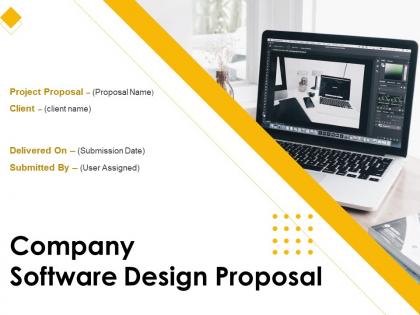
Slide 1: This slide introduces Company Software Design Proposal. State Client name, Submission date, User assigned.
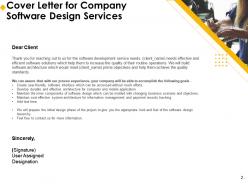
Slide 2: This slide displays Cover letter for Company software design.
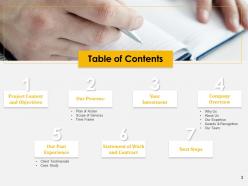
Slide 3: This slide displays Table of Contents of the presentation.
Slide 4: This slide showcases Table of Contents
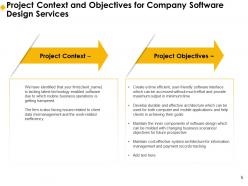
Slide 5: This slide describes Project Context & Objectives for Company software design.
Slide 6: This slide displays Table of Contents.
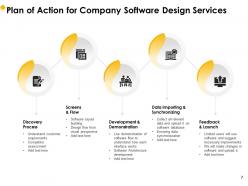
Slide 7: This slide showcases Plan of Action for Company software design.
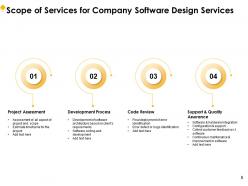
Slide 8: This slide describes Scope of Services for Company software design.
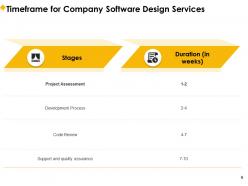
Slide 9: This slide showcases Timeframe for Company software design.
Slide 10: This slide displays Table of Contents of the presentation.
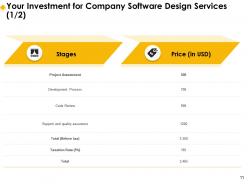
Slide 11: This slide displays Investment details.
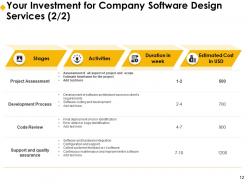
Slide 12: This slide displays Investment details.
Slide 13: This slide showcases Table of Contents of presentation.
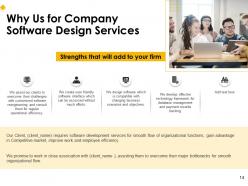
Slide 14: This slide depicts reasons for choosing us for Software Development Services
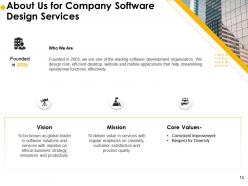
Slide 15: This is About Us slide to showcase Company specifications.
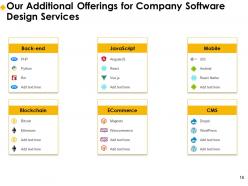
Slide 16: This slide shows Our Additional Offerings.
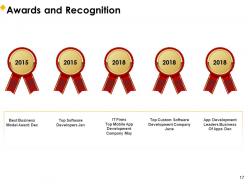
Slide 17: This slide depicts Awards and Recognition
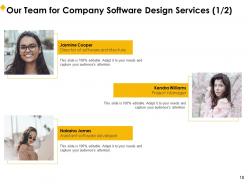
Slide 18: This is Our Team slide with Names and Designations.
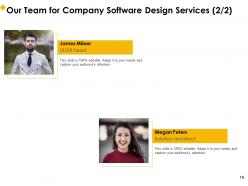
Slide 19: This is Our Team slide with Names and Designations.
Slide 20: This slide displays Table of Contents
Slide 21: This slide displays Client Testimonials.
Slide 22: This slide showcases Client Testimonials.
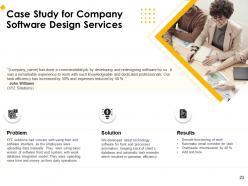
Slide 23: This slide represents Case Study for Company software design.
Slide 24: This slide shows Table of Contents
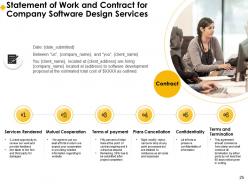
Slide 25: This slide describes Statement of Work and Contract for New Software Development Services
Slide 26: This slide displays Table of Contents.
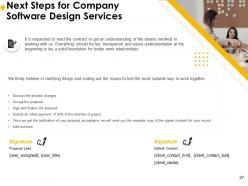
Slide 27: This slide depicts Next Steps for Company software design.
Slide 28: This is Contact Us slide with Address, Contact number and Email address.
Slide 29: This is Company Software Design Proposal Icons Slide.
Slide 30: This slide is titled as Additional Slides for moving Forward.
Slide 31: This is About US slide to showcase Company specifications.
Slide 32: This slide displays Organization Mission and Vision Statement.
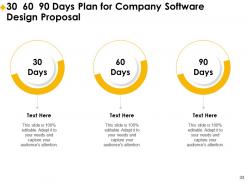
Slide 33: This is 30 60 90 Days Plan slide.
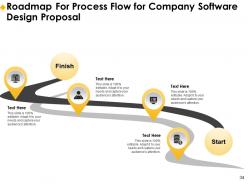
Slide 34: This slide shows Roadmap process.
Company Software Design Proposal Powerpoint Presentation with all 34 slides:
Use our Company Software Design Proposal Powerpoint Presentation to effectively help you save your valuable time. They are readymade to fit into any presentation structure.


FAQs for Company Software Design
Key components of an effective software design proposal include project scope and objectives, technical architecture and technology stack, detailed timeline with milestones, resource allocation and team structure, and comprehensive budget breakdown. These elements work together to demonstrate feasibility and value, with many organizations finding that well-structured proposals streamline approval processes, reduce project risks, and ultimately deliver clearer communication between stakeholders and development teams.
Clearly defining project goals involves establishing specific deliverables, measurable success metrics, timeline milestones, technical requirements, and stakeholder expectations upfront. This strategic approach enables development teams to maintain focus, allocate resources effectively, and demonstrate progress to clients, while ultimately delivering solutions that align with business objectives and minimize scope creep throughout the development process.
Software development methodologies that can be highlighted include Agile, Scrum, DevOps, Waterfall, and Lean Development approaches. These methodologies enhance project delivery by streamlining collaboration, accelerating development cycles, and ensuring quality control, with many organizations finding that strategic methodology selection ultimately delivers faster time-to-market and improved client satisfaction.
User experience considerations should be integrated through comprehensive user research, intuitive interface design, accessibility standards, usability testing protocols, and performance optimization requirements within the proposal's technical specifications. These UX elements streamline development by reducing costly redesigns, minimizing user training needs, and enhancing product adoption rates, with many software teams finding that early UX integration ultimately delivers faster time-to-market and higher customer satisfaction.
**INPUT**: What are the best practices for outlining the technical architecture in a proposal? **OUTPUT**: Best practices include creating clear system diagrams, defining component relationships, specifying technology stacks, outlining data flows, and establishing security frameworks. These architectural elements enhance proposal credibility by demonstrating technical feasibility, scalability considerations, and implementation roadmaps, with many organizations finding that comprehensive technical blueprints significantly improve stakeholder confidence and project approval rates.
Effectively communicating software benefits requires presenting clear ROI metrics, visual demonstrations of key features, and specific use cases relevant to each stakeholder group's priorities and concerns. Through compelling presentations and detailed documentation, organizations streamline decision-making processes, reduce implementation risks, and accelerate stakeholder buy-in, ultimately delivering faster project approvals and stronger organizational alignment.
Key factors include project scope and complexity, development timeline, technology stack requirements, team size and expertise levels, and ongoing maintenance needs. These considerations enable accurate resource allocation by assessing feature specifications, integration requirements, and scalability demands, with many organizations finding that thorough upfront planning ultimately delivers cost predictability and competitive advantage.
Risk management strategies can be incorporated through comprehensive threat assessment, mitigation planning, contingency protocols, security frameworks, and performance monitoring systems. These approaches streamline project delivery by identifying potential vulnerabilities early, establishing clear response procedures, and ensuring regulatory compliance, with many software development teams finding that proactive risk planning ultimately delivers faster deployment timelines and enhanced system reliability.
Scalability plays a critical role in software design proposals by demonstrating how the system will handle increased users, data volume, and transaction loads without performance degradation. It addresses long-term viability through horizontal and vertical scaling strategies, resource optimization, and architectural flexibility, ultimately ensuring the software delivers sustained performance and cost-effectiveness as business demands grow.
You can demonstrate software design feasibility through detailed technical architecture diagrams, prototype development showcasing core functionality, comprehensive resource allocation plans, and realistic project timelines with milestones. By including proof-of-concept demonstrations, technology stack validation, and risk mitigation strategies, organizations can effectively validate their approach while building stakeholder confidence and securing project approval for successful implementation.
Key performance indicators include user adoption rates, system performance metrics, error reduction percentages, processing time improvements, and user satisfaction scores. These benchmarks enable organizations to measure operational efficiency gains, cost savings, and enhanced user experiences, with many enterprises finding that combining quantitative data with qualitative feedback ultimately delivers comprehensive insights into software ROI and strategic value.
Project timelines and milestones should be presented through clear visual representations like Gantt charts, milestone maps, and phase breakdowns that showcase deliverables, dependencies, and critical path activities. These timeline presentations enable stakeholders to understand project progression, resource allocation requirements, and key decision points, while demonstrating your team's strategic planning capabilities and commitment to transparent, accountable project delivery.
Common pitfalls include unclear requirements definition, unrealistic timeline estimates, insufficient technical architecture details, inadequate risk assessment, and poor stakeholder communication planning. These oversights often lead to scope creep, budget overruns, and project delays, with many development teams finding that thorough upfront planning and realistic resource allocation ultimately deliver smoother implementations and stronger client relationships.
Aligning proposals with client objectives requires thorough discovery sessions, stakeholder interviews, and detailed requirements gathering to understand strategic goals, operational challenges, and success metrics. Through comprehensive business analysis and regular validation checkpoints, organizations can map technical solutions directly to client outcomes like revenue growth, cost reduction, and operational efficiency, ultimately delivering measurable value that supports long-term business transformation.
Real-world implementations, performance benchmarks, user testimonials, pilot program results, and similar industry deployments can significantly enhance design credibility. These examples demonstrate proven functionality across sectors like healthcare systems, financial platforms, or retail applications, while showcasing measurable outcomes such as improved efficiency, reduced costs, and enhanced user satisfaction, ultimately providing stakeholders with confidence in the proposed solution's viability.
-
Best Representation of topics, really appreciable.
-
Much better than the original! Thanks for the quick turnaround.