


Comparative Market Analysis For Real Estate Property Execution Of Successful House





Try Before you Buy Download Free Sample Product
 Impress Your
 Audience
 100%
100% Editable
 Save Hours
 of Time


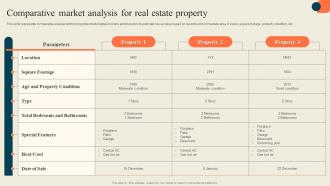
This slide represents comparative assessment for properties that enables brokers and investors to estimate house value based on recent sod in immediate area. It covers square footage, property condition, etc.
People who downloaded this PowerPoint presentation also viewed the following :
Comparative Market Analysis For Real Estate Property Execution Of Successful House with all 6 slides:
Use our Comparative Market Analysis For Real Estate Property Execution Of Successful House to effectively help you save your valuable time. They are readymade to fit into any presentation structure.





FAQs for Comparative Market Analysis For Real Estate Property Execution
A comprehensive CMA includes property details and condition assessments, recent comparable sales data, current market listings, neighborhood demographics and trends, and pricing adjustments for unique features. These components work together by establishing baseline valuations, identifying market positioning opportunities, and accounting for location-specific factors, with real estate professionals finding that thorough CMAs ultimately deliver more accurate pricing strategies and faster transaction outcomes.
Property features significantly impact CMA results by directly influencing market value comparisons, with location determining neighborhood desirability and pricing trends, size affecting per-square-foot valuations, and condition influencing buyer appeal and pricing adjustments. These factors enable real estate professionals to stratify comparable properties more accurately, ultimately delivering precise market valuations that reflect true competitive positioning, with many agents finding that detailed feature analysis enhances client confidence and transaction success rates.
Recently sold properties, or comparable sales, serve as the primary foundation for CMA accuracy by establishing current market values, pricing trends, and neighborhood demand patterns. These recent transactions enable real estate professionals to validate property valuations, identify market shifts, and set competitive listing prices, with many agents finding that properties sold within the past three to six months provide the most reliable benchmarks for strategic pricing decisions.
Active listings influence CMA market trends by providing current inventory levels, pricing strategies, and competitive positioning data that shapes buyer behavior and market dynamics. These listings reveal supply-demand imbalances, pricing pressures, and market velocity patterns, with real estate professionals finding that high inventory typically moderates price growth while limited listings accelerate competitive bidding and appreciation rates.
Residential CMAs focus on comparable home sales, neighborhood trends, and buyer preferences, while commercial CMAs analyze income potential, capitalization rates, lease terms, and investment returns. Commercial analyses require deeper financial modeling and longer market cycles, with commercial brokers evaluating cash flow projections and tenant stability, ultimately delivering more complex valuations than residential property assessments.
Historical market data enhances CMA accuracy by providing trend analysis, seasonal patterns, price appreciation rates, and market cycle insights that reveal long-term performance indicators. Through comprehensive data spanning multiple years, real estate professionals can identify neighborhood stability, predict future values, and adjust current assessments accordingly, while banks and appraisers find that historical context delivers more reliable valuations and strategic market positioning.
CMA software tools include MLS platforms, automated valuation models like Zillow's Zestimate, comparative analytics tools such as RealtyTrac, cloud-based CRM systems, and AI-powered property valuation software. These technologies streamline data collection, enhance accuracy through predictive analytics, and automate report generation, with many real estate professionals finding that integrated platforms deliver faster market insights and more competitive property assessments.
Comparative Market Analysis should be updated every 3-6 months for optimal accuracy, with quarterly updates recommended for dynamic markets like technology or retail sectors. Market conditions, competitor positioning, pricing strategies, and consumer preferences shift regularly, so frequent updates ensure organizations maintain competitive advantage through current data, ultimately enabling more strategic decision-making and market positioning.
Common mistakes in CMA include using outdated or irrelevant comparables, ignoring market timing and seasonal trends, overlooking property condition differences, relying on limited data sources, and failing to adjust for unique features or locations. These oversights can significantly skew valuations, with many real estate professionals finding that comprehensive research, recent sales data, and careful property-by-property analysis ultimately deliver more accurate assessments and stronger client confidence.
Real estate agents can leverage CMA findings by using comparable sales data to justify listing prices, identifying market trends that support negotiation positions, and highlighting property advantages or disadvantages relative to recent sales. This data-driven approach enables agents to present compelling evidence during negotiations, build credibility with clients and counterparts, and ultimately secure more favorable terms while reducing time on market.
Seasonal trends significantly impact Comparative Market Analysis results by affecting property values, inventory levels, and buyer demand patterns throughout the year. Spring and summer typically show higher prices and faster sales, while winter markets often present lower inventory and reduced activity, with many real estate professionals finding that adjusting comparable timeframes and incorporating seasonal data delivers more accurate valuations and strategic pricing decisions.
A CMA can be adapted by incorporating current interest rates, employment data, local economic indicators, recent comparable sales adjustments, and market velocity metrics. Through real-time data integration and economic trend analysis, real estate professionals can adjust pricing strategies, modify time-on-market expectations, and provide clients with contextually relevant valuations, ultimately delivering more accurate market assessments in volatile conditions.
Essential CMA metrics include recent comparable sales, active listings, price per square foot, days on market, absorption rates, and neighborhood price trends. These metrics enable real estate professionals to demonstrate market positioning through comprehensive data analysis, support pricing strategies with concrete evidence, and build client confidence by showcasing thorough market knowledge, ultimately delivering competitive advantage in negotiations.
Understanding buyer behavior enhances CMA effectiveness by revealing price sensitivity patterns, preferred property features, seasonal purchasing trends, and decision-making timelines that influence market dynamics. This behavioral insight enables agents to better position properties, anticipate market shifts, and provide strategic pricing recommendations, with many real estate professionals finding that buyer psychology data significantly improves accuracy and competitive advantage.
Ethical considerations in CMA include ensuring data accuracy, maintaining client confidentiality, avoiding conflicts of interest, providing unbiased property valuations, and transparently disclosing methodology limitations. These practices build trust by delivering reliable market insights, protecting sensitive information, and maintaining professional integrity, with many real estate professionals finding that ethical compliance ultimately enhances client relationships and competitive advantage.
-
Thrilled to see several customizable templates catering various verticals and industries.
-
A beautiful, professional design paired with high-quality images and content that is sure to impress. It is a must-use PPT template in my opinion.